top10alternative

Top 10 Restaurant POS Systems (2026)

Ten restaurant point of sale systems ranked by how many of 21 ordering, kitchen, payment and staff features they cover, with the price of each entry plan.

The best restaurant POS system for your situation

<p>Each line pairs a common restaurant situation with the system whose published facts fit it. The score on this page counts how many of 21 restaurant features a system covers. It measures coverage, not quality, speed or support.</p>

  • You run table service and want most features inside one software feeRezku · From $99 a month, software only, with the kitchen display and online ordering listed as included.
  • You want to start for $0 and keep the freedom to leaveSquare for Restaurants · Square Free costs $0 a month; Plus costs $49 per location, with no contract.
  • You need a detailed floor plan and stock counted by ingredientLightspeed Restaurant · Essential, at 189 USD, includes online ordering and advanced inventory.
  • You want to keep your current card processorLavu · Lavu supports outside processors; its software price is on quote.
  • You prefer to buy the device once and pay a small monthly feeClover · Essentials costs $29.95 a month with a Mini bought for $849.
  • You run a bar or venue where guests order and pay by QR codeGoTab · Basic costs $15 a month per location, on a two-year agreement.
  • You want to pay month to month and know the price of every extraSpotOn · POS Essentials costs $55 per station a month.
  • You want the hardware with nothing to pay upfrontEpos Now · Plus Monthly costs $99 a month with the terminal, printer and card machine.
  • You run a café, kiosk or food truck on a tight budgetLoyverse POS · The POS and kitchen display are free; staff time tracking costs $25 a month.
  • You want POS, payroll and online ordering from one vendorToast · Point of Sale starts at $69 a month; most modules are priced on quote.

How to choose a restaurant POS system

Every system on this list takes orders, sends them to the kitchen and takes card payments, so the score only builds the shortlist. Six checks narrow it to one or two systems. Each check rests on vendor pages read on 20 November 2026.

1. Count your terminals and kitchen screens before you compare prices

Restaurant POS prices are set per location, per terminal or per screen, so one restaurant can see very different totals. Square Plus and GoTab charge per location. SpotOn charges per station, and the $69 of Toast covers only the first terminal. Kitchen screens usually cost extra: $30 a month each on Square Plus and Lightspeed, $20 on SpotOn.

Take a restaurant with two terminals and one kitchen screen. On SpotOn its software costs $130 a month: two stations at $55, plus $20 for the screen. On Square Plus it costs $79, if both terminals sit in one location. On GoTab Basic it costs $65. That is $15 for the plan, then $25 for the second POS and $25 for the screen. Write down your number of terminals, handhelds and kitchen screens, then price each system with that list.

2. Find out who must process your card payments

Card fees are charged on every sale, so they can outweigh the software fee. Toast, Clover, SpotOn and Rezku require their own card processing. Lightspeed charges a monthly fee to restaurants that use another processor. Lavu, Epos Now and Loyverse accept outside processors, though Epos Now then charges $129 a month instead of $99.

A restaurant that takes $40,000 a month by card pays $1,000 at a rate of 2.5%, before the fixed fee per payment. A difference of 0.2 points in the rate is worth $80 a month at that volume. If you already have a good rate with your bank, choose a system where you can keep it.

3. List the features you need, then check which ones are extras

The score on this page counts a paid extra as half a feature, but your bill counts it in full. Toast sells online ordering, loyalty and gift cards as modules without published prices. SpotOn publishes each price: online ordering costs $55 a month, loyalty $65 and reservations $100. Rezku lists the kitchen display, online ordering and loyalty inside its $99 software fee.

A restaurant that wants online ordering and loyalty on SpotOn adds $120 a month and a $200 setup fee. On Rezku, the same two features sit inside the starting fee. Ask each vendor for a quote that names every feature on your list.

4. Decide whether you will use your own devices

Some systems run only on their own hardware, which raises the cost of starting. Toast works only on Toast-approved hardware, and SpotOn requires its own stations. Clover sells each plan with a Clover device. Loyverse runs on a phone or tablet the restaurant already owns. GoTab runs on Windows, iOS and Android devices, and Square needs no hardware to take payments.

Starting with one SpotOn Station 15 costs $750, and with a Clover Mini $849. A café that already owns a tablet can start on Loyverse for $0, then add a $59 card reader. If you already own iPads, ask Lavu and Rezku which models they support before you buy new ones.

5. Read the contract length before you sign

Contracts on this list run from none to three years, and leaving early can cost money. Square and Loyverse have no contract, and SpotOn POS Essentials runs month to month. Epos Now contracts last one year, and the Toast agreement renews each year. The standard GoTab agreement lasts two years. Clover bundles are paid over 36 months, and its hardware credit needs a 3-year contract.

On GoTab Basic, two years of software come to at least $360 before add-ons. The same two years on Square Plus cost $1,176, but the restaurant can leave in any month. If your concept is new, pay a little more for the right to leave.

6. Check what keeps working when the internet drops

All ten document some offline mode, but not the same one. Toast keeps taking orders and card payments while offline. Square accepts offline card payments, but declines them if the device does not reconnect within 24 hours. Clover documents offline card payments for up to 7 days, but not offline table orders. GoTab adds a local server for outages on its Sync plan, at $229 a month.

If your connection drops often, ask each vendor how orders reach the kitchen during an outage. Ask too how offline card payments are settled once the connection returns.

The 10 Restaurant POS systems

by overall score
  1. 1. Rezku

    Rezku suits a sit-down restaurant that wants most features in one software fee and accepts Rezku's own card processing.

    Score
    93/100
    Best for
    Table service with most features in one software price
    From
    $99/mo
    Free plan
    No · free trial on request

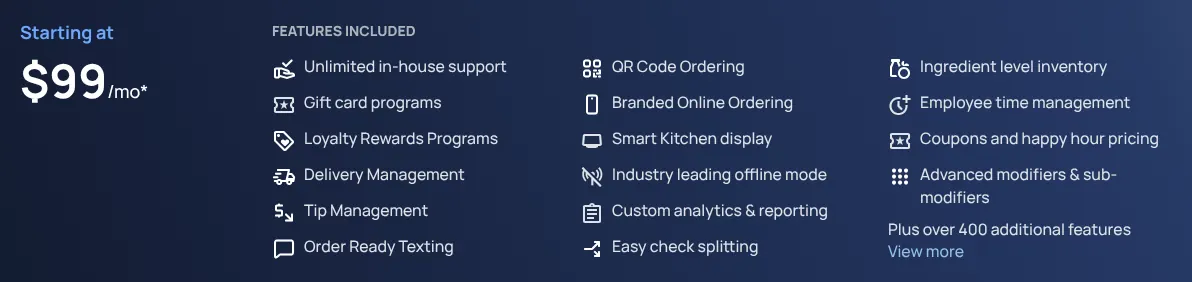
    Rezku has the highest score of the ten, 93/100. Its one published price, from $99 a month, lists the kitchen display (a screen in the kitchen that replaces paper tickets), online ordering, QR code ordering, loyalty and gift cards as included. Most rivals sell those as extras.

    The $99 is the software fee only. Hardware, card processing and setup come on top, and the total is given by the sales team. Rezku runs on iPads and uses its own card processing; a restaurant cannot bring another processor.

    Two gaps show. No reservation or waitlist product was found on its site, and no public API (a documented way for other software to read and write its data). Staff schedules are built in 7shifts, an outside app. Orders from DoorDash or Uber Eats arrive through Chowly, an outside partner.

    Rezku price card: starting at $99 a month, next to the list of features included such as gift cards, loyalty, online ordering, kitchen display and offline mode.
    The $99 a month covers the software listed beside it; hardware and card processing are charged on top. Source: rezku.com, captured on 20 Nov 2026.
  2. 2. Square for Restaurants

    Square for Restaurants is the low-risk start: free to try, no contract, with a clear price for each extra screen.

    Score
    91/100
    Best for
    Starting with no monthly fee and no contract
    From
    $49/mo per location
    Free plan
    Yes · Square Free, card fees only

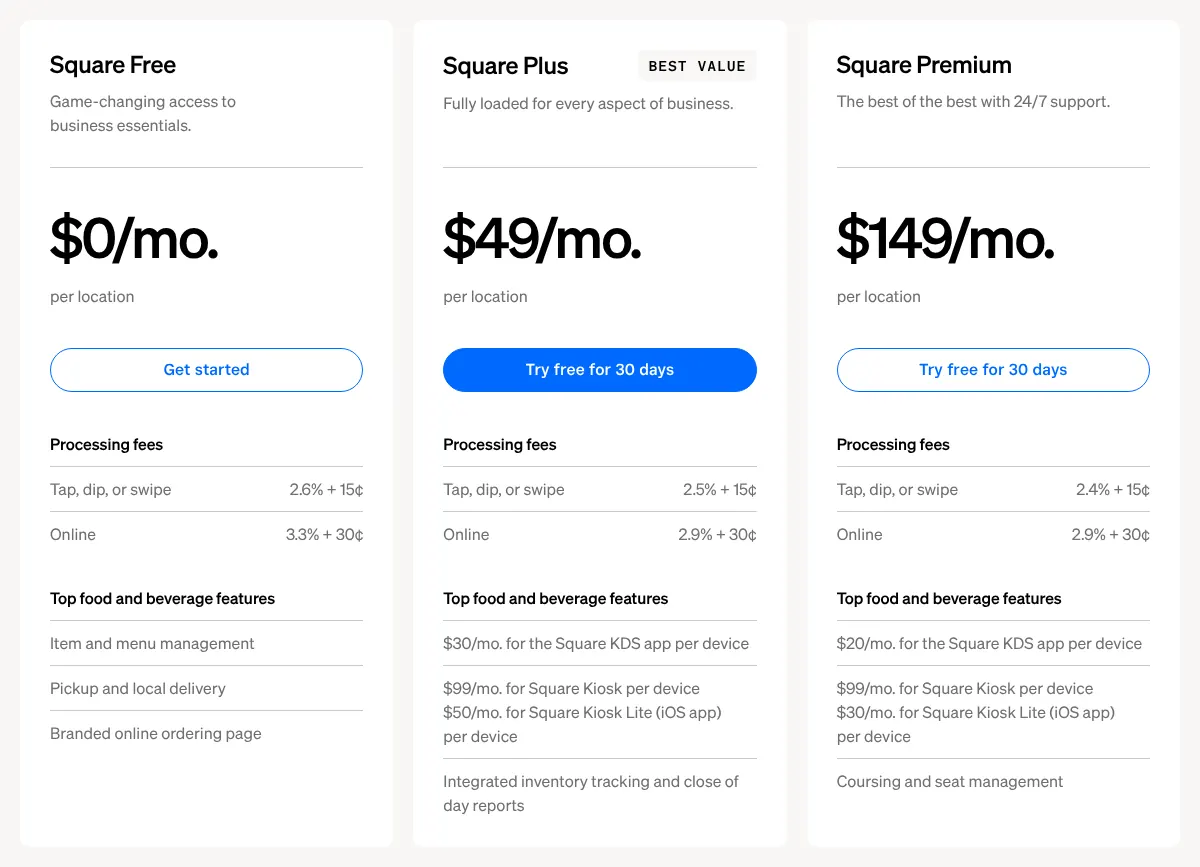
    With Square for Restaurants, a restaurant can start for $0 and move to a paid plan later, without a contract. Square Free costs nothing a month; the restaurant pays only card fees of 2.6% + 15¢ in person. Square Plus costs $49 a month per location, after a 30-day free trial.

    On Plus the card rate drops to 2.5% + 15¢. The kitchen display app is not part of Square Free; on Plus it costs $30 a month per screen. No contract ties the restaurant: Square says it can upgrade or cancel at any time.

    Square sells its own devices, from a $59 card reader to a $399 handheld, but none is required to take payments. Stock is counted per item. Counting ingredients needs the MarketMan add-on at $99 a month per location.

    Square for Restaurants plans per location: Square Free at $0, Square Plus at $49 a month and Square Premium, with card fees and kitchen display prices under each.
    Square Plus shows $49 a month per location, with in-person card fees of 2.5% + 15¢ and a monthly fee for each kitchen display. Source: squareup.com, captured on 20 Nov 2026.
  3. 3. Lightspeed Restaurant

    Lightspeed Restaurant fits a table-service restaurant ready for its Essential plan, where most features are included.

    Score
    90/100
    Best for
    Full-service rooms with floor plans and ingredient stock
    From
    $69 (billing period not stated)
    Free plan
    No · free demo

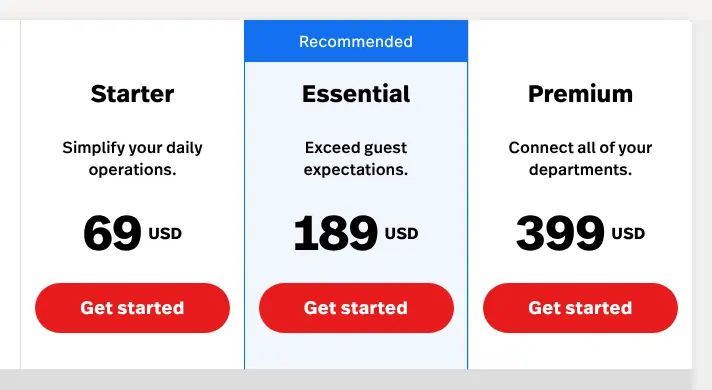
    Lightspeed Restaurant pairs a detailed floor plan with stock that falls ingredient by ingredient as dishes sell. Its US pricing page shows Starter at 69 USD, Essential at 189 USD and Premium at 399 USD. The page prints no billing period and has no monthly or yearly switch.

    Starter covers the POS, menus, floor plans and reports. Online ordering, QR ordering, multi-location reports and advanced inventory start with Essential; some can be added to Starter. Every kitchen screen costs $30 a month on every plan. Gift cards, reservations and delivery app links are add-ons without a published price.

    Card payments must go through Lightspeed Payments. Its help centre says a restaurant that uses another processor pays a monthly fee for it. The POS runs on iPad; the hardware kit is priced on quote.

    Lightspeed Restaurant US plans: Starter at 69 USD, Essential at 189 USD and Premium at 399 USD, with no billing period printed next to the prices.
    Starter shows 69 USD with no billing period beside it; Essential at 189 USD is marked Recommended. Source: lightspeedhq.com, captured on 20 Nov 2026.
  4. 4. Lavu

    Lavu suits a restaurant that wants to keep its own card processor and is ready to ask for a quote.

    Score
    90/100
    Best for
    Keeping an outside card processor
    From
    On quote
    Free plan
    No · free demo

    Lavu is an iPad POS that accepts outside card processors, unlike Toast, Clover, SpotOn and Rezku. It publishes no price for its software: its pricing address leads to the home page, and every product page leads to a demo. The only published software price is Tap to Pay on iPhone, at $29.99 a month per device.

    The POS covers floor plans, split checks, a kitchen display, ingredient stock and a time clock. Online ordering and QR ordering run on MenuDrive, a separate Lavu product with its own account. Reservations go through OpenTable. Accounting links go through outside integrators.

    Lavu sells its hardware on its own shop. A complete iPad station costs $2,374 and a handheld kit $1,270. Its terms describe monthly or yearly subscriptions that renew on their own, with no refund for part of a period.

  5. 5. Clover

    Clover fits a restaurant that prefers to own its device and pay a small monthly fee, once the contract terms are read.

    Score
    88/100
    Best for
    Buying the countertop device outright
    From
    $29.95/mo + $849 device
    Free plan
    No · 90-day software trial offer

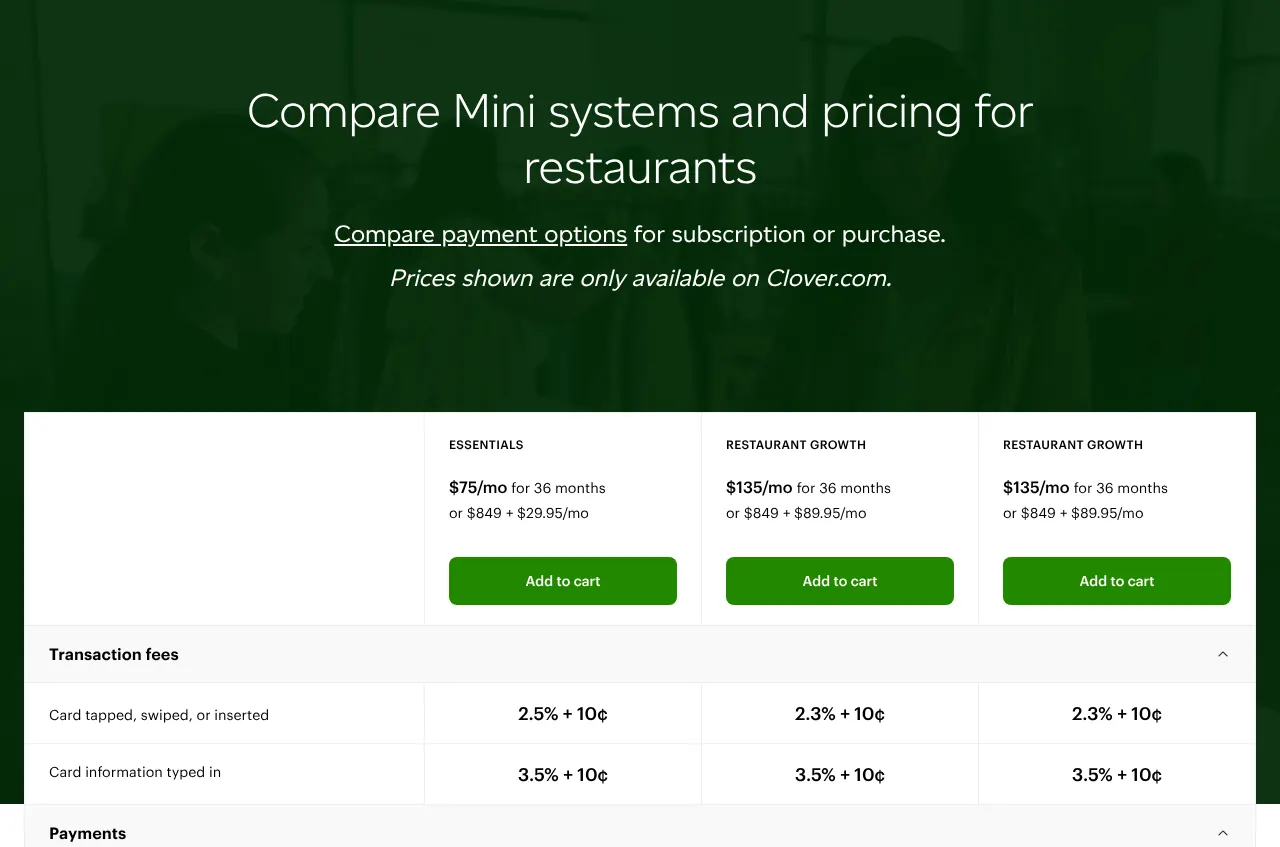
    Clover sells each restaurant plan with a device, either bought outright or paid over 36 months. With a Clover Mini bought for $849, Essentials costs $29.95 a month. Essentials has no table map, no split bills and no item variations. The Restaurant Growth plan adds them for $89.95 a month.

    In person, card fees are 2.5% + 10¢ on Essentials. On Restaurant Growth they drop to 2.3% + 10¢. Clover devices cannot be used with another processor. Each kitchen screen carries its own $25 monthly software fee.

    Contract terms and cancellation fees depend on the company that sells the Clover account. A $450 statement credit for buying a device requires a 3-year contract. The offer ends on 31 December 2026. Staff schedules come from Homebase, a partner product, and accounting links from apps in the Clover App Market.

    Clover Mini restaurant bundles: Essentials at $75 a month for 36 months or $849 plus $29.95 a month, Restaurant Growth at $849 plus $89.95 a month, with card fees below.
    With the Mini bought for $849, Essentials costs $29.95 a month; the $75 figure is the same plan paid over 36 months. Source: clover.com, captured on 20 Nov 2026.
  6. 6. GoTab

    GoTab is the cheapest software fee to start, for a venue that can commit to two years and counts its add-ons first.

    Score
    86/100
    Best for
    Bars and venues where guests order from their phone
    From
    $15/mo per location
    Free plan
    No

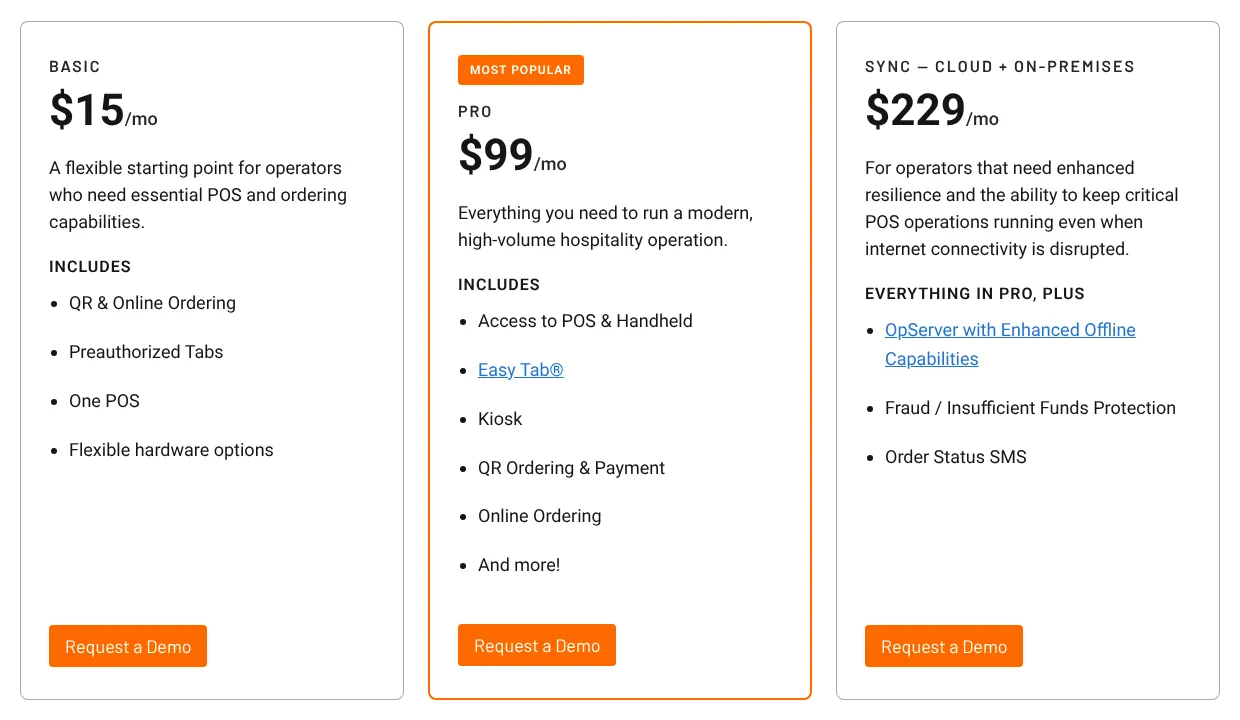
    GoTab has the lowest published software fee of the ten, at $15 a month per location for Basic. Basic includes QR ordering, online ordering and pre-authorised tabs (a card held open at the bar until the guest closes the tab). Pro, at $99, adds handhelds, kiosks and order-and-pay by QR code.

    The entry price (the price of the first paid plan) grows quickly with add-ons, the features sold for an extra monthly fee. A kitchen screen adds $25 a month on Basic, and each extra counter or handheld POS adds the same. Gift cards add $35 and delivery app orders $55. Loyalty and multi-location reports are not available on Basic.

    GoTab runs on Windows, iOS and Android devices the restaurant may already own. Card fees start at 2.40% + $0.15 for qualifying venues. The standard agreement lasts two years, then renews each year unless either side gives 60 days' notice.

    GoTab plans per location: Basic at $15 a month, Pro at $99 a month and Sync, cloud plus on-premises, with what each plan includes.
    Basic shows $15 a month with QR and online ordering; Pro at $99 includes the handheld and kiosk, which Basic can add as paid extras. Source: gotab.com, captured on 20 Nov 2026.
  7. 7. SpotOn

    SpotOn suits a restaurant that wants to stay month to month and add each feature at a known price.

    Score
    80/100
    Best for
    Month-to-month table service with published add-on prices
    From
    $55/mo per station
    Free plan
    No · All-In plan at $0 with higher card fees

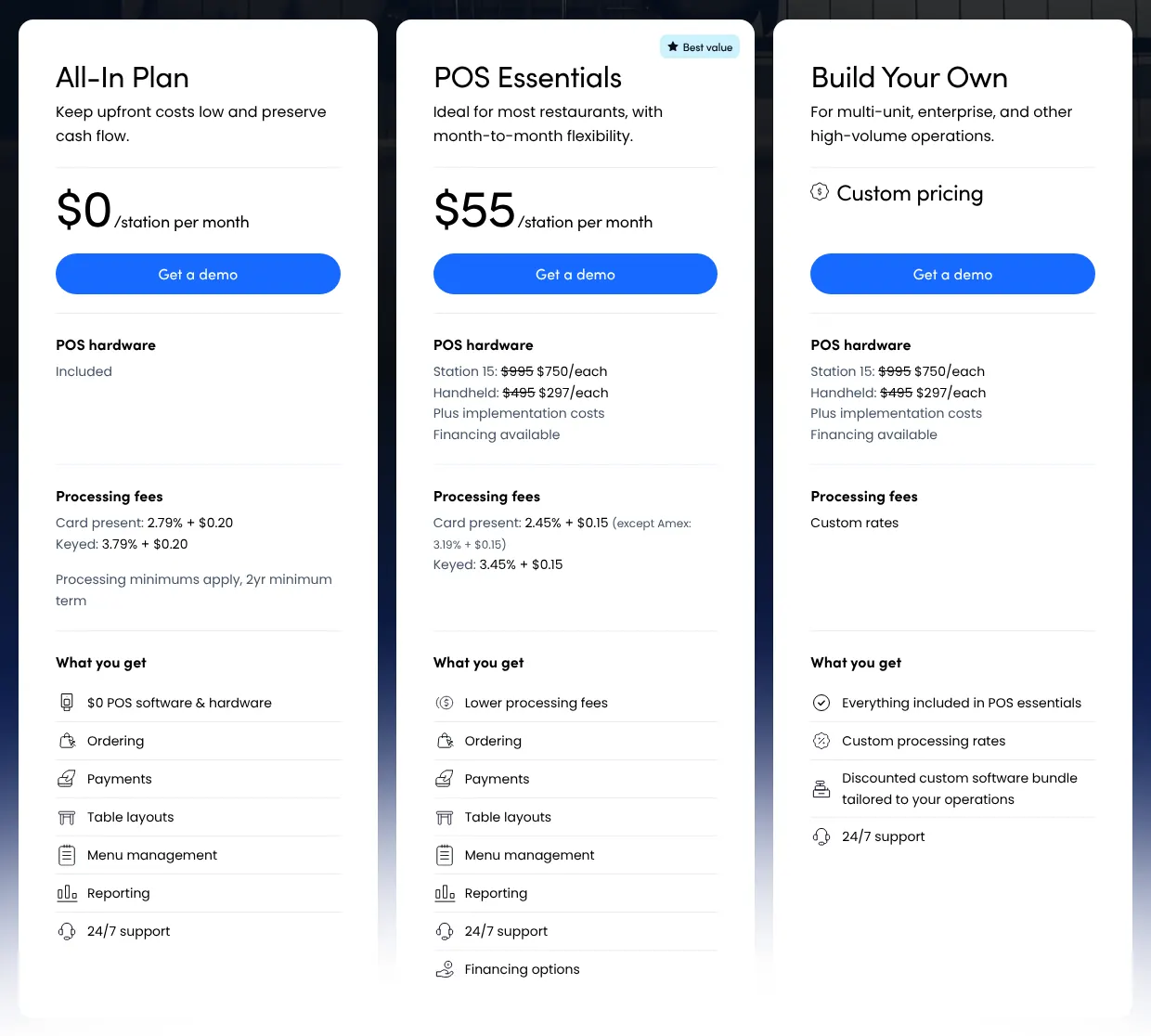
    SpotOn prices its software per station (each POS terminal), at $55 a month on POS Essentials, month to month. Card fees on that plan are 2.45% + $0.15 in person. Basic tip pooling is included. SpotOn publishes the price of almost every extra, which makes the total easy to add up.

    The kitchen display costs $20 a month per station, plus $500 per screen and $100 to install. Online ordering costs $55 a month plus $200 setup. Loyalty costs $65 a month, reservations $100 and staff scheduling $3 per employee. Inventory and accounting go through outside apps, and SpotOn says it has no open API.

    The All-In plan costs $0 per station but charges 2.79% + $0.20 per card payment. It has a monthly processing minimum and a two-year minimum term. SpotOn hardware is required, from $297 for a handheld.

    SpotOn plans: All-In Plan, POS Essentials at $55 per station a month and a third plan on custom pricing, with hardware prices and card fees under each.
    POS Essentials shows $55 per station a month, month to month; the All-In Plan beside it has a 2-year minimum term. Source: spoton.com, captured on 20 Nov 2026.
  8. 8. Epos Now

    Epos Now suits a restaurant that wants hardware without an upfront payment and accepts a one-year contract.

    Score
    79/100
    Best for
    Hardware included with nothing to pay upfront
    From
    $99/mo, hardware included
    Free plan
    No · free demo

    Epos Now bundles the terminal, receipt printer and card machine into one monthly fee with nothing to pay upfront. Its US pricing page is only a quote form. The prices appear in its US terms: Plus Monthly at $99 a month with Epos Now Payments, or Basic at $129 with another processor. The terms date these offers from September 2022.

    Plus asks the restaurant to run most of its card payments through Epos Now, at 2.6% + 10¢. Otherwise the account moves to Basic. The terms value the Plus hardware at $2,000 if it is not returned when the contract ends. Epos Now describes its contracts as lasting one year.

    Most restaurant extras are apps bought separately. The kitchen display costs $24 a month as software only. Online ordering charges 3.15% + 30¢ per delivery order. Gift cards run through VoucherCart, an outside app.

    Epos Now US terms, Appendix 1: Plus Monthly at $99 recurring with Epos Now Payments at 2.6% + 10c, Basic Upfront at $129 recurring with third-party payments.
    The US terms list Plus Monthly at $99 and Basic at $129 a month, both with nothing to pay upfront. Source: eposnow.com, captured on 20 Nov 2026.
  9. 9. Loyverse POS

    Loyverse POS fits a counter-service café or food truck that wants a working POS for $0 and can live without a floor plan.

    Score
    78/100
    Best for
    Cafés and counters on a small budget
    From
    Free
    Free plan
    Yes · POS free, sales history 31 days

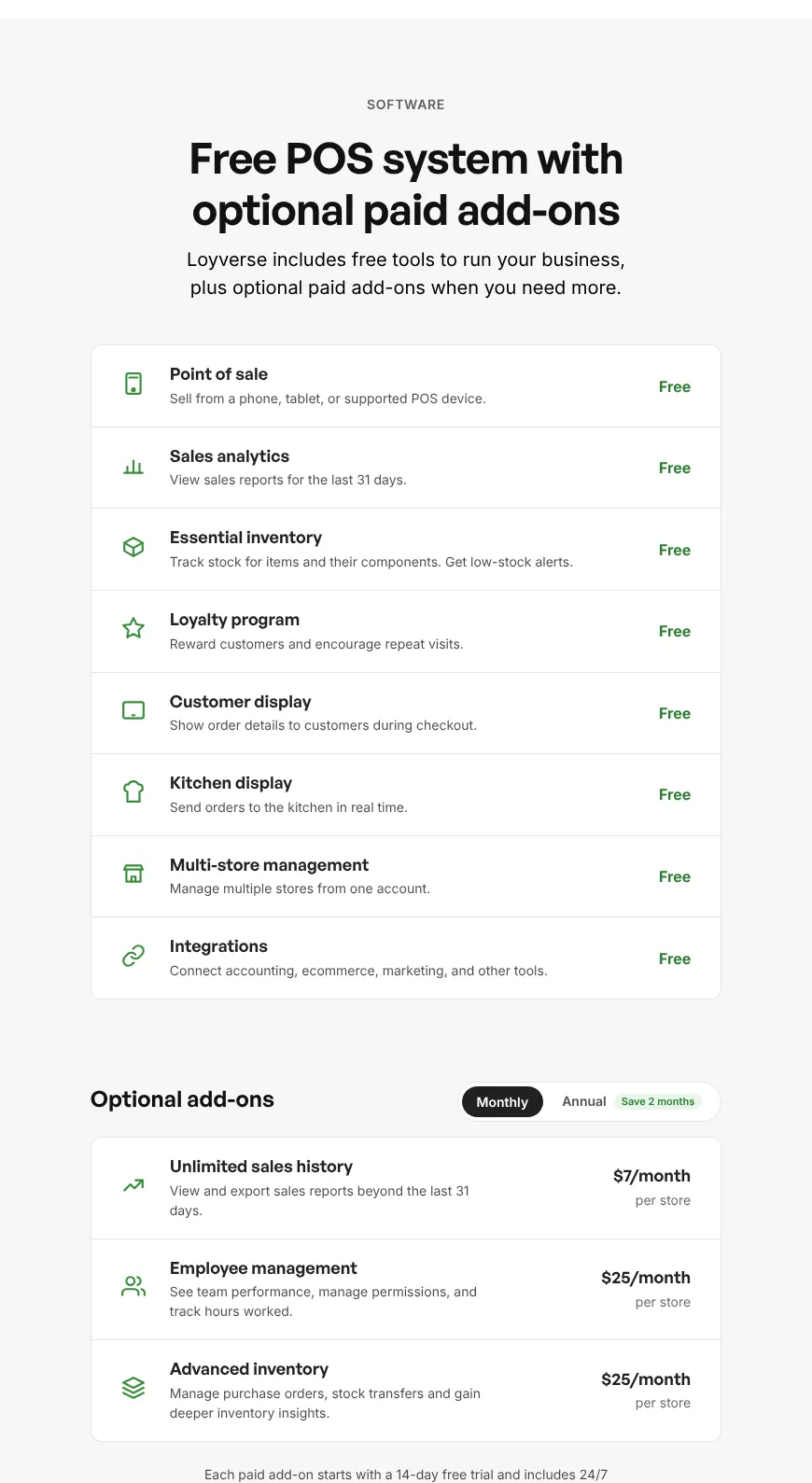
    Loyverse POS is free, and its kitchen display, loyalty program and multi-store management are free too. It runs on a phone or tablet the restaurant already owns. Free sales reports cover the last 31 days; a longer history costs $7 a month per store.

    The time clock and tips per employee sit in the Employee management add-on, at $25 a month per store. Tables are a list of named tickets rather than a floor plan. No shift scheduling, gift card or reservation tool was found. Online and delivery orders come through outside apps.

    In person, Loyverse Payments costs 1.99% + 15¢ on a debit card. A credit card costs 2.49% + 15¢. A store can also use another card processor. There is no contract and no cancellation fee.

    Loyverse US pricing: point of sale, sales analytics for 31 days, inventory, loyalty, kitchen display and multi-store marked Free, then add-ons at $7 and $25 a month per store.
    The POS and kitchen display are marked Free; unlimited sales history costs $7 and employee management $25 a month per store. Source: loyverse.com, captured on 20 Nov 2026.
  10. 10. Toast

    Toast fits a restaurant that wants one vendor for everything and is ready to price each module with its sales team.

    Score
    78/100
    Best for
    One vendor for POS, payroll and online ordering
    From
    $69/mo for the first terminal
    Free plan
    Yes · Starter Kit, paid through a 3.09% card fee

    Toast sells nearly every restaurant feature, but most of them as paid modules. That is why it ranks tenth: online ordering, loyalty, gift cards, QR ordering and ingredient stock each count as an add-on here. Their prices are not published.

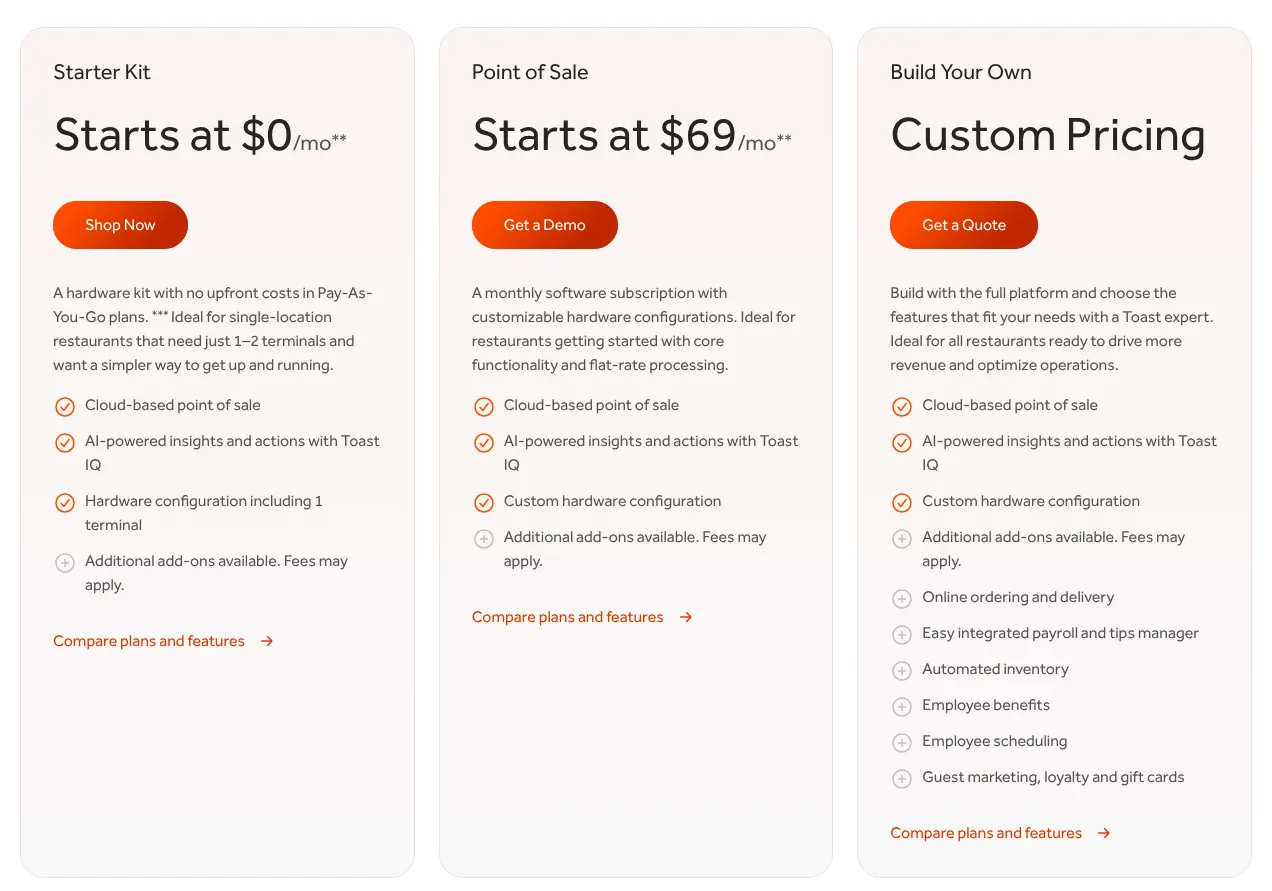
    The Point of Sale plan starts at $69 a month and covers the first terminal only. Each further device has its own monthly fee. The Starter Kit costs $0 a month for new single-location restaurants. Its 3.09% card fee pays for the hardware and software instead.

    Card processing must go through Toast, and only Toast-approved hardware works. The agreement renews for one-year periods unless the restaurant gives notice. Payroll, scheduling, a handheld built for service and multi-location tools are all available from the same vendor.

    Toast restaurant plans: the Starter Kit hardware offer, Point of Sale from $69 a month and a third plan on custom pricing, with the features listed under each.
    Point of Sale starts at $69 a month for the first terminal; the Starter Kit beside it is paid through card fees instead. Source: pos.toasttab.com, captured on 20 Nov 2026.

Summary table

The table puts the ten systems side by side. Each price is that of the first paid software plan, per month, at the usual price. The last column says who processes card payments and at what rate, when the rate is published.

The 10 restaurant POS systems side by side: score, entry price, billing, free plan and card processing
SystemScoreEntry priceBilling and commitmentFree planCard processing
01Rezku93$99 per month, software onlyMonthly price; term not publishedNo · trial on requestRezku only; rate not published
02Square for Restaurants91$49 per locationMonthly, no contractYes · Square Free2.5% + 15¢ in person on Plus
03Lightspeed Restaurant9069 USDPeriod not statedNo · demoLightspeed Payments required; rate not published
04Lavu90On quoteMonthly or annual, renews automaticallyNo · demoOutside processors accepted
05Clover88$29.95 + Mini at $849Monthly; terms set by the sellerNo · 90-day software trial offerClover only; 2.5% + 10¢
06GoTab86$15 per locationMonthly, 2-year agreementNoFrom 2.40% + $0.15
07SpotOn80$55 per stationMonth to monthNo · All-In plan with higher card feesSpotOn only; 2.45% + $0.15
08Epos Now79$99, hardware includedMonthly, 1-year contractNo · demo2.6% + 10¢ on Plus; other processors on Basic
09Loyverse POS78FreeNo contractYes · POS free2.49% + 15¢ on credit; other processors allowed
10Toast78$69 for the first terminalMonthly, renews yearlyYes · Starter Kit, 3.09% card feeToast only; rate quoted

Prices in USD, before taxes, read on vendor pages on 20 November 2026. Lightspeed prints 69 USD with no period beside it. Epos Now prices come from Appendix 1 of its US terms, which dates them from 5 September 2022; its pricing page is a quote form. Lavu publishes no POS price.

What a restaurant POS system costs

For one terminal and one kitchen screen, the monthly software starts at $0 on Loyverse, and Rezku comes to $99 with its screen included. GoTab Basic comes to $40 with its screen add-on. Square Plus comes to $79 and SpotOn to $75. Lightspeed Starter comes to $99 with its $30 screen. Card fees, taxes and setup are left out, and the hardware column shows what it takes to start.

Entry plan, monthly software price, the price of each kitchen screen and the hardware needed to start
SystemEntry planSoftware per monthEach kitchen screenHardware to start
01RezkuStarting price$99IncludedExtra, on quote
02Square for RestaurantsSquare Plus$49 per location$30 per monthNone required; Square Handheld $399
03Lightspeed RestaurantStarter69 USD, period not stated$30 per monthiPad kit on quote
04LavuOn quoteOn quotePrice not publishediPad station bundle $2,374
05CloverEssentials$29.95$25 per monthClover Mini $849
06GoTabBasic$15 per location$25 per monthOwn Windows, iOS or Android devices
07SpotOnPOS Essentials$55 per station$20 per month + $500 per screenSpotOn Station 15 $750
08Epos NowPlus Monthly$99, hardware included$24 per month, software onlyIncluded, nothing upfront
09Loyverse POSFree POS$0FreeOwn phone or tablet; card reader $59
10ToastPoint of Sale$69 for the first terminalPrice not publishedToast hardware, price not published

Monthly list prices. Each kitchen screen is the software fee per screen; SpotOn and Clover sell the screen itself on top. GoTab charges $35 per screen on Pro and Sync. Toast and Lightspeed charge a monthly fee for each further terminal; Toast does not publish it.

How we rank

  1. The ten systems are ranked by a category score out of 100. The score measures how many of 21 features expected of a restaurant POS system each vendor documents on its own site. It does not measure speed, reliability or support.Taking orders 33% · 6 featuresKitchen and stock 13% · 2 featuresPayments and guests 20% · 4 featuresOnline and delivery 13% · 3 featuresTeam and management 23% · 6 features
  2. The 21 features form a grid in five groups: taking orders, kitchen and stock, payments and guests, online and delivery, team and management. Five define the category and weigh 3: menu items with modifiers, floor plan and table management, a kitchen display screen, integrated card payments and online ordering. Nine weigh 2, including split checks, offline orders, tips and a staff time clock. Seven weigh 1, including gift cards, reservations and a public API. A system receives 1 for a feature documented as built in, on at least one plan. It receives 0.5 for a partial feature: a stated limit, a paid add-on, a separate product of the same vendor, or an outside app the vendor documents. A feature that is absent, or that could not be found on the vendor's site, counts 0. The score is the weighted sum divided by the total weight, 40, rounded to the nearest whole number.
  3. At equal scores, the lower entry price ranks first. Lightspeed Restaurant ranks ahead of Lavu at 90, because Lavu publishes no price. Loyverse POS, which is free, ranks ahead of Toast at 78. Fifteen systems were checked. Eats365 POS (75) and TouchBistro (74) score below the ten. Shift4 Dine, formerly SkyTab POS, scores 95 from its help centre, but its pricing pages refuse the browser used by this site, so no price could be read and it is not ranked. Revel Systems and Heartland Restaurant refuse every page of their sites and could not be scored.
  4. Lavu publishes no price, so it carries no image of a pricing page. All prices, limits and features were read on vendor pages on 20 November 2026.
  5. No entry on this page is sponsored. A sponsored entry is marked Sponsored and holds the position paid for; its score stays the computed one.

FAQ

Is there a free restaurant POS system?

Yes, with conditions. Loyverse POS is free, including its kitchen display, but staff time tracking costs $25 a month. Square Free costs $0 a month, and the restaurant pays only card fees. The Toast Starter Kit and the SpotOn All-In plan cost $0 a month but charge higher card fees, and SpotOn adds a two-year term. If you sell more than a few thousand dollars a month by card, compare the card fees, not just the monthly fee.

Why is Toast only tenth?

Toast offers almost every feature on this page, but sells many of them as paid modules. Online ordering, loyalty, gift cards and ingredient stock each count as half here. Their prices are not published. Toast can still be the right choice if you want payroll, scheduling and online ordering from one vendor. Ask for a quote that prices each module you need.

Can I keep my own card processor?

On some systems only. Lavu supports outside processors, and Loyverse gives you the choice. Epos Now accepts other processors on its Basic plan, at $129 a month instead of $99. Toast, Clover, SpotOn and Rezku require their own processing. Lightspeed charges a monthly fee if you use another processor. If your current rate is low, check this before anything else.

Can I run a restaurant POS on an iPad I already own?

Several systems run on iPads or tablets. Lavu, Rezku and Lightspeed Restaurant are iPad systems, and Loyverse runs on any phone or tablet. GoTab supports Windows, iOS and Android devices. Toast works only on Toast-approved hardware, and SpotOn requires its own stations. Ask the vendor which iPad models it supports before you plan on reusing yours.

Why are Shift4 Dine, Revel and Heartland not on the list?

Their sites could not be read. Shift4 Dine, the new name of SkyTab POS, documents most restaurant features in its help centre. Its pricing pages refused the browser used by this site, so its price could not be checked. Revel Systems now redirects to Shift4, and the Heartland Restaurant pages refused every request. If you are considering them, ask for a written price and contract before you compare.