top10alternative

Top 10 AI App Builders (2026)

Ten AI app builders, tools that turn a written description into a working web or phone app, compared on what they include and what they cost. They are ranked by how many of 20 common features each one covers.

The best AI app builder for your situation

Each line matches a situation with the tool whose published facts fit it. The score out of 100 counts how many of 20 features expected of an AI app builder a tool documents. It measures coverage, not the quality of the apps it makes.

  • You build apps for your company's own staffZoho Creator · Standard costs US$12 per user a month, and the AI builder needs a paid plan.
  • You want a whole team on one flat priceRocket · Pro costs $25 a month and includes unlimited team members.
  • You need your app in the App Store and Google PlayEmergent · It builds real iOS and Android apps on paid plans, from $20 a month.
  • You want login, data and payments without outside accountsBase44 · Its payment service is built in, and Starter costs $20 a month.
  • You would rather pay for extra use than stop mid-projectReplit · Use beyond the $20 of credits in Core is billed as it happens.
  • Each person on your team needs their own AI allowanceBolt · Teams costs $30 per member, and each member gets their own tokens.
  • You want to keep editing by hand after the AI draftBubble · Its visual editor keeps working when the AI credits run out.
  • Your company already hosts its sites on Vercelv0 · Apps publish to Vercel, and Plus costs $30 per user a month.
  • You want a full web app and may hire a developer laterLovable · You own the code, and GitHub sync works on every plan.

How to choose an AI app builder

A high score means a tool covers many common features, not that it suits every project. Six checks narrow the list to one or two. Each rests on facts read on vendor pages on 16 November 2026.

1. Find out what a credit buys

Check how each tool counts use before you compare prices, because a credit is not the same unit everywhere. Lovable and Rocket sell 100 credits for $25 a month. Bolt counts tokens, and Replit counts dollars of AI use. Check what happens at zero, too. Replit bills the extra use, while Base44, Emergent and v0 pause the work. On Emergent Standard, 100 credits a month shrink to 50 once one app is live.

2. Count the people, not only the price

Count everyone who will build, because the bill grows per person on some tools and stays flat on others. Bolt Teams and v0 charge $30 per member, so a team of 5 pays $150 a month. Lovable, Blink and Rocket allow unlimited members on a $25 plan. Zoho Creator charges for every person who uses the apps, builders and staff alike. On a flat plan, the whole team draws on the same credits.

3. Decide whether the app must be in the phone stores

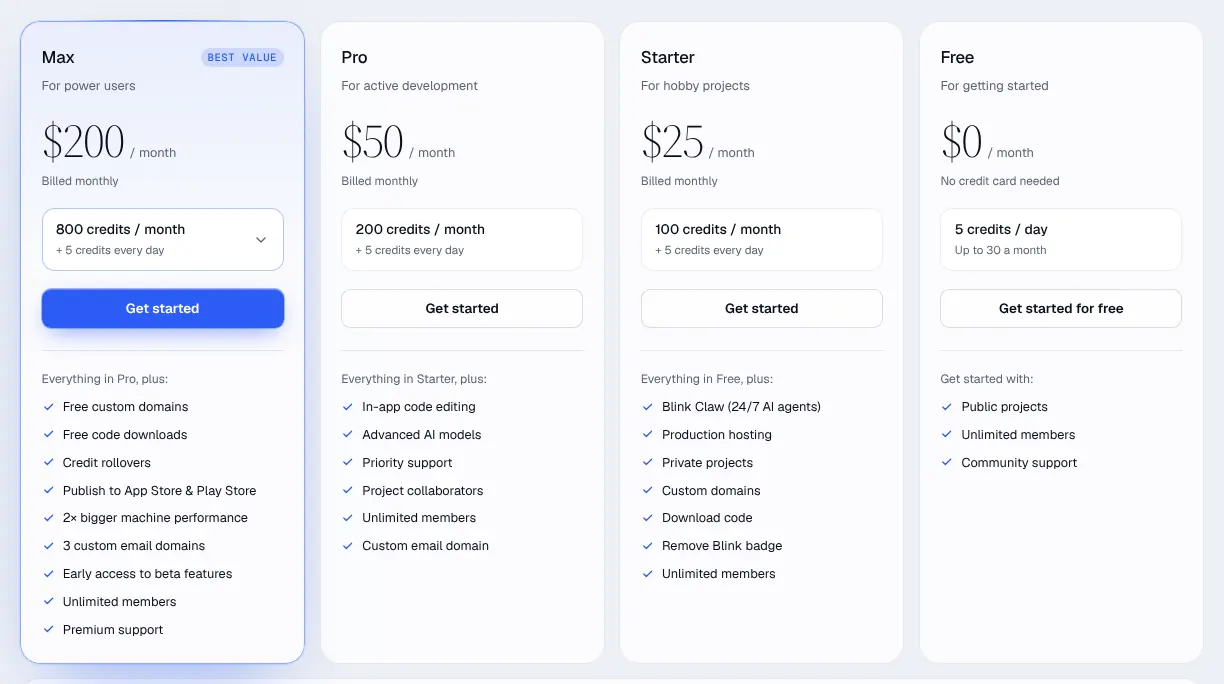
Settle this early, because only some tools make real phone apps. Emergent builds iOS and Android apps itself on paid plans. Blink publishes to both stores on Max, at $200 a month. Replit reaches the App Store but not Google Play yet. Lovable and v0 make web apps only, and Base44 wraps the web app in a phone app. A shop that needs both stores pays $20 a month on Emergent Standard, before hosting credits.

4. Check who holds the data

Look at where the database lives, because it decides how many accounts you manage. Lovable, Base44, Replit and Blink run the database themselves. Rocket uses your own account with Supabase, an outside database service, and v0 adds a provider such as Neon or Supabase through Vercel. For one internal tool, a built-in database means one login and one bill, such as $20 a month on Base44 Starter.

5. Plan your exit before you start

Check how the code leaves the tool, in case you outgrow it. Lovable and Bolt leave the code to the user and sync it with GitHub. The code exported from Base44 still relies on Base44 to run. Bubble has no code download, and Zoho Creator exports a file that only Zoho Creator opens. If you may hire a developer later, connect GitHub from the first week. On Base44 this starts with Builder, at $50 a month.

6. Put hosting in the budget

Ask what keeping the app online costs, because some tools take it from the building credits. Blink spends 50 credits a month for up to 10,000 visits. Emergent takes at least 50 credits a month for each live app. Bubble counts server work and bills the extra units. Rocket bills no hosting on top of its plan, which makes the monthly bill easier to predict.
The 10 AI app builders

by overall score
  1. 1. Lovable

    Lovable suits someone who wants a complete web app from a chat and shares the work with a team at no extra cost per person.

    Score
    94/100
    Best for
    Full web apps built and hosted from one chat
    From
    $25/mo
    Free plan
    Yes · 5 credits a day, up to 30 a month

    Lovable builds a full web app from a chat: screens, data, user login and hosting. Its built-in backend holds the database (where the app keeps its records) without an outside account. Pro has a list price (the normal price, before any offer) of $25 a month for 100 credits. A credit is the unit Lovable spends each time its AI works. Every plan allows unlimited members, who all draw on the same credits.

    Unused monthly credits roll over, but they expire two months after they were issued. When credits run out, building and the app's backend stop, while published pages keep showing. Lovable makes web apps only. For the App Store or Google Play, its help pages point to a wrapper built outside Lovable. The user owns the code, and GitHub sync, a copy of the code kept on the code-hosting site GitHub, works on every plan.

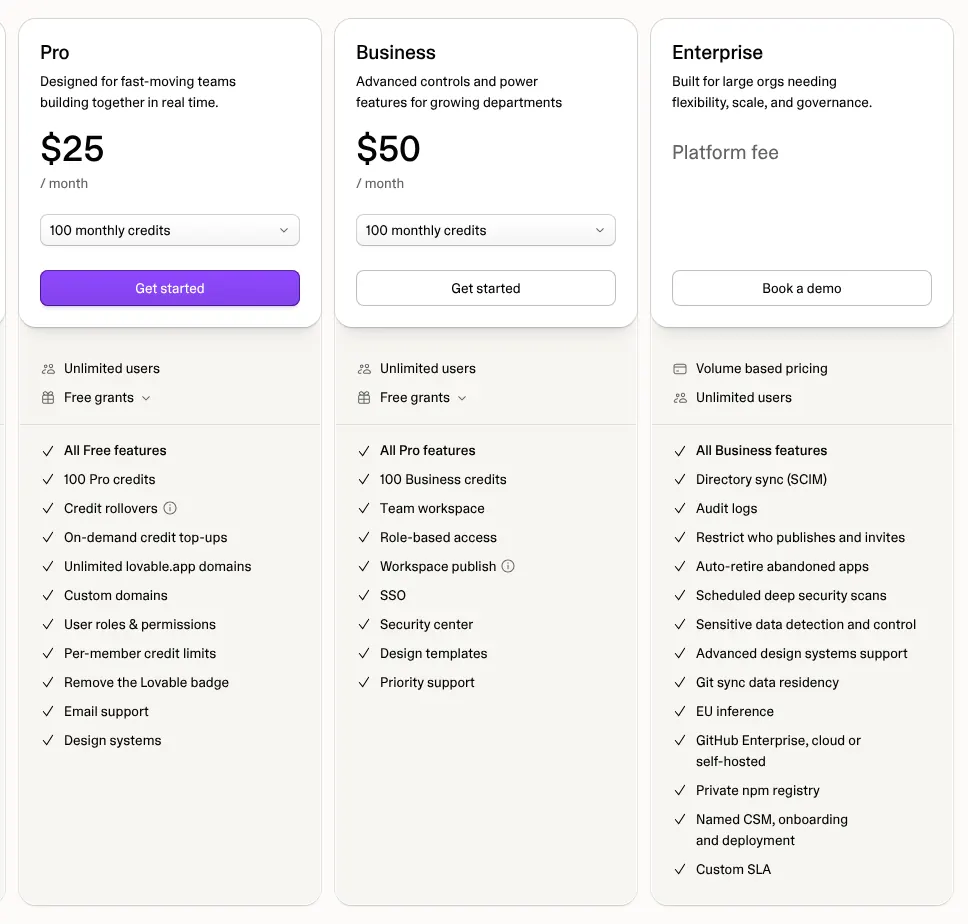
    Lovable Pro, Business and Enterprise plan cards: Pro at $25 a month with 100 monthly credits and unlimited users, Business with SSO, Enterprise on a platform fee.
    The Pro card gives the $25 monthly price and the 100 credits it includes; the menu on the card sells larger credit amounts. Source: lovable.dev, captured on 16 Nov 2026.
  2. 2. Base44

    Base44 suits a small team that wants login, data and payments in one flat plan and does not plan to take the code elsewhere.

    Score
    93/100
    Best for
    Login, data and payments run by the builder itself
    From
    $20/mo
    Free plan
    Yes · 25 message credits a month, up to 5 apps

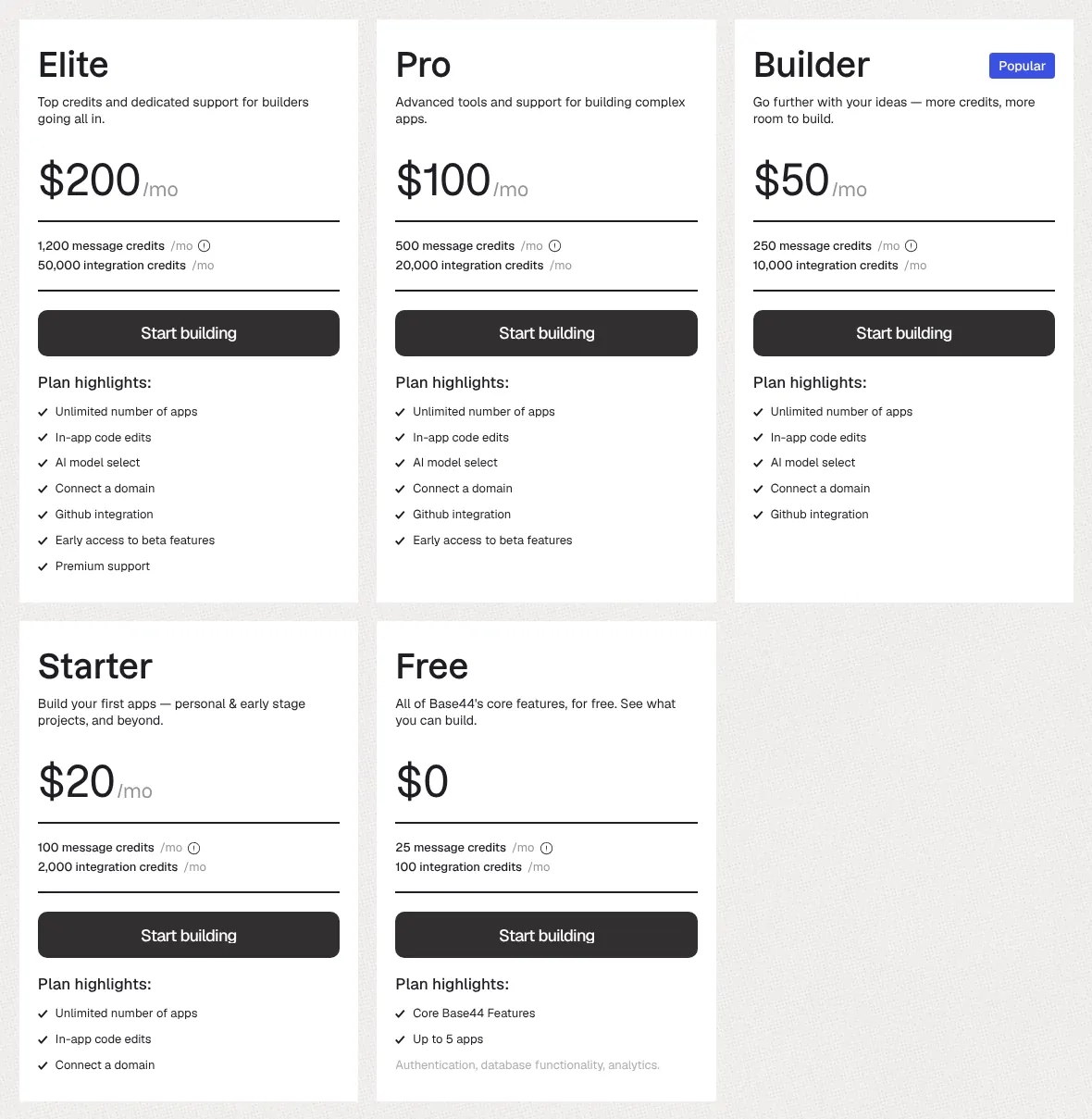
    Base44 turns a description into an app whose data, user login and payments all run on Base44. Its payment service is built in, so selling inside the app needs no outside payment provider. Starter costs $20 a month on monthly billing. It includes 100 message credits, spent on each request to the AI. It also includes 2,000 credits for the running app, spent when it sends email, calls an AI model or stores files.

    One plan covers a whole workspace, and invited members need no plan of their own. Unused credits do not carry over to the next month. Code export and GitHub sync start with Builder, at $50 a month, and the exported code still relies on Base44 to run. Apps for the phone stores are a web view: a phone app that displays the web app inside it.

    Base44 plans in monthly view: Elite, Pro, Builder, then Starter at $20 a month with 100 message credits, and Free with 25 message credits.
    After the Monthly switch, the Starter card shows $20 a month; the pricing page opens on yearly prices. Source: base44.com, captured on 16 Nov 2026.
  3. 3. Replit

    Replit suits a builder who wants code, hosting and AI in one place and accepts a bill that follows actual use.

    Score
    93/100
    Best for
    Projects that should keep going when the monthly credits end
    From
    $20/mo
    Free plan
    Yes · daily credits, 1 app online for 30 days

    Replit Agent writes, runs and publishes an app from a description, inside Replit's online coding space. Core costs $20 a month and includes $20 of credits for the AI. Up to 5 builders can be invited to the same workspace. Work is priced by effort, so a larger request costs more credits. Use beyond the monthly credits is billed as it happens, instead of stopping the work.

    Hosting and the production database are also paid from credits. A security scan runs before every publish. Phone apps can go to Apple's App Store, but Google Play publishing is not supported yet. On the free plan, the one published app goes offline after 30 days. Replit's pricing page refused the capture tool on 16 November 2026, so no image of it is shown.

  4. 5. Bolt

    Bolt suits a team that wants each person to keep their own allowance, at a known price per member.

    Score
    92/100
    Best for
    Teams where each person needs their own AI allowance
    From
    $25/mo
    Free plan
    Yes · 1M tokens a month, 300K a day

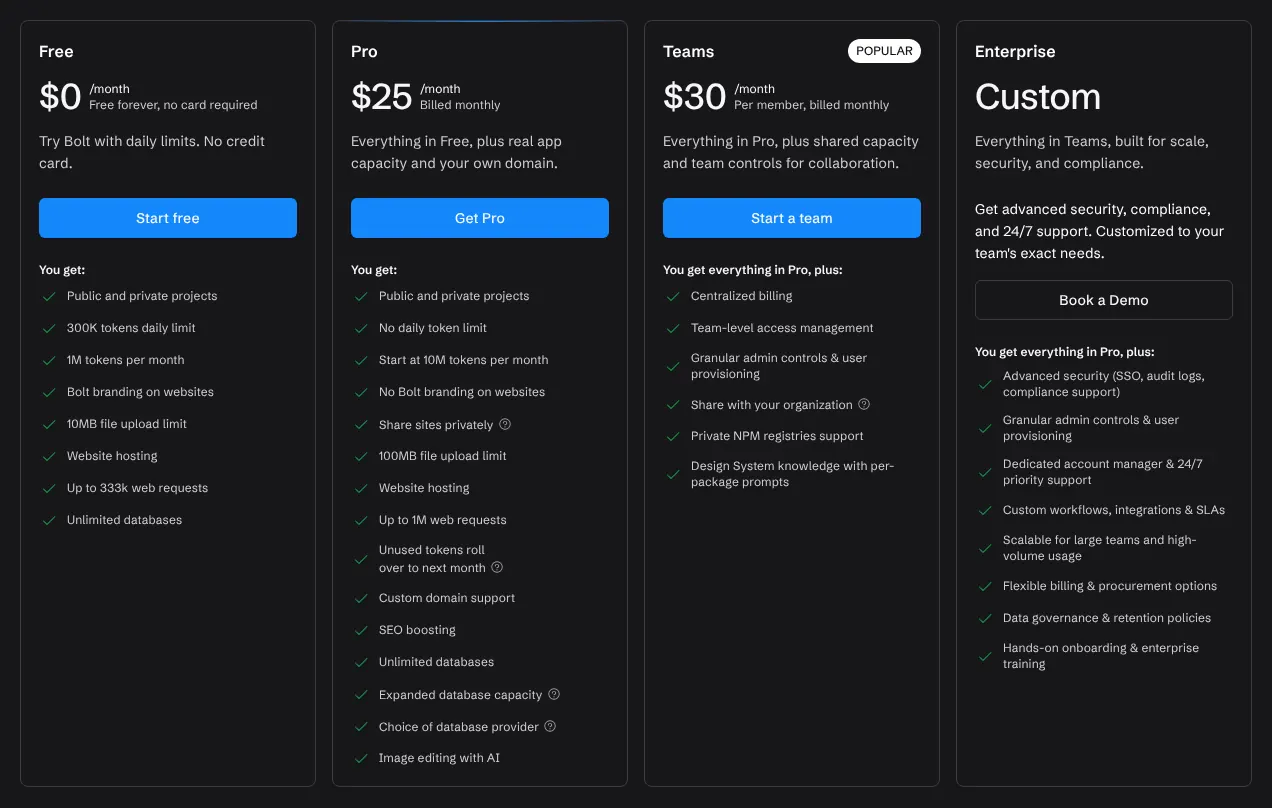
    Bolt builds web and phone apps from a prompt and hosts them. It counts use in tokens, small pieces of text that the AI reads and writes. Pro costs $25 a month, billed monthly, and starts at 10 million tokens. Unused paid tokens roll over for up to two months, and the code can be downloaded or synced with GitHub.

    Teams costs $30 per member a month, and each member gets their own tokens instead of a shared pool. Changing text or styles by clicking in the preview is free until the edits are saved. Phone apps go through Expo, an outside service, and reach the stores from the builder's own computer. Payments rely on the builder's own account with Stripe, an outside payment service. Single sign-on is kept for the Enterprise plan, sold by quote.

    Bolt Free, Pro, Teams and Enterprise plans: Pro at $25 a month billed monthly from 10M tokens, Teams at $30 per member, Enterprise custom.
    The Pro card reads $25 billed monthly; the Teams card charges $30 for each member. Source: bolt.new, captured on 16 Nov 2026.
  5. 6. Emergent

    Emergent suits someone who needs a phone app in the stores and can set aside credits for hosting.

    Score
    90/100
    Best for
    Real iOS and Android apps for the stores
    From
    $20/mo
    Free plan
    Yes · 10 credits, no publishing

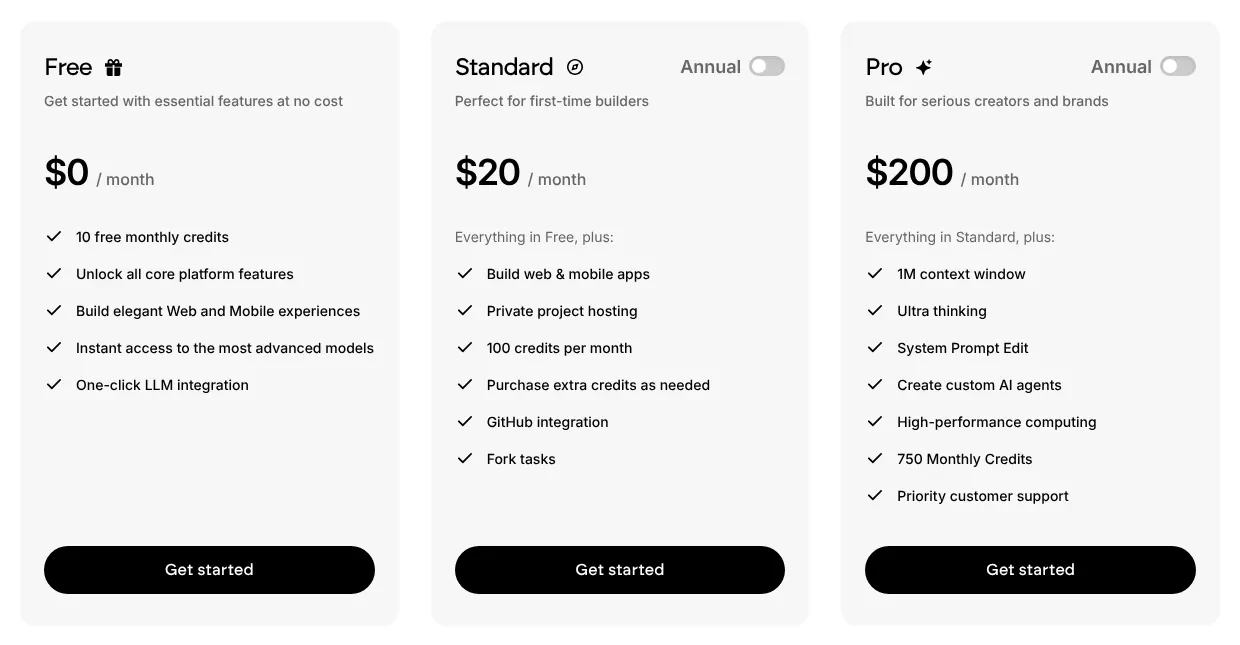
    Emergent uses AI agents that design, code and publish a full web or phone app from a chat. Its phone apps are real iOS and Android builds that Emergent produces itself, on paid plans. Standard costs $20 a month for 100 credits. Invited project members work on the owner's credits and need no plan of their own.

    The catch is hosting. Each live app costs at least 50 credits a month, half of what Standard includes. At zero credits, work pauses, and a negative balance can take the live app offline. The code leaves through GitHub or by copying it; there is no download button. Publishing needs at least 50 credits, more than the 10 of the free plan.

    Emergent Free at $0, Standard at $20 a month with 100 credits per month, and Pro at $200 a month with 750 monthly credits, annual switches off.
    With the Annual switch off, Standard shows $20 a month and lists 100 credits per month and GitHub integration. Source: emergent.sh, captured on 16 Nov 2026.
  6. 7. Bubble

    Bubble suits a builder who wants to keep editing by hand after the AI draft and does not need the code.

    Score
    88/100
    Best for
    Apps edited by hand after an AI first draft
    From
    $39/mo
    Free plan
    Yes · 500 AI credits a month, no live site

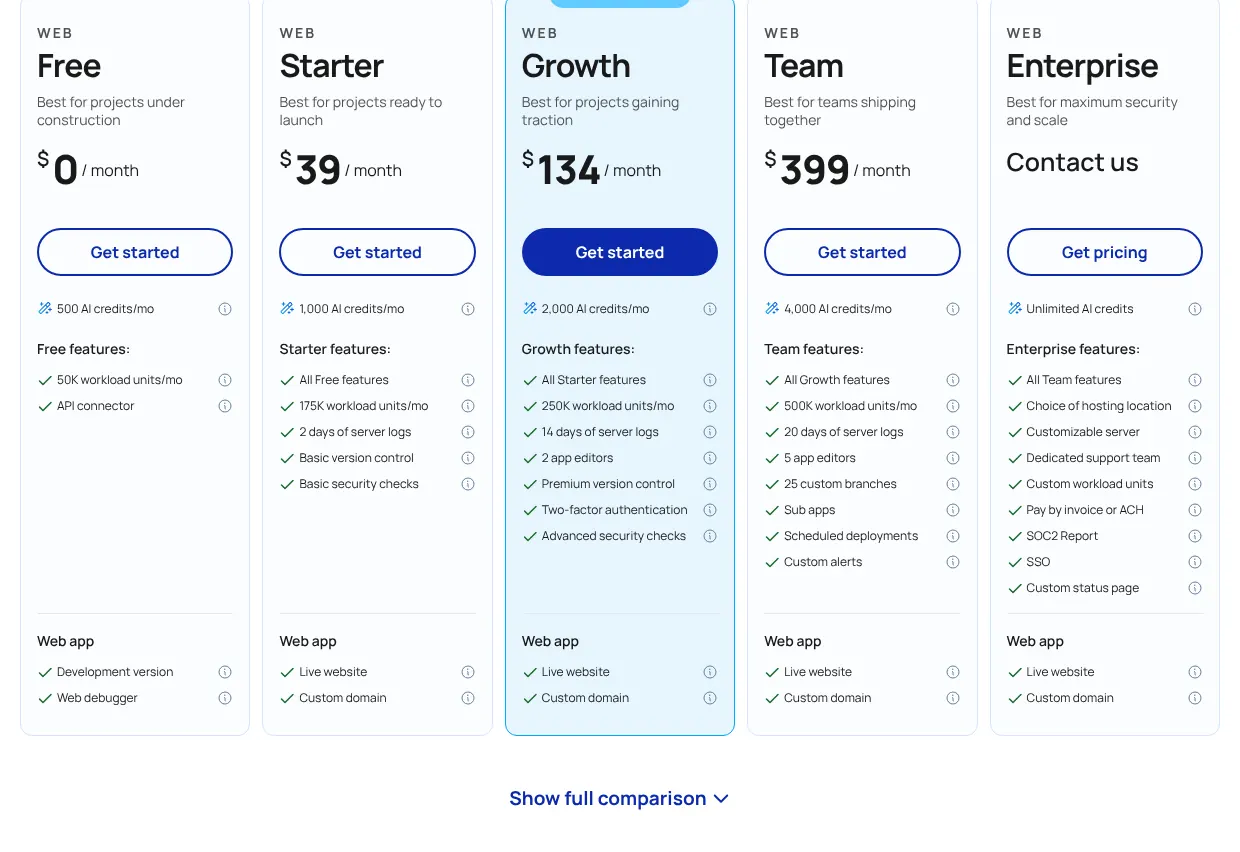
    Bubble is a visual app builder, where screens and logic are set with the mouse rather than written as code. Its AI Agent writes a first version from a description. After that, the app changes by chat or by hand in the visual editor. Starter costs $39 a month for a web app, billed monthly. Generating the app uses no AI credits; later edits with the AI Agent do.

    The free plan builds but cannot put a site live. Starter allows no collaborators, Growth allows two editors and Team five, at $399 a month. Server use is counted in workload units, Bubble's measure of the work its servers do, and extra units are billed unless switched off. There is no code download. To leave, an AI agent rebuilds the app in code through a connection still in beta.

    Bubble web plans in monthly view: Free, Starter at $39 with 1,000 AI credits, then Growth, Team and Enterprise.
    In monthly view, Starter costs $39 a month and is the first plan with a live website and a custom domain. Source: bubble.io, captured on 16 Nov 2026.
  7. 8. Zoho Creator

    Cheapest

    Zoho Creator suits a company that builds apps for its own staff and finds a price per user easier to plan than credits.

    Score
    85/100
    Best for
    Business apps for a company's own staff
    From
    US$12/user/mo
    Free plan
    Yes · 1 app, no AI building

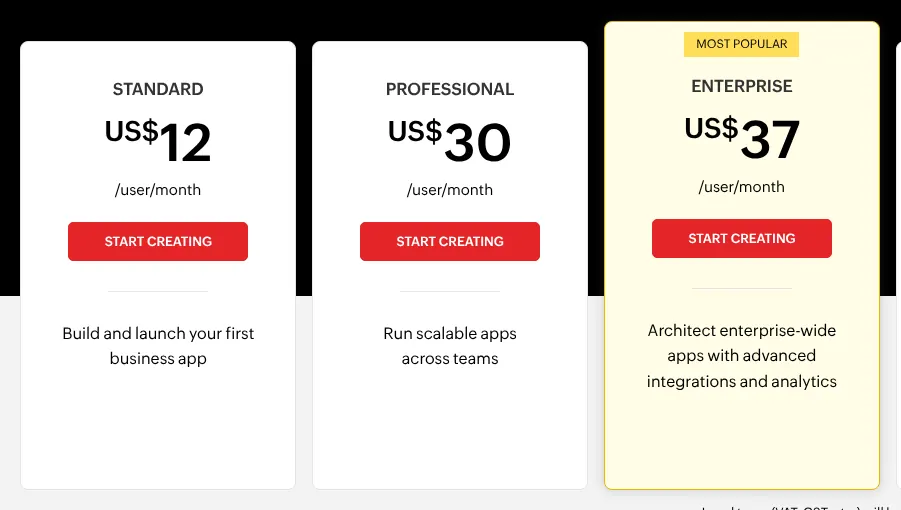
    Zoho Creator is a low-code platform for business apps: most of the work happens on screen, with a little scripting where needed. Its AI helper, Zia, builds an app from a prompt or a document. Standard costs US$12 per user a month, billed monthly, the lowest starting price of the ten. It is limited to one app; Professional, at US$30 per user, removes that limit.

    Every person who uses the apps needs a licence, including staff who never build anything. Apps run inside Zoho's own iOS and Android apps, and own-brand store apps come with Enterprise. The AI builder works only on paid plans. An app can be exported only as a script file that goes back into Zoho Creator.

    Zoho Creator plans in monthly view: Standard at US$12, Professional at US$30, and Enterprise, each priced per user per month.
    In monthly view, Standard costs US$12 for each user, and every person who opens the apps counts as a user. Source: zoho.com, captured on 16 Nov 2026.
  8. 9. v0

    v0 suits a team that already hosts on Vercel and is ready to bring its own database service.

    Score
    83/100
    Best for
    Teams that already host their sites on Vercel
    From
    $30/user/mo
    Free plan
    Yes · $5 of credits once, 7 messages a day

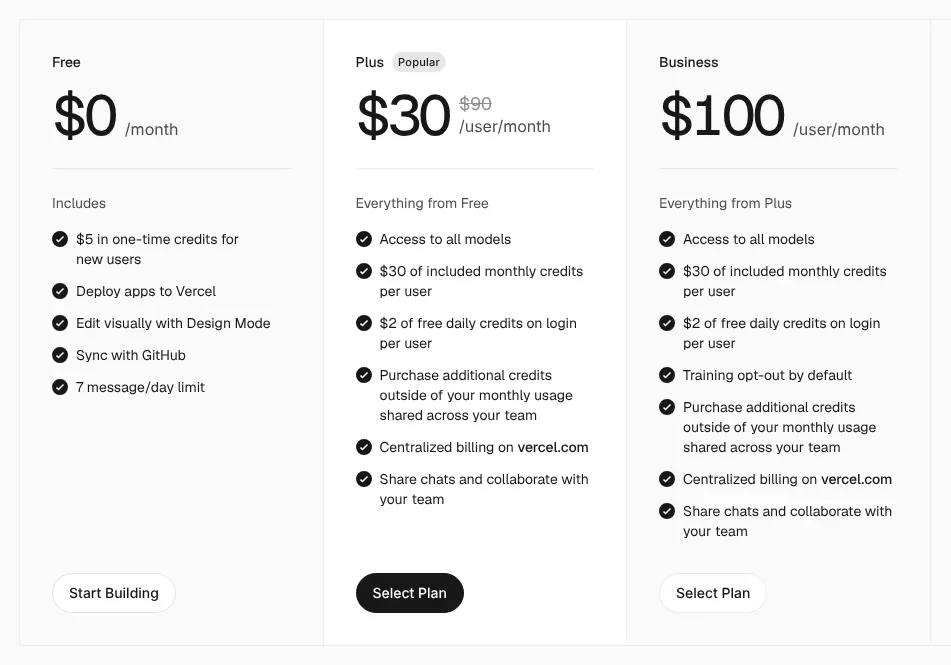
    v0 is the app builder of Vercel, a hosting company: it writes an app from a prompt and publishes it on Vercel. Plus costs $30 per user a month and includes $30 of credits per user. Each user also gets $2 of free credits a day on login. On 16 November 2026 the Plus card also showed $90 crossed out. v0's own pricing guide lists Plus at $30 per user a month.

    Credits are spent per token, at a rate set by each AI model. Unused credits roll over but expire after 65 days. The database comes from an outside provider, such as Neon or Supabase, added through Vercel. v0 makes web apps, not phone apps for the stores.

    v0 Free at $0, Plus at $30 per user per month next to a crossed-out $90, and Business, also priced per user.
    The large $30 is the Plus price per user; the crossed-out $90 above it carries no explanation on the page. Source: v0.app, captured on 16 Nov 2026.
  9. 10. Rocket

    Rocket suits a larger team that wants one flat price and already uses, or accepts, Supabase for its data.

    Score
    82/100
    Best for
    Large teams on one flat monthly fee
    From
    $25/mo
    Free plan
    Yes · 20 credits, once

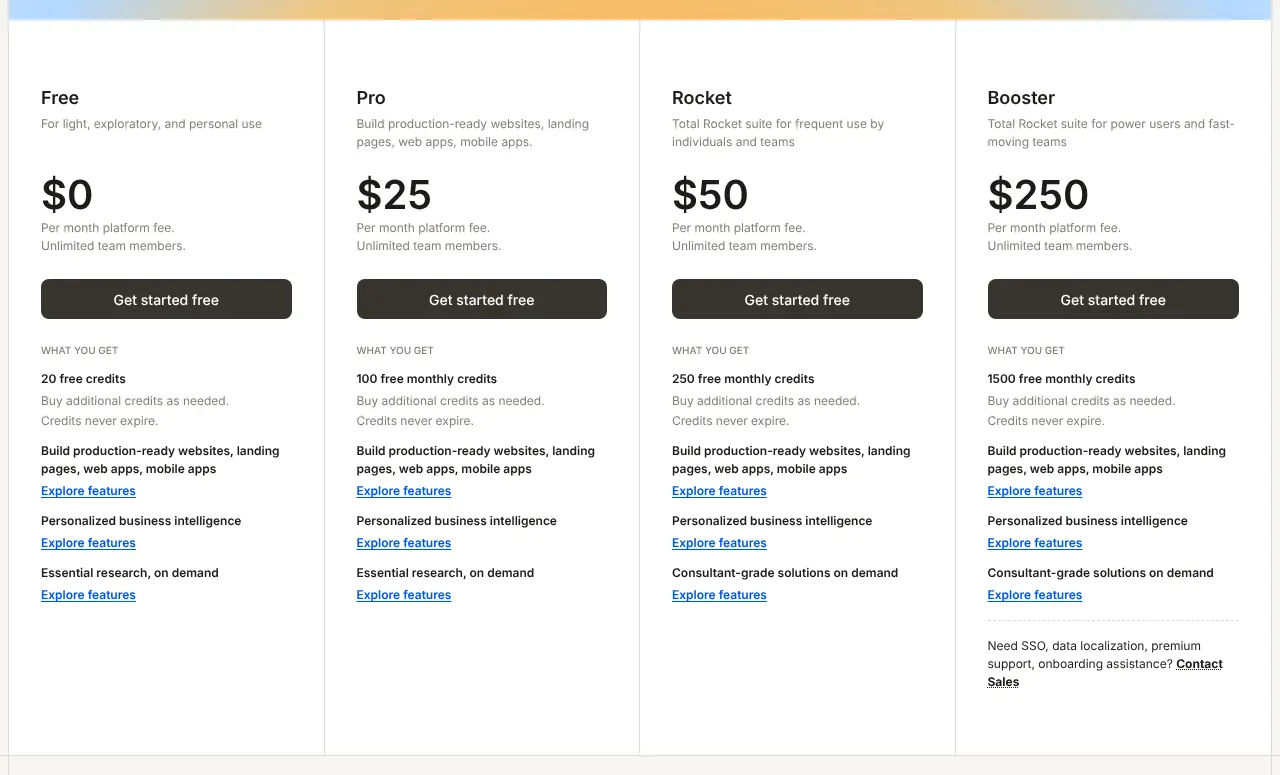
    Rocket builds web apps in Next.js and phone apps in Flutter, two common code frameworks, from a description. Pro costs $25 a month for 100 credits, with unlimited team members. A team of 20 therefore pays the same as one person. Unused credits roll over while the plan stays active, and all of them expire if it is cancelled.

    Data, user login and file storage run on the builder's own Supabase account, an outside database service, linked to Rocket. Payments go through the builder's own Stripe account. Rocket generates the phone apps, but sending them to the stores is done by hand. Figma import, which turned designs into code, was withdrawn on 29 September 2026.

    Rocket plans in monthly view: Free at $0 with 20 credits, Pro at $25, Rocket at $50 and Booster at $250, each with unlimited team members.
    Each card states a monthly platform fee with unlimited team members, and Pro at $25 includes 100 monthly credits; despite the line Credits never expire, Rocket's help says credits expire if the plan is cancelled. Source: rocket.new, captured on 16 Nov 2026.

Summary table

The table sets the ten tools side by side. The entry price is the first paid plan, billed monthly. Credits and tokens are each vendor's own unit, so the allowance column compares poorly across tools. It is most useful between two plans of the same vendor.

The 10 AI app builders side by side: score, entry price, monthly allowance, free plan, team billing and phone store apps
ToolScoreEntry priceMonthly allowanceFree planTeam billingPhone store apps
01Lovable94$25/mo100 credits5 credits a day, 30 a monthUnlimited membersNo, web apps only
02Base4493$20/mo100 message credits25 message creditsOne plan per workspaceWeb view wrapper
03Replit93$20/mo$20 of creditsDaily credits, 1 app for 30 daysUp to 5 builders on CoreApp Store only
04Blink92$25/mo100 credits + 5 a day5 credits a day, public projectsUnlimited membersOn Max
05Bolt92$25/mo10M tokens1M tokens a month$30 per member on TeamsThrough Expo
06Emergent90$20/mo100 credits10 creditsMembers use the owner's creditsYes, paid plans
07Bubble88$39/mo1,000 AI credits500 AI credits, no live siteEditors: none, 2, then 5Paid mobile plan
08Zoho Creator85US$12/user/mo200 AI calls1 app, no AIPer userOwn-brand apps on Enterprise
09v083$30/user/mo$30 of credits per user$5 once, 7 messages a dayPer userNo
10Rocket82$25/mo100 credits20 credits, onceUnlimited membersSubmitted by hand

Prices in USD for the first paid plan billed monthly, read on vendor pages on 16 November 2026. Zoho Creator and v0 charge per user. The pricing pages of Base44, Replit, Blink, Bubble and Zoho Creator open on yearly prices; the captures above show the monthly view, except for Replit, whose page refused the capture tool. Bubble's price is for a web app; a phone app needs a mobile plan.

What an AI app builder costs for your team

Six of the ten charge one price for a shared workspace rather than a price per person. For 5 people, the bill runs from $20 a month on Base44, Replit or Emergent to $399 on Bubble Team. On those flat plans, a team of 5 shares the credits that one person would otherwise use alone. Bolt and v0 charge $30 per member, and Zoho Creator charges US$12 per user. Taxes, extra credits and usage-based hosting are left out.

Monthly cost of each tool at 1, 5 and 20 users
ToolPlan used1 user5 users20 users
01LovablePro, unlimited members$25/mo$25/mo$25/mo
02Base44Starter, one workspace$20/mo$20/mo$20/mo
03ReplitCore, then Enterprise$20/mo$20/moOn request
04BlinkStarter, unlimited members$25/mo$25/mo$25/mo
05BoltPro, then Teams$25/mo$150/mo$600/mo
06EmergentStandard, owner's credits$20/mo$20/mo$20/mo
07BubbleStarter, Team, Enterprise$39/mo$399/moOn request
08Zoho CreatorStandard, per userUS$12/moUS$60/moUS$240/mo
09v0Plus, per user$30/mo$150/mo$600/mo
10RocketPro, unlimited members$25/mo$25/mo$25/mo

Prices billed monthly, read on 16 November 2026. Replit Core covers up to 5 invited builders and Pro up to 15, so 20 people need Enterprise. Bubble Starter allows no collaborators and Team allows five editors; 20 editors need Enterprise. Emergent's help pages do not say which plan is needed to invite members. Zoho Creator Standard is limited to one app; Professional costs US$30 per user.

How we rank

  1. The ten tools are ranked by a score out of 100. It measures how many of 20 features expected of an AI app builder each vendor documents. It does not measure the quality of the apps, speed or support.Building 31% · 5 featuresData and backend 28% · 6 featuresPublishing 19% · 3 featuresCode ownership 11% · 3 featuresTeam 11% · 3 features
  2. The 20 features fall into five groups: building, data and backend, publishing, code ownership, and team. Four define the category and weigh 3: an app built from a text prompt, changes asked in plain words, a built-in database, and hosting with one-click publish. The others weigh 2 or 1. A tool scores 1 for a feature documented on its free plan or on a plan sold online at a published price. A feature counts for half when it has a stated limit or needs a plan whose price is not published, such as an Enterprise plan sold by quote. It also counts for half when it runs on an outside service that the builder connects with their own account or key. It scores 0 when the feature is absent or could not be verified. The score is the weighted sum over the total weight, rounded.
  3. At equal scores the lower starting price ranks first, then the alphabet. Base44 and Replit both score 93 at $20 a month, so Base44 comes first by name. Blink and Bolt both score 92 at $25, and Blink comes first by name. Sixteen tools were looked at and 15 were scored. Anything, Softr and Adalo score 81 each, just below Rocket's 82. FlutterFlow scores 78 and Glide 75. Firebase Studio was set aside because Google closed its sign-ups on 22 June 2026 and will shut it on 22 March 2027.
  4. No entry on this page is sponsored. A sponsored entry is marked Sponsored and holds the position paid for; its score stays the computed one.

FAQ

Can an AI app builder put my app in the App Store?

Some can, at very different prices. Emergent builds real iOS and Android apps on its paid plans, from $20 a month. Blink publishes to both stores from Max, at $200 a month. Replit reaches Apple's App Store but not Google Play yet, and Bolt goes through Expo, an outside service. Lovable and v0 make web apps only. If the store matters, check which plan includes store publishing before you pay.

Who owns the code of an app built with AI?

On most tools here the user does, but taking it out differs. Lovable states that the user owns the code, the apps and the data, and Bolt says the code belongs to the user. Base44 exports the code from Builder, but that copy still needs Base44 to run. Bubble has no code download, and Zoho Creator exports a file that only Zoho Creator reads. If you may move the app later, connect GitHub early.

What happens when the credits run out?

Most tools pause the AI until the next month or a top-up: Base44, Emergent, Rocket and v0 work this way. Lovable stops building and the app's backend, but published pages keep showing. Replit keeps going and bills the extra use. On Emergent a negative balance can take the live app offline, so keep a margin once your app is live.

Is there a free AI app builder?

All ten have a free plan, but each one is meant for trying, not for running an app. Lovable and Blink give 5 credits a day, up to 30 a month. Replit's free app goes offline after 30 days, and Bubble's free plan cannot put a site live. Zoho Creator's free plan has no AI building at all. Test on a free plan, then pay for one month to publish.

Why is Firebase Studio not in the top 10?

Google is closing Firebase Studio on 22 March 2027. New sign-ups and new workspaces have been off since 22 June 2026. A new user cannot start a project there. Google points its users to Google AI Studio or Google Antigravity. Apps already deployed to Firebase keep running after that date, but if you build there, plan the move now.