top10alternative

Top 10 Lovable Alternatives (2026)

Base44 and Replit are the closest alternatives to Lovable: each does 95% of what Lovable does, for $20 a month against $25. This page ranks ten AI app builders by how much of Lovable each one replaces, with prices read on vendor pages on 20 November 2026.

Short answer · top 3 of 10

See all 10 ↓
  1. Base44Closest match
    95%From $20/moMigration Low
    Visit
  2. 95%From $20/moMigration Medium
    Visit
  3. 94%From $25/moMigration Medium
    Visit

Ranked by similarity to Lovable on 18 Lovable features. Prices in USD, billed monthly; v0 and Zoho Creator charge per user.

Lovable in three lines

What it is
An AI platform that builds and publishes web apps from a written description, with real code, a database and logins included.
Price
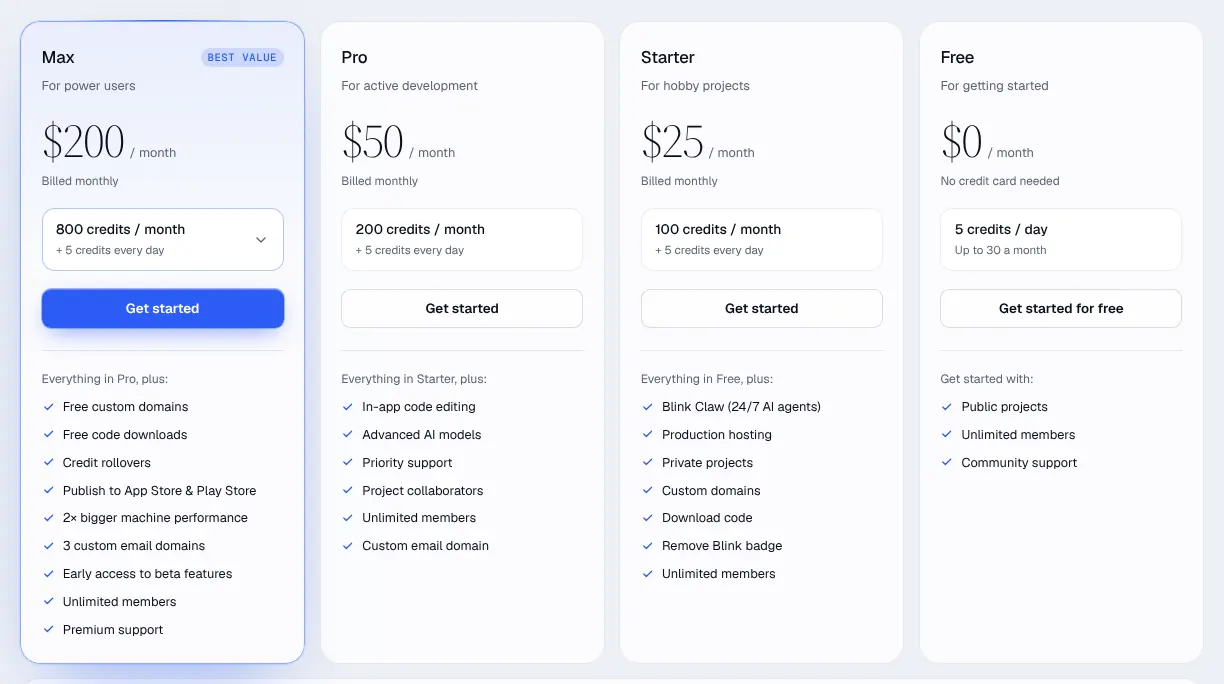
Free for 5 build credits a day, up to 30 a month. Pro costs $25/mo billed monthly for 100 credits a month, Business $50/mo with single sign-on (staff log in with their company account). Any number of members share one plan.
Used for
Prototypes, internal tools, websites and web apps with user accounts, built by people who do not write code.

Why teams look for a Lovable alternative

Three points of Lovable's pricing and scope explain most moves. All three were read on Lovable's own pages on 20 November 2026.

Building and running the app draw on the same credits

Lovable sells credits (units of AI work that each request uses). Pro includes 100 a month. Hosting, the built-in back end and AI features in the app come with a small monthly allowance. Above it, they are paid from the same credits as building. When credits run out, building stops, and so do the app's back end and its AI features. The published pages keep serving. Rocket bills nothing separately for compute, storage or hosting.

Unused credits expire

On monthly billing, unused Lovable credits expire two months after they are issued. A team that builds in bursts loses what it does not use in time. Rocket keeps unused credits for as long as the subscription is active.

Web apps only

Lovable builds web apps, and publishing always goes to a web address. Lovable has no built-in flow that packages an app for the App Store or Google Play. Emergent and Bubble publish to the App Store and Google Play, and Blink does so on its Max plan. Anything lists submission to the App Store.

How to choose a Lovable alternative

Five checks bring the ten tools down to one or two. They come in the order that removes the most candidates first.

1. Decide what happens to your data

A Lovable project has two parts: the code and the database (where the app keeps its records). The code moves easily, because Lovable syncs it to GitHub (a service that stores code) on every plan. The data is the hard part. Only Base44 documents bringing Lovable tables across with their rows. Blink copies a database held in Supabase (the database service many AI builders use). With Replit, the table structure arrives, but you load the records again.

2. Check who runs the back end

The back end is the part of the app that stores data and checks logins. Lovable runs it for you, and eight of the ten alternatives do the same. Rocket connects to your own Supabase account, and v0 to a provider you choose. With those two you open and manage one more account.

3. Count the people who build

Lovable charges one price for the workspace, whatever the number of members. Base44, Blink, Rocket and Emergent work the same way. Bolt Teams and v0 charge per member, and Zoho Creator per user. A team of 5 pays $25 a month on Lovable Pro and $150 on v0 Plus. The cost table does the sum for 1, 5 and 20 people.

4. Check how the live app is paid for

On several tools, keeping an app online uses the same credits as building it. Emergent takes at least 50 credits a month for each live app. Blink takes 50 credits a month for up to 10,000 visits. Rocket bills nothing separately for hosting. Ask yourself how many apps you will keep online, then compare.

5. Decide whether you need phone apps

If an app in the App Store or Google Play is the goal, look first at Emergent and Bubble. Blink publishes to the stores only on its Max plan, and Anything lists the App Store. Lovable and the other tools build for the web.

Which Lovable alternative for which situation

  • You want the closest match and your data moved with the appBase44
  • A developer on your team wants to keep working on the codeReplit · Lovable import through GitHub
  • You build alone and want Lovable's price with a documented importBolt · $25/mo billed monthly
  • You want a phone app in the App Store and Google PlayEmergent
  • Your Lovable data already sits in a Supabase projectBlink · Code and Supabase data migrated
  • Your developers already publish on Vercelv0
  • You build in bursts and do not want credits to expireRocket · Credits kept while subscribed
  • You prefer a visual editor to writing promptsBubble
  • You work alone on a phone appAnything
  • You build internal tools for a few colleaguesZoho Creator · US$12/user/mo billed monthly

The 10 alternatives

by similarity to Lovable
What can you not lose?Tick the Lovable functions you need. The tools where a ticked function was not found fade, with the reason.
Building
Data and backend
Publishing
Code ownership
Team

The ranks do not change: they measure how much of Lovable each tool replaces.

  1. Only partly: Export the source codeSingle sign-on for the team

    1. Base44

    Closest match
    Similarity to Lovable
    95%
    Starting price
    $20/mo−$5/mo · cheaper
    Migration effort
    LowBase44 documents a migration from Lovable that brings the tables with their data and the front end (the screens) from the GitHub copy of the project.

    Same as Lovable

    • An app built from a written description, then changed by chat
    • Built-in database, user sign-up and file storage, with nothing to set up
    • Built-in payments, through Wix Payments, Base44's own payment provider
    • Hosting and version history, plus a custom domain (the app on the company's own web address) on Starter

    What you lose

    • Code download: a ZIP from the Builder plan, and the copy still depends on Base44 for data and logins
    • Single sign-on only on Base44's Business and Enterprise plans

    Switching from Lovable to Base44

    Base44 covers the most of Lovable on this page, tied with Replit at 95%. Like Lovable, it builds the whole app from a description: screens, database, logins and payments. Payments are built in, through Wix Payments, so no outside payment account is needed to start.

    The move is also the shortest. Base44 lists Lovable among the platforms it migrates from. It copies the tables of the Lovable database with their rows, and the front end from the project's GitHub repository (the online copy of the code). No other tool on this page documents bringing the data across from Lovable itself.

    The gap is code ownership. On Lovable, a paid user can download the whole code base. Base44 offers a ZIP export only from the Builder plan, at $50 a month, and that copy still relies on Base44 for data, logins and integrations. Starter costs $20 a month for 100 message credits, against $25 for Lovable Pro.

    Choose it if
    You want the closest match and want your Lovable tables to arrive with their data.
    Skip it if
    You may need to run the app's code on your own servers one day: Base44's export keeps it tied to Base44.
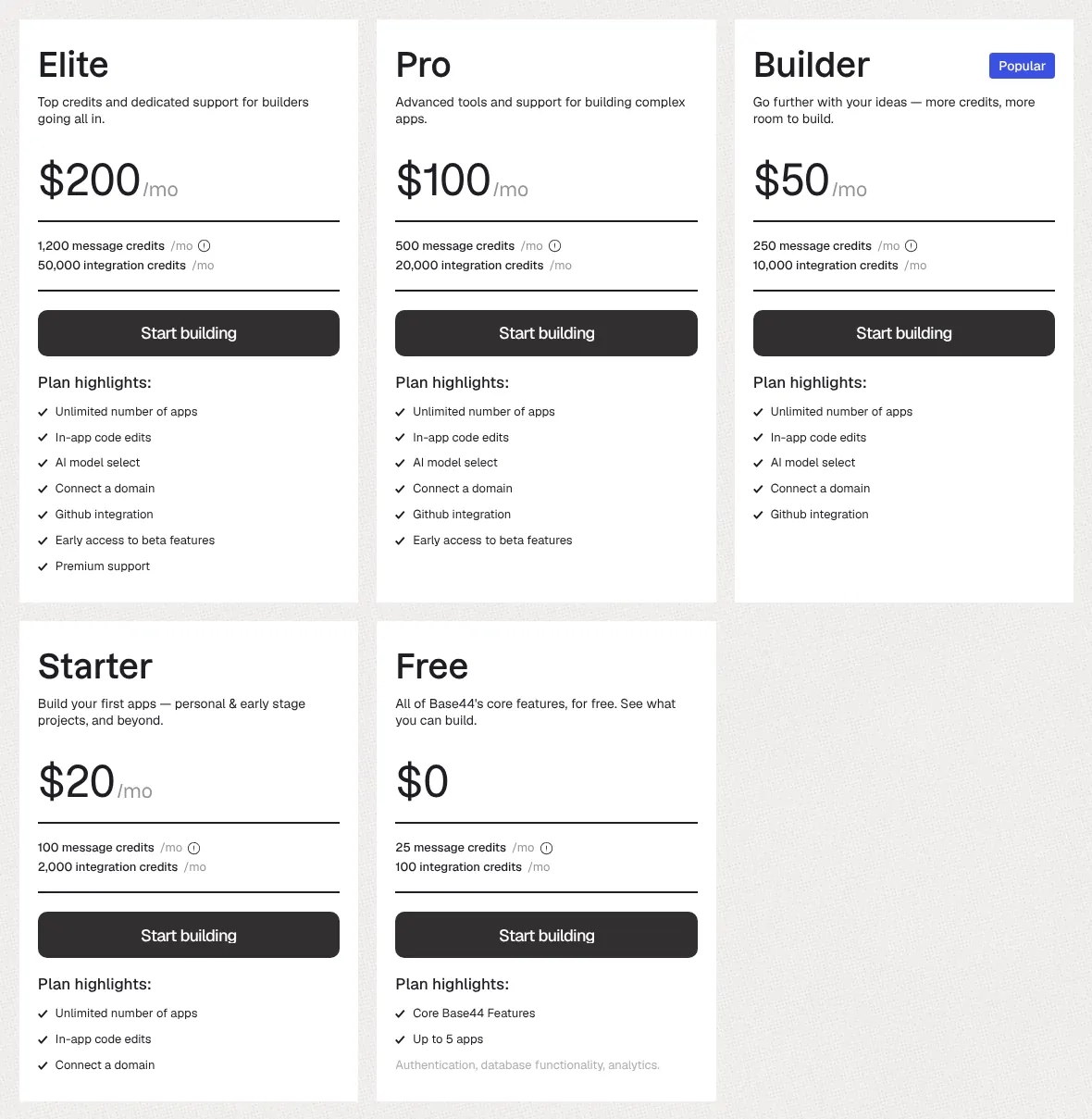
    Base44 plans in monthly view: Elite, Pro and Builder on the top row, then Starter at $20 a month with 100 message credits, and Free with 25 message credits.
    After the Monthly switch, the Starter card reads $20 a month; GitHub integration first appears on the Builder card above it. Source: base44.com, captured on 20 Nov 2026.

    Verdict: Base44 replaces almost all of Lovable for $5 a month less and is the only tool here that documents moving Lovable data with the code.

  2. Only partly: Payments in the appSingle sign-on for the team

    2. Replit

    Similarity to Lovable
    95%
    Starting price
    $20/mo−$5/mo · cheaper
    Migration effort
    MediumReplit has a Lovable import that starts from the project's GitHub repository. Code, design and table structure arrive; the records in the database do not.

    Same as Lovable

    • An app described in plain words, then refined by chat
    • Managed database, built-in sign-in and file storage
    • Publishing, custom domains, checkpoints to roll back, and code edited by hand
    • GitHub sync and a security check of the project

    What you lose

    • Built-in payments: Replit connects to Stripe (an online payment service), on paid plans
    • Single sign-on only on the Enterprise plan, priced on request

    Switching from Lovable to Replit

    Replit matches Base44's 95%, and it is the alternative closest to a code editor. Its AI builds the app, and the files stay open for anyone who wants to change them by hand. Database, sign-in and storage come built in.

    Replit documents a Lovable import. The project goes to GitHub first, then Replit imports that repository. The code, the design, the server logic and the table structure come across. Existing database records do not, so the data has to be loaded again.

    Core costs $20 a month, billed monthly, and includes $20 of AI usage. Up to 5 builders can join the workspace on Core. Usage beyond the monthly credits is billed on top, where Lovable stops building unless credits are topped up. The free Starter plan keeps one published app online for 30 days.

    Choose it if
    Someone on your team writes code and wants the Lovable project as real files to keep working on.
    Skip it if
    You want a fixed monthly bill: Replit bills usage above the included credits.

    Verdict: Replit is as close to Lovable as Base44 and suits teams with a developer, but the data in the database has to be moved separately.

  3. Only partly: Payments in the appAI features inside the appSingle sign-on for the team

    3. Bolt

    Similarity to Lovable
    94%
    Starting price
    $25/mo±$0/mo · same price
    Migration effort
    MediumBolt's help centre has an Import from Lovable guide: the project goes through GitHub. The guide does not mention the data in Lovable's database.

    Same as Lovable

    • A web app built from a prompt and changed by chat
    • Bolt Database, created automatically when the project needs one
    • Hosting, custom domain, version history and code edited by hand
    • GitHub sync, as on Lovable

    What you lose

    • Payments need the builder's own Stripe account and keys
    • AI inside the app needs an account with an outside AI provider
    • Single sign-on only on the Enterprise plan

    Switching from Lovable to Bolt

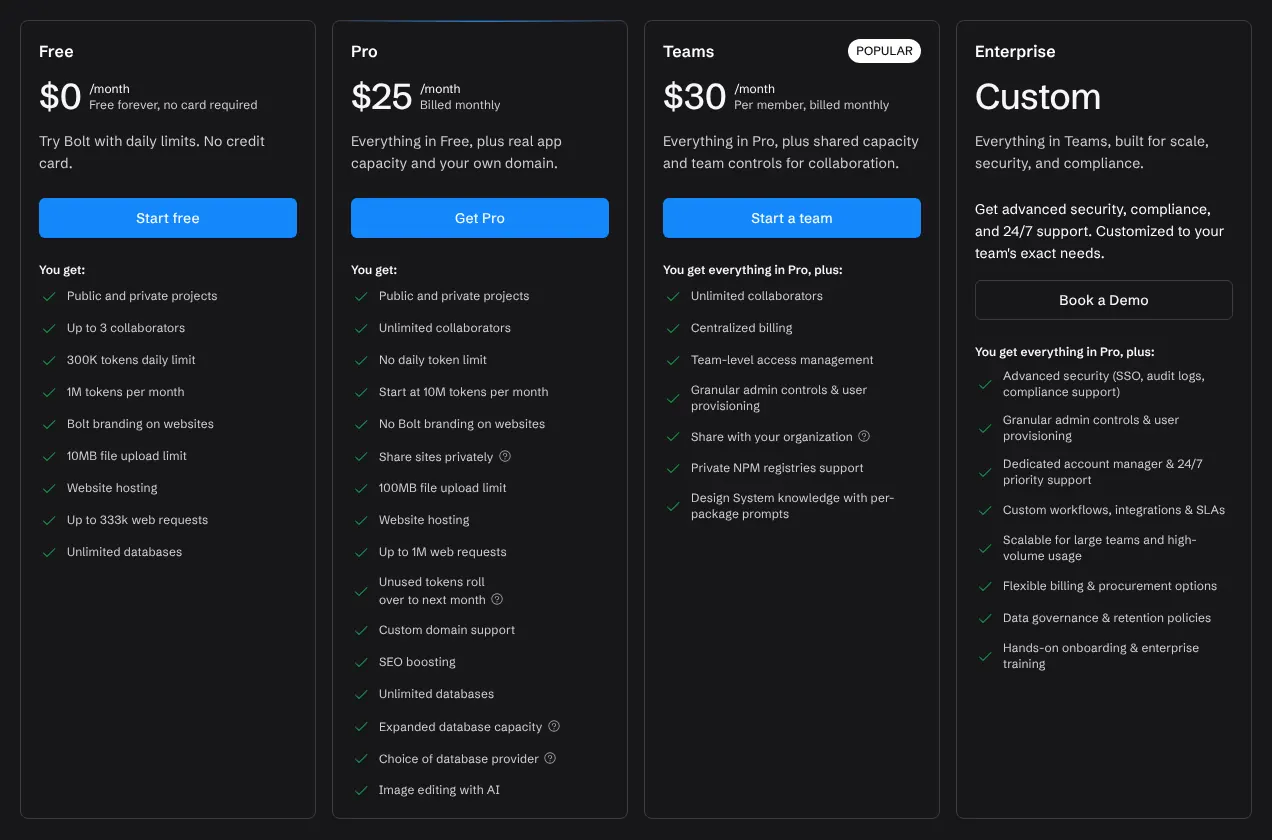
    Bolt sells AI work as tokens (small units of text the AI reads and writes) rather than credits. Pro costs the same $25 a month as Lovable Pro, billed monthly, and starts at 10M tokens a month. Unused tokens stay for up to two months while the plan is paid, the same window as Lovable's credits.

    The import is documented in Bolt's own help centre, under Import from Lovable. The code reaches Bolt through GitHub. Bolt then creates its own database when the project needs one.

    Teams are billed differently. On Lovable, any number of members share one plan. Bolt Teams costs $30 per member a month, and each paid member gets a separate token allowance. A team of 5 therefore pays $150 a month.

    Choose it if
    You build alone or in pairs and want the same price as Lovable with a documented import.
    Skip it if
    Several people build together: per-member pricing quickly costs more than Lovable's shared plan.
    Bolt plans: Free, Pro at $25 a month billed monthly starting at 10M tokens, Teams at $30 per member, and Enterprise on a custom price.
    The Pro card reads $25 billed monthly; the Teams card charges $30 for each member. Source: bolt.new, captured on 20 Nov 2026.

    Verdict: Bolt costs the same as Lovable for one builder, imports Lovable projects through GitHub, and becomes expensive for teams.

  4. Only partly: Payments in the appSingle sign-on for the teamSecurity checks before publishing

    4. Emergent

    Similarity to Lovable
    94%
    Starting price
    $20/mo−$5/mo · cheaper
    Migration effort
    HighEmergent documents no import of an existing project as of 20 November 2026. The app is rebuilt from a prompt, on a MongoDB database rather than Lovable's PostgreSQL.

    Same as Lovable

    • AI agents that design, code and publish the app from a conversation
    • Built-in database, sign-in and file storage
    • Custom domain, checkpoints to undo changes, and GitHub on the Standard plan

    What you lose

    • Payments go through outside providers such as Stripe or PayPal
    • Single sign-on only on the Business plan, priced on request
    • Emergent's security audit runs on the live app, and its help centre describes only a check that the app works

    Switching from Lovable to Emergent

    Emergent covers 94% of Lovable and goes one step further on phones. It produces the files that the App Store and Google Play require, through its own build service. Lovable builds web apps only.

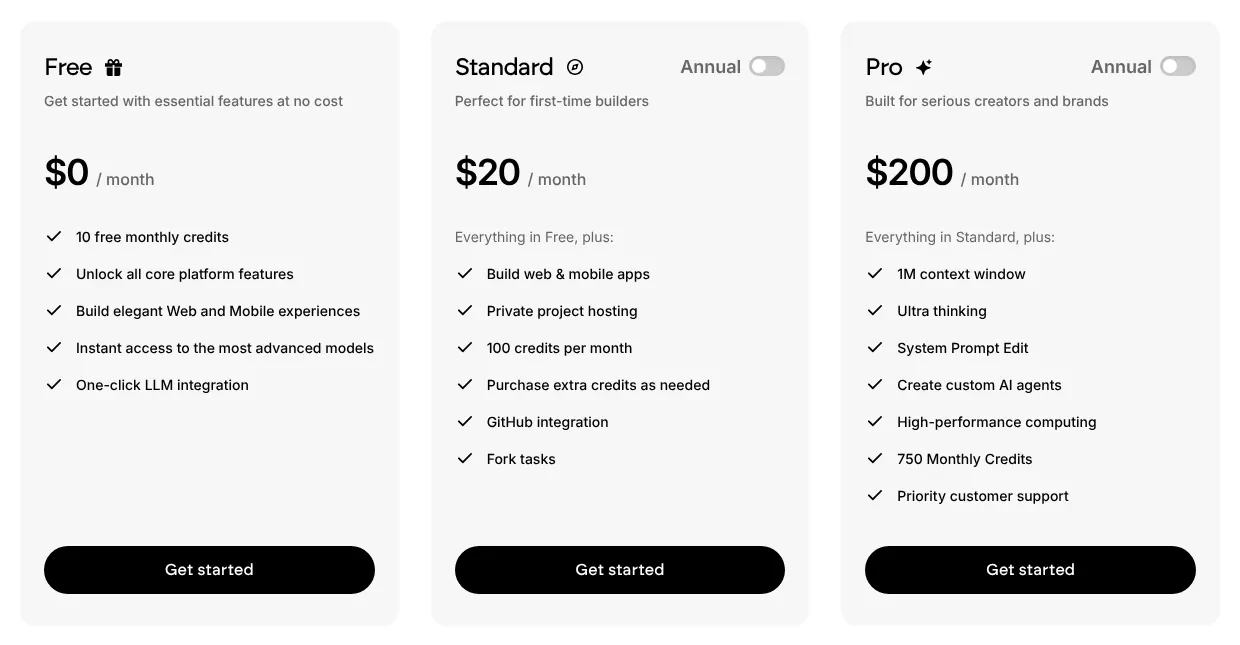
    Standard costs $20 a month, billed monthly, for 100 credits. Keeping an app online also costs credits: at least 50 a month per live app, taken from the same balance. On Standard, one live app can use half the monthly credits before any building starts.

    Moving in means starting again. Emergent documents no import, and its apps store data in MongoDB (a different type of database). Lovable exports its database as a PostgreSQL archive, a format MongoDB does not read as it is.

    Choose it if
    Your next step is a phone app in the stores and you accept rebuilding from a prompt.
    Skip it if
    You keep a lot of data in Lovable: there is no documented way to bring it into Emergent.
    Emergent plans with the Annual switches off: Free at $0 with 10 monthly credits, Standard at $20 a month with 100 credits, and Pro at $200 a month with 750 monthly credits.
    With the Annual switch off, Standard reads $20 a month and lists 100 credits per month and GitHub integration. Source: emergent.sh, captured on 20 Nov 2026.

    Verdict: Emergent costs $5 less than Lovable and adds store-ready phone apps, at the price of a full rebuild.

    Visit emergent.shPartner link · may earn us a commission
  5. Only partly: Built-in databaseUser sign-up and loginPayments in the appSingle sign-on for the team

    6. v0

    Similarity to Lovable
    88%
    Starting price
    $30/user/mo+$5/mo · pricier, per user
    Migration effort
    Mediumv0 imports an existing GitHub repository, so a Lovable project synced to GitHub can be opened in v0. The database has to be set up again with a provider.

    Same as Lovable

    • Apps built from plain-language prompts and refined by chat
    • Publishing on Vercel, custom domains and version history
    • GitHub sync, code download and code edited by hand

    What you lose

    • The database comes from an outside provider such as Neon or Supabase, with its own account
    • No built-in sign-in service: v0 writes the login code
    • Payments run through Stripe from the Vercel Marketplace

    Switching from Lovable to v0

    v0 publishes apps on Vercel, a hosting service, and bills through vercel.com. It reads a GitHub repository with Import from GitHub, so a Lovable project synced to GitHub opens as code in v0. That makes v0 a fit for teams that plan to keep developing the code.

    The back end is where v0 differs from Lovable. Lovable Cloud gives each project a database, logins and storage with nothing to sign up for. On v0 the database comes from a provider of the Vercel Marketplace, under its own account and terms.

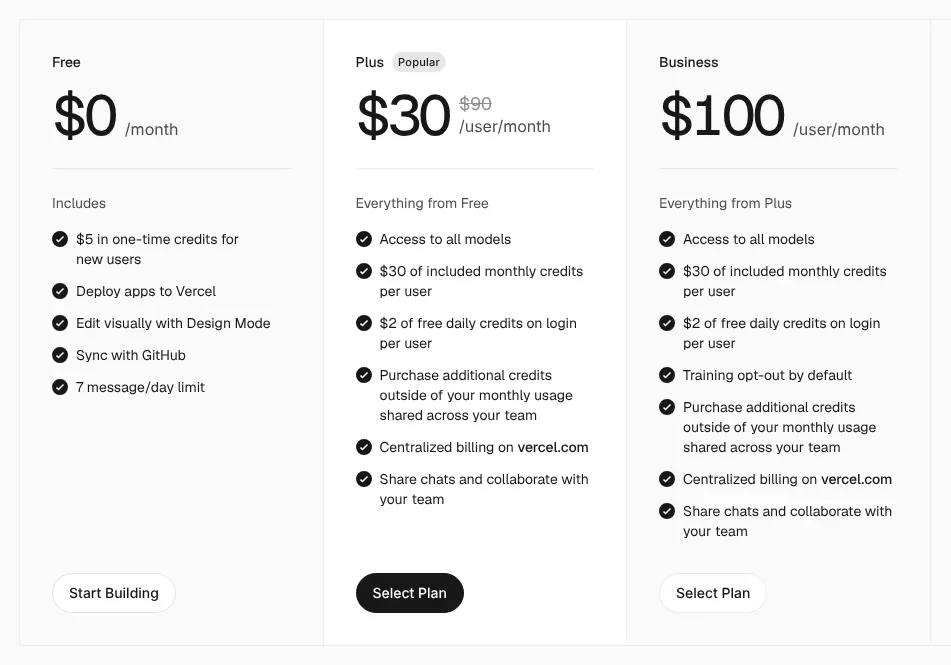
    Pricing is per person. Plus costs $30 per user a month and includes $30 of credits per user. A team of 5 pays $150 a month, where Lovable Pro stays at $25. Unused credits expire after 65 days.

    Choose it if
    Your developers already use Vercel and want to keep the Lovable code and work on it there.
    Skip it if
    You rely on Lovable's built-in database and logins and have no one to set up a provider.
    v0 plans: Free at $0 with one-time credits for new users, Plus at $30 per user per month next to a crossed-out $90, and Business, also priced per user.
    The large $30 is the Plus price per user per month; the crossed-out $90 beside it carries no explanation on the page. Source: v0.app, captured on 20 Nov 2026.

    Verdict: v0 suits a team with developers on Vercel, but it costs more per person than Lovable and leaves the database to an outside provider.

  6. Only partly: Built-in databaseUser sign-up and loginPayments in the appFile uploads and storageAI features inside the appSingle sign-on for the teamSecurity checks before publishing

    7. Rocket

    Similarity to Lovable
    83%
    Starting price
    $25/mo±$0/mo · same price
    Migration effort
    HighRocket's GitHub import accepts Next.js projects in TypeScript only. Lovable projects are built with TanStack Start or React with Vite, so they are rebuilt.

    Same as Lovable

    • Apps generated from a description, for the web and for phones
    • Hosting, custom domains, version history and GitHub code sync
    • Unlimited team members on one flat monthly fee

    What you lose

    • Database, sign-in and file storage run in the builder's own Supabase project, not in Rocket
    • AI features in the app need a key from each AI provider
    • Security help is limited to warnings about exposed secret keys

    Switching from Lovable to Rocket

    Rocket's main difference is how credits last. Unused credits carry forward as long as the subscription is active. Lovable's monthly credits expire two months after they are issued. Rocket also bills no separate charge for compute, storage or hosting.

    Pro costs $25 a month, the same as Lovable Pro, with 100 credits a month and unlimited team members. The free plan gives 20 credits once, not every month.

    The back end is less complete. Rocket connects to the builder's own Supabase account for the database, logins and files. AI features need keys from each AI provider. Rocket's import from GitHub accepts only Next.js projects (one code framework among several). Lovable projects use other frameworks, so the app is rebuilt.

    Choose it if
    You build in bursts and want unused credits to stay available month after month.
    Skip it if
    You want the database and logins handled for you, as Lovable Cloud does.
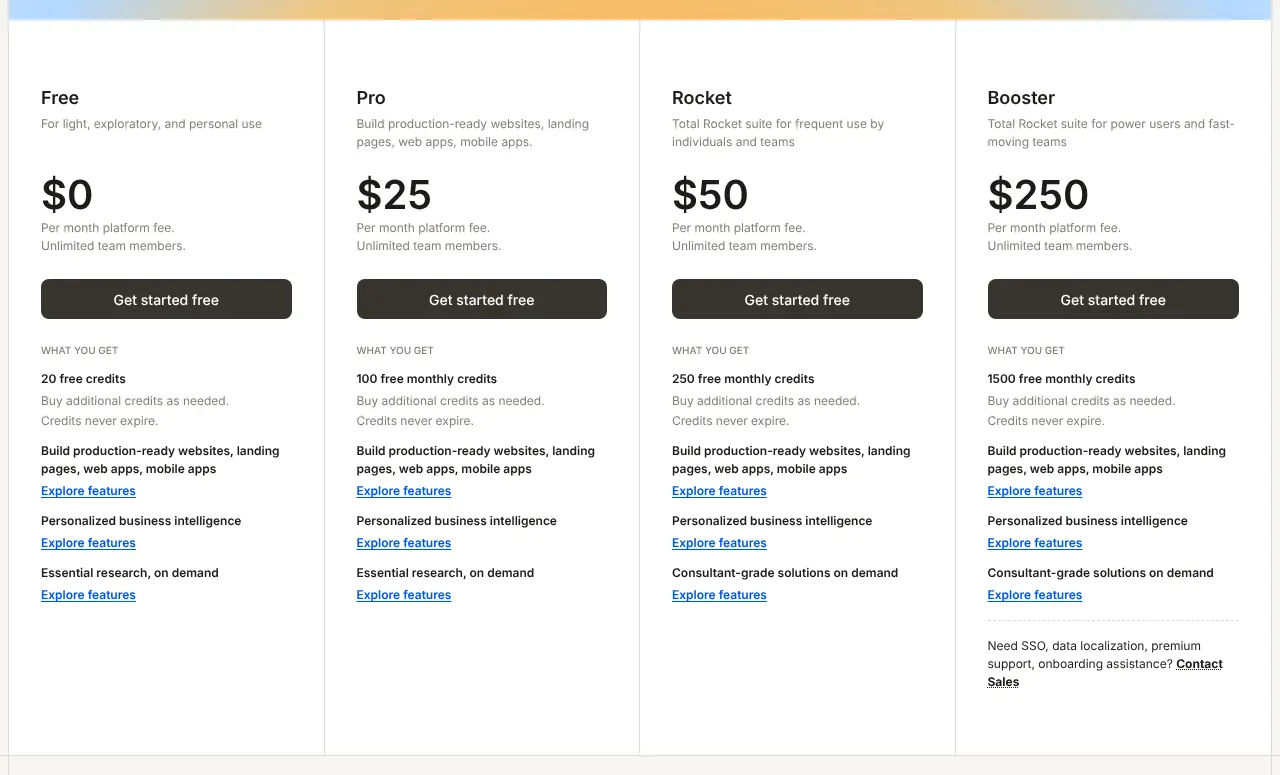
    Rocket plans: Free at $0 with 20 credits, Pro at $25 with 100 monthly credits, Rocket at $50 and Booster at $250, each a monthly platform fee with unlimited team members.
    Each card states a monthly platform fee with unlimited team members; Pro at $25 includes 100 monthly credits. Source: rocket.new, captured on 20 Nov 2026.

    Verdict: Rocket matches Lovable's price and keeps credits while the plan lasts, but the back end runs on the builder's own Supabase account.

  7. Not found on Bubble's site: GitHub syncOnly partly: Payments in the appAI features inside the appExport the source codeEdit the code by handSingle sign-on for the team

    8. Bubble

    Similarity to Lovable
    83%
    Starting price
    $39/mo+$14/mo · pricier
    Migration effort
    HighBubble apps are built in a visual editor, not as code, and Bubble documents no import of a Lovable project. The app is rebuilt.

    Same as Lovable

    • An AI agent that generates a first version from a description
    • Built-in database, user accounts and file storage
    • Hosting, custom domain, version control and security checks from Starter

    What you lose

    • No source code to download: an outside AI agent can recreate the app in code, without guaranteed fidelity
    • No GitHub sync for apps
    • AI features in the app go through an outside provider such as OpenAI

    Switching from Lovable to Bubble

    Bubble is a visual builder (a no-code tool where the app is assembled on screen) with an AI agent added. Generating a first version from a description uses no AI credits. The app can still be edited in the visual editor when AI credits run out.

    That changes who can maintain the app. A Lovable project is code that a developer can open elsewhere. A Bubble app lives inside Bubble: there is no code base to download. Bubble also publishes native apps to the App Store and Google Play, on a paid mobile plan.

    Starter costs $39 a month for the web, billed monthly, which is $14 more than Lovable Pro. Starter allows no collaborators. Two editors need Growth at $134 a month, and five need Team at $399.

    Choose it if
    You prefer editing on screen to writing prompts, and native phone apps matter to you.
    Skip it if
    Several people build together, or you want to keep the option of taking the code elsewhere.
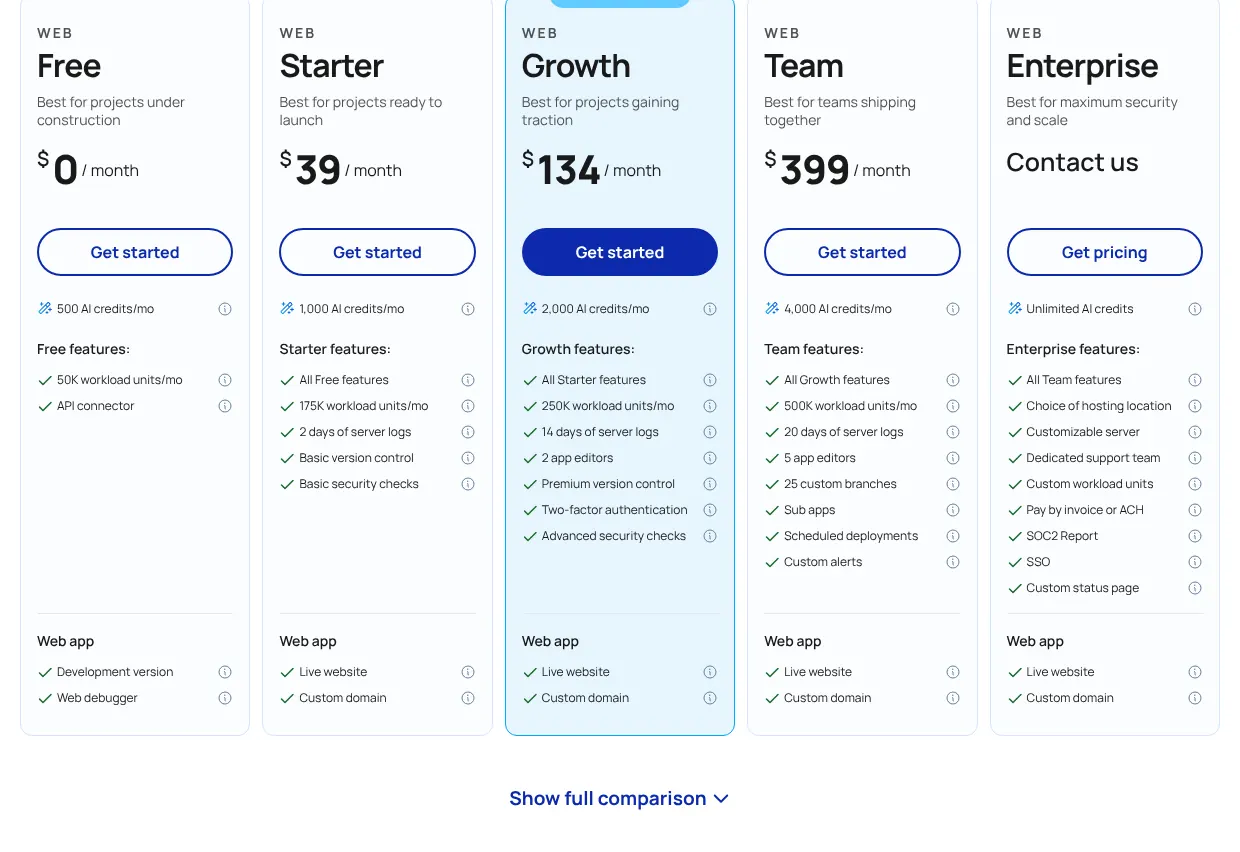
    Bubble web plans in monthly view: Free, Starter at $39 with 1,000 AI credits, then Growth, Team and Enterprise, which is on request.
    In monthly view, Starter costs $39 a month and is the first plan with a live website and a custom domain. Source: bubble.io, captured on 20 Nov 2026.

    Verdict: Bubble covers most of what Lovable does in a visual editor, costs $14 more to start and keeps the app inside Bubble.

  8. Not found on Anything's site: GitHub syncEdit the code by handSingle sign-on for the teamSecurity checks before publishingOnly partly: Payments in the app

    9. Anything

    Similarity to Lovable
    82%
    Starting price
    $24/mo−$1/mo · cheaper
    Migration effort
    HighAnything documents imports from Mocha and Figma, not from Lovable or from GitHub, as of 20 November 2026. The app is rebuilt from a conversation.

    Same as Lovable

    • Phone and web apps built from a conversation
    • Built-in database, file uploads and sign-in
    • Publishing, custom domains and version history

    What you lose

    • No GitHub sync: the code is downloaded and pushed to GitHub by hand
    • No single sign-on and no security scan found in Anything's documentation
    • The free plan cannot start a build

    Switching from Lovable to Anything

    Anything builds phone apps as well as web apps, and its pricing page lists submission to the App Store. That is the main thing it adds to Lovable. It costs $24 a month billed monthly for 20K credits, $1 less than Lovable Pro.

    The free plan is narrower than Lovable's. On Anything, building requires a paid plan, so the free plan cannot start new generations. Unused monthly credits expire at the end of the billing cycle.

    Code leaves Anything as a download, not through a GitHub link kept in step. Anything does not document a single sign-on or a security scan, and its Teams plan is priced on request. It suits one person more than a company team.

    Choose it if
    You work alone and want your app in the App Store as well as on the web.
    Skip it if
    Your team relies on GitHub to follow and review changes to the code.
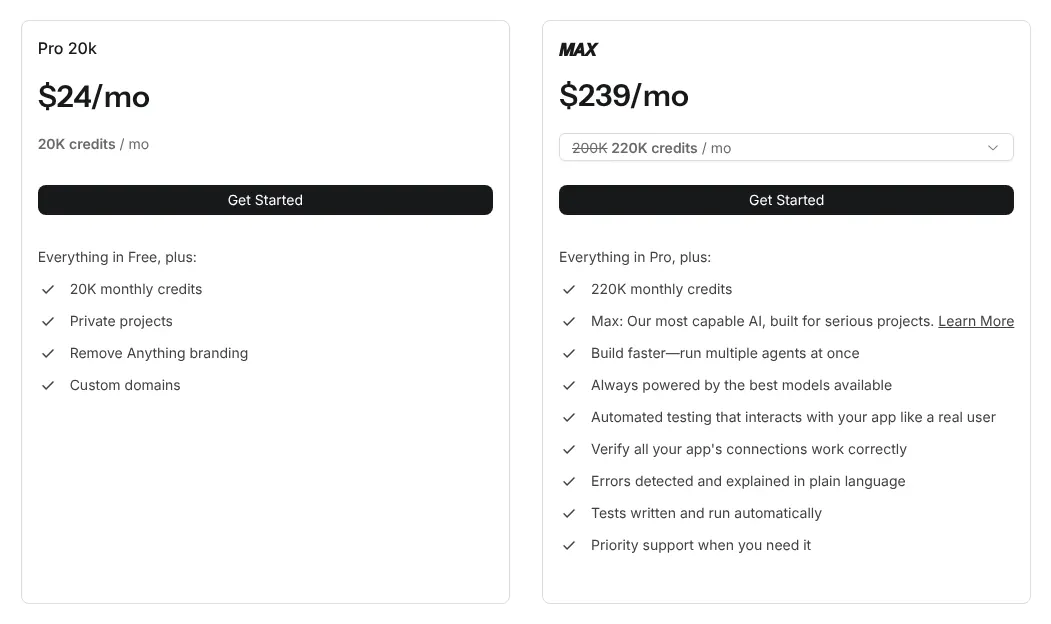
    Anything plans in monthly view: Pro 20k at $24 a month with 20K monthly credits, private projects and custom domains, next to Max with 220K monthly credits.
    After the Monthly switch, the Pro 20k card reads $24 a month; the page opens on yearly prices. Source: anything.com, captured on 20 Nov 2026.

    Verdict: Anything costs about the same as Lovable and adds App Store apps, with fewer tools for teams and no way to import a Lovable project.

  9. Only partly: Build from an image or design fileUser sign-up and loginPayments in the appCustom domainExport the source codeGitHub syncSecurity checks before publishing

    10. Zoho Creator

    Cheapest
    Similarity to Lovable
    82%
    Starting price
    US$12/user/mo−US$13/mo · cheaper, per user
    Migration effort
    HighZoho Creator is a low-code platform with its own app format and documents no import of a Lovable project. The app is rebuilt with Zia, its AI assistant.

    Same as Lovable

    • Apps generated from a prompt by Zia, Zoho's AI assistant
    • Built-in database, file storage and AI inside the app
    • Hosting by Zoho, version history and shared work for a team

    What you lose

    • Code export only in Deluge, Zoho's own scripting language, which runs only inside Zoho Creator
    • Outside users sign in through a customer portal: 3 portal users are free, more are paid
    • A custom domain only for that portal, paid extra below the Enterprise plan

    Switching from Lovable to Zoho Creator

    Zoho Creator has the lowest entry price on this page (the price of the cheapest paid plan, billed monthly). Standard costs US$12 per user a month. It is a low-code tool (apps built mostly from forms and reports, with a little scripting) for business apps used inside a company. Zia, its AI assistant, generates an app from a prompt.

    The price model is the opposite of Lovable's. Every person who uses the apps needs a licence, builders and staff alike. Five users on Standard cost US$60 a month, and 20 cost US$240. Lovable Pro stays at $25 for any number of members.

    Customer-facing apps are harder. Outside users come in through a customer portal, and only that portal can use the company's own domain. The code export is in Deluge, which runs only inside Zoho Creator.

    Choose it if
    You build internal tools for a few colleagues and already use other Zoho apps.
    Skip it if
    You build a public app for customers: portals, domains and per-user licences add up.
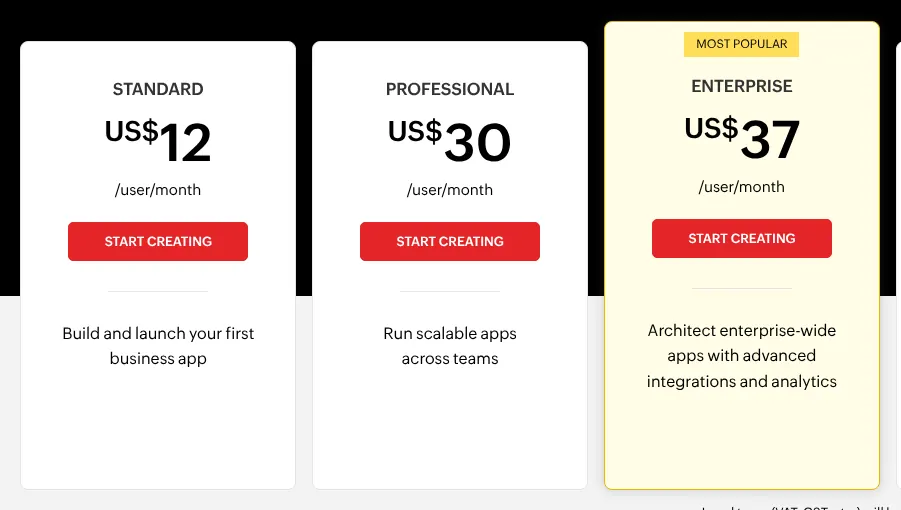
    Zoho Creator plans after the Monthly switch: Standard at US$12 and Professional at US$30, then Enterprise, each priced per user per month.
    In monthly view, Standard costs US$12 for each user, and every person who uses the apps counts as a user. Source: zoho.com, captured on 20 Nov 2026.

    Verdict: Zoho Creator has the lowest entry price here, per user, and fits internal business apps better than public ones.

Comparison table: the 10 alternatives vs Lovable

The 10 Lovable alternatives compared with Lovable
ToolMatchEntry price, billed monthlyFree planHow a team paysLovable import
REFLovable100%$25/mo5 credits a day, 30 a monthOne plan, unlimited membersn/a
01Base4495%$20/mo25 message credits a monthOne plan, shared creditsCode and data
02Replit95%$20/moDaily credits, 1 app online for 30 daysUp to 5 builders on CoreCode and table structure
03Bolt94%$25/mo1M tokens a month$30 per member on TeamsCode, through GitHub
04Emergent94%$20/mo10 credits a monthOwner's creditsNot documented
05Blink91%$25/mo5 credits a day, 30 a monthOne plan, unlimited membersCode, and data held in Supabase
06v088%$30/user/mo$5 of credits oncePer userCode, through GitHub
07Rocket83%$25/mo20 credits onceOne fee, unlimited membersNo: Next.js projects only
08Bubble83%$39/moBuilds, no live websiteEditors from the Growth planNot documented
09Anything82%$24/moNo building on the free planTeams plan on quoteNot documented
10Zoho Creator82%US$12/user/moOne appPer userNot documented

Entry price: the first paid plan billed monthly, read on each vendor's pricing page on 20 November 2026. Lovable import: an import of a Lovable project documented on the vendor's own site. Not documented: no such import was found on that site. Replit's pricing page refused the capture tool, so its price was read from the page text.

What a Lovable alternative really costs

Credits do not compare from one tool to another: one request costs a different amount on each. What does compare is how the bill grows with the team. The table below takes the cheapest paid plan that allows each team size, billed monthly.

Lovable Pro costs $25 a month whatever the number of members, who share its credits. Base44, Blink, Rocket and Emergent also keep one price. Bolt and v0 charge $30 per member, so a team of 20 pays $600 a month. Zoho Creator charges US$12 per user. A shared plan does not grow, but its credits run out faster with more people building.

Monthly cost at 1, 5 and 20 people, billed monthly
ToolPlan used1 person5 people20 people
REFLovablePro, unlimited members$25$25$25
01Base44Starter, shared credits$20$20$20
02ReplitCore, then Enterprise$20$20On request
03BoltPro, then Teams$25$150$600
04EmergentStandard, owner's credits$20$20$20
05BlinkStarter, unlimited members$25$25$25
06v0Plus, per user$30$150$600
07RocketPro, unlimited members$25$25$25
08BubbleStarter, Team, Enterprise$39$399On request
09AnythingPro 20k$24Not publishedNot published
10Zoho CreatorStandard, per userUS$12US$60US$240

Prices read on 20 November 2026, before tax, extra credits and usage-based hosting. Replit Core takes up to 5 builders and Pro up to 15, so 20 people need Enterprise. Bubble Starter allows no collaborators and Team allows 5 editors; 20 editors need Enterprise. Emergent's help pages say members use the owner's credits but do not say which plan is needed to invite them. Teammates can join an Anything workspace, but no team price is published; its Teams plan is on quote.

How to migrate from Lovable in five steps

Lovable does not move a project to another back end in one step, and its documentation calls the move developer work. The five steps below follow what Lovable documents. The order keeps the old app online until the new one works.

  1. Sync the code to GitHub

    Connect the Lovable project to GitHub. Git sync works on every plan, so no upgrade is needed. Base44, Replit, Bolt, Blink and v0 import from that repository.

  2. Export the database and the files

    In More, then Database, open Manage, then Settings, and choose Export data. Lovable emails you when the file is ready. It is a compressed PostgreSQL archive (a standard database format) with the tables, the rows and your users' accounts. Files that users uploaded are not in it: download them from More, then Storage. Lovable exports databases of up to 15 GB, once every 24 hours.

  3. Import or rebuild in the new tool

    With Base44, start from its migration option, which brings the data. With Blink, Replit, Bolt or v0, import the GitHub repository. With the five other tools, describe the app again and use the old one as your model.

  4. Set up secrets and sign-in again

    Lovable's export leaves out secrets (the private keys your app uses to reach other services), sign-in settings and server function code. Add each key again in the new tool. Reconnect payments, email and any AI provider, then sign in as a test user.

  5. Move the domain, then downgrade

    Point your domain to the new app only when a full test passes. Then downgrade Lovable. Unused monthly credits expire two months after they were issued, so do the move before buying more.

When it is better to stay on Lovable

Staying on Lovable is the better choice in three situations. The ranking on this page measures how closely a tool resembles Lovable, not whether it suits a given team.

  • A team builds together. Lovable Pro costs $25 a month for any number of members. Bolt Teams and v0 Plus cost $150 a month for 5 people. Zoho Creator costs US$60 for 5 users.
  • Single sign-on is required. Lovable includes it on Business, a plan bought online at $50 a month. Among the closest alternatives, Replit, Bolt and v0 keep it for Enterprise, priced on request. Blink does not offer it.
  • The app uses payments and AI with no outside account. Lovable sets up payments itself and provides AI to the app without a provider key. Only Base44 also has payments built in. Bolt, Rocket and Bubble need an outside AI provider.

A cheaper route also exists inside Lovable. Billed annually, Pro costs $250 a year, or $21 a month. That is $50 less than twelve monthly payments of $25.

How we rank

  1. The order of this page is a similarity index: the share of Lovable's features that each tool reproduces. It measures resemblance, not quality, reliability or support.Building 21% · 3 featuresData and backend 30% · 6 featuresPublishing 21% · 3 featuresCode ownership 15% · 3 featuresTeam 12% · 3 features
  2. The comparison uses a grid of 18 Lovable features read on lovable.dev, worth 33 points in total, in five groups: building, data and back end, publishing, code ownership, and team. Four features weigh 3: an app built from a prompt, changes asked in plain words, a built-in database, and hosting with one-click publishing. Each other feature weighs 2 (common use) or 1 (secondary). A tool gets 1 for a documented native equivalent, 0.5 for a partial one, and 0 when the feature is absent or could not be verified on the vendor's own site.
  3. Fourteen candidates were scored on 20 November 2026, and the ten highest are listed. Softr, FlutterFlow, Glide and Adalo were scored too and fall below the tenth. Ties go to the smaller entry-price gap with Lovable, then to alphabetical order. Price, migration effort and labels do not change the rank.
  4. No entry on this page is sponsored. A sponsored entry is marked Sponsored and holds the position paid for; its percentage stays the computed one.

FAQ

Can a Lovable project move without losing its data?

Yes, with Base44, which documents bringing the Lovable tables with their rows and the front end from GitHub. Blink copies the data when it sits in a Supabase project. With Replit, Bolt and v0, the code moves, and you load the records again from Lovable's database export.

What is the cheapest Lovable alternative?

Zoho Creator has the lowest entry price, US$12 per user a month billed monthly. That stays cheaper than Lovable Pro only for one or two users. For a shared plan, Base44, Replit and Emergent cost $20 a month, $5 less than Lovable Pro.

Which Lovable alternatives publish apps to the App Store and Google Play?

Emergent and Bubble publish to both stores, and Blink does so on its Max plan. Anything lists App Store submission. Lovable itself builds web apps only. On Bubble you need a paid plan to publish.

Do the alternatives let you take the code with you?

Most of them do. Replit, Bolt, Emergent, Blink, v0 and Rocket sync with GitHub, as Lovable does, and let you download the code. Base44 syncs with GitHub from its Builder plan, but its ZIP export still depends on Base44. Bubble has no code to download, and Zoho Creator exports in its own format.

Is there a free alternative to Lovable?

Several have free plans, all small. Bolt gives 1M tokens a month and Blink 5 credits a day. Base44 gives 25 message credits a month. Rocket and v0 give credits once, and Anything's free plan cannot build. None of them is enough to run a busy app for free.