top10alternative

Top 10 Inventory Management Software (2026)

Ten inventory tools ranked by how many of 21 stock, buying, selling and connection features they cover, with the price of each first paid plan.

The best inventory management software for your situation

<p>Each line pairs a common situation with the tool whose published facts fit it. The score on this page counts how many of 21 inventory features a tool covers. It measures coverage, not quality or ease of use.</p>

  • You want stock, sales, purchases and accounts in one systemOdoo Inventory · Standard costs $38.90 per user a month; the Inventory app alone is free.
  • You are a small team and want one price for the whole companyZoho Inventory · Standard costs $39 a month with 3 users and 500 orders a month.
  • Your accounts are in QuickBooks OnlineSOS Inventory · Companion costs $74.95 a month with 2 users.
  • You resell finished goods from one warehouseinFlow Inventory · Lite costs $129 a month with 2 team members and one location.
  • You want a demo-led setup tied to QuickBooks Online or XeroFishbowl Inventory · Essentials costs $229 a month, billed annually.
  • You sell on several online channels and can sign a yearly contractFinale Inventory · Essentials starts at $499 a month.
  • You sell food or other goods with batch numbers and expiry datesUnleashed · Lite costs $99 a month with 3 users and 100 sales orders a month.
  • Five people need a login from the first dayCin7 Core · Standard costs $349 a month with 5 users.
  • You make your products and plan productionMRPeasy · Starter costs $49 per user a month; warehouses and barcodes start on Enterprise.
  • You sell on many marketplaces at high volumeLinnworks · The price is quoted on monthly orders.

How to choose inventory management software

All ten track stock in real time across several locations, so the score only builds the shortlist. Six checks narrow it to one or two tools. Each check rests on vendor pages read on 18 November 2026.

1. Count your orders and products before you compare prices

Entry plans cap volume, and the cap moves you to a dearer plan faster than any feature. Zoho Inventory Standard stops at 500 orders a month. Unleashed Lite handles 100 sales orders a month, or 500 for $70 more. Cin7 Core Standard allows 6,000 sale orders a year. MRPeasy Starter stops at 1,000 products.

Take a shop with 800 orders a month, or 9,600 a year. It outgrows Zoho Standard and needs Premium, at $99 a month. It outgrows Unleashed Lite, whose orders stop at 500 even with an upgrade. Unleashed Core costs $399 and also includes 100 orders a month. Raising that to 1,500 costs $200 more, so $599 a month. On Cin7 Core it needs Pro, at $599. Write down your monthly orders and your product count, then check them against the plan you can afford.

2. Count the people who need a login

Odoo and MRPeasy charge per user; the others include a few users and charge for more. Zoho Inventory and Unleashed include 3 users. SOS Inventory, inFlow and Fishbowl include 2. Cin7 Core includes 5.

For a team of five on monthly billing, Zoho Inventory costs $57 a month. SOS Inventory costs $164.95 and Odoo $194.50. inFlow costs $216 and Unleashed $237. Cin7 Core stays at $349 because five users are included. If only one person updates the stock and the others read it, check whether a cheaper user type exists, such as Odoo's light user.

3. Check which plan unlocks barcodes, serial numbers and warehouses

A feature on this page can sit on a higher plan than the cheapest one. Serial numbers identify each single unit; batch or lot numbers group units made together, with an expiry date. These tools often come later. Zoho Inventory adds serial and batch tracking on Premium. SOS Inventory adds barcodes and serial numbers on Plus, at $144.95. inFlow sells serial numbers as a $39 add-on. MRPeasy opens several warehouses and barcodes on Enterprise, at $99 per user.

If you sell food, cosmetics or parts that can be recalled, list these features first. Then price the plan that has them, not the entry plan.

4. Decide where the accounts live

Inventory software tracks quantities and cost; the accounting software keeps the books. The two must agree on what stock is worth. SOS Inventory is built around QuickBooks Online. Fishbowl syncs with QuickBooks Online and Xero from its first plan. Zoho Inventory syncs with QuickBooks Online, Xero and Zoho Books. Odoo has its own accounting app in the same suite. Linnworks connects to QuickBooks Online only through a one-way app in open beta.

Stock value also depends on the costing method. Finale uses average cost only and does not support FIFO (first in, first out, where the oldest stock is costed first). Ask your accountant which method the books use before you choose.

5. Check the connection to your store and marketplaces

A sale on Shopify or Amazon must lower the stock in the inventory tool within minutes, or the same item sells twice. Store sync is documented by all ten, but marketplaces differ. SOS Inventory names no Amazon or eBay connector. Unleashed sells its Amazon connector as an add-on at £30 a month. MRPeasy reaches Amazon only through Zapier. Cin7 Core Standard includes 2 integrations; a third channel is bought separately.

If you sell on three channels, count them, and check that each one is native on the plan you price.

6. Read the full cost: setup fees, contracts and offers

Several vendors add costs outside the monthly price. inFlow charges $499 once for onboarding on Core and above. Unleashed onboarding starts at $449. Fishbowl adds an implementation package to every purchase and bills yearly. Most Finale customers sign for 12, 24 or 36 months. Linnworks recommends a paid onboarding, charged once, and works on contract.

The first year of inFlow Core costs $5,047 on monthly billing with its onboarding fee. Offers also blur the comparison: Unleashed shows 90% off the first 3 months of Core, Odoo a first-year discount, and inFlow a code that waives its onboarding fee until 30 November. Compare the price that applies after the offer, which is the one this page uses.

The 10 Inventory management software

by overall score
  1. 1. Odoo Inventory

    Odoo Inventory fits a business ready to run sales, purchases and accounts in one suite, and its bill grows with every person who logs in.

    Score
    100/100
    Best for
    One system for stock, sales, purchases and accounts
    From
    $38.90/user/mo
    Free plan
    Yes · the Inventory app alone, unlimited users

    Odoo Inventory is the only tool of the ten that covers all 21 features on this page. It is the stock app of Odoo, a suite of business apps that share one database (a single store of records). A sale, a purchase and a stock move therefore update each other without any export.

    The price works differently from the other nine. Inventory alone is free for unlimited users, forever. That free plan has no purchase, sales, barcode or accounting app, so most of the features above need Standard. Standard includes every app; billed monthly, it costs $38.90 per user. The pricing page also shows a lower, discounted figure. The discount lasts 12 months and covers only the users of the first order. The page here uses the list price, which applies after that year.

    A team of five on Standard pays $194.50 a month. A connection from outside software through the API (a documented way for other programs to read and write data) needs the Custom plan, at $76.20 per user. Light users, such as warehouse staff who only scan barcodes, cost $8.90 each. Setup help is not included in any plan. Odoo sells online through its own store app; no Shopify or WooCommerce connector was found in its documentation.

  2. 2. Zoho Inventory

    Zoho Inventory gives a small team almost every feature for $39 a month, as long as its orders stay under the monthly cap of its plan.

    Score
    99/100
    Best for
    A small team that wants one price per company
    From
    $39/mo
    Free plan
    Yes · 50 orders, 1 user, 1 location

    Zoho Inventory has every feature on this page except one part of forecasting: it draws a sales trend on its reports but suggests no reorder quantity per item. Everything else on this page is documented, from dropshipping (the supplier ships straight to the customer) to sync with QuickBooks Online, Xero and Zoho Books.

    The price is per organization, not per person. Standard is $39 a month when paid monthly, or $29 a month billed yearly. It includes 3 users and 2 locations. It also caps volume at 500 orders a month. Each extra user costs $9 a month, so a team of five pays $57.

    Standard leaves out several warehouse tools. Serial and batch tracking, barcode generation and stock counts start on Premium. Premium costs $99 a month and raises the cap to 3,000 orders. A free plan stays open after the 14-day trial, for 50 orders, one user and one location.

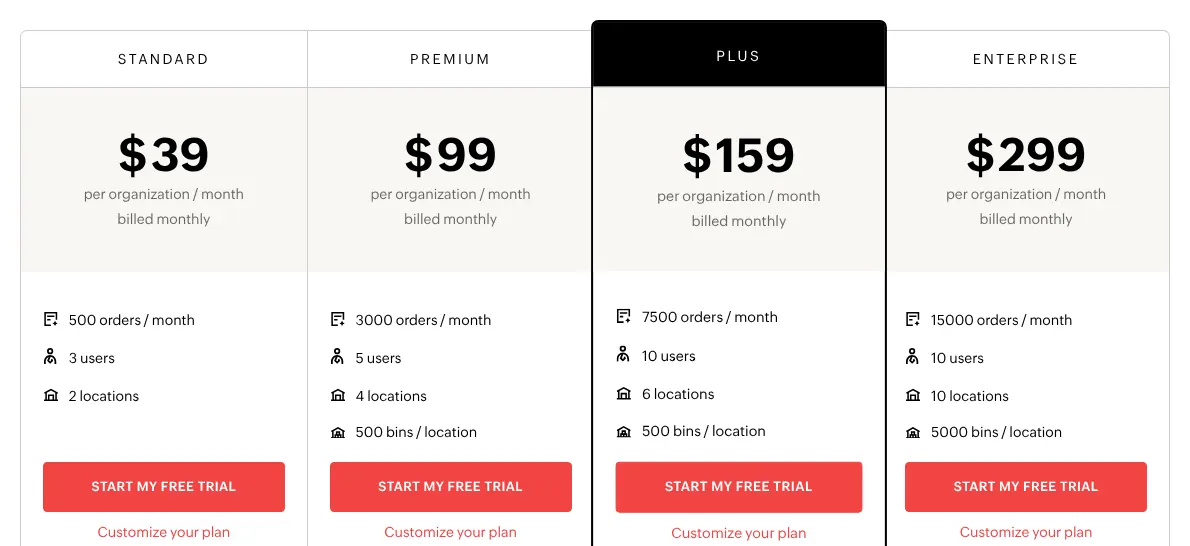
    Zoho Inventory plans on monthly billing: Standard at $39 and Premium at $99 per organization per month, Plus and Enterprise beside them, with orders, users and locations listed under each price.
    Standard shows $39 per organization on monthly billing, with 500 orders a month, 3 users and 2 locations; Premium at $99 raises each limit. Source: zoho.com, captured on 18 Nov 2026.
  3. 3. SOS Inventory

    SOS Inventory suits a QuickBooks Online business that sells on its own store rather than on marketplaces, and its barcodes start on the second plan.

    Score
    97/100
    Best for
    A business whose books are in QuickBooks Online
    From
    $74.95/mo
    Free plan
    No · 14-day trial

    SOS Inventory was built to work with QuickBooks Online, and it covers 20 of the 21 features. The missing one is marketplace sync: its list of connections names Shopify and BigCommerce but no Amazon, eBay, Etsy or Walmart. A seller on Amazon would need a separate connector.

    Companion, the first plan, costs $74.95 a month when billed monthly, with 2 users and one location. Yearly billing charges ten months for twelve. Companion has no barcodes, no serial or lot numbers and no pick tickets (the list a warehouse worker follows to gather an order). Those start on Plus, at $144.95 a month, which also opens unlimited locations. Job costing (the cost of each customer job) and advanced manufacturing are on Pro, at $199.95.

    The price of an extra user is not consistent on the page. The plan cards say $30 a month, and the questions further down say $25. A team of five on Companion pays $164.95 at the card price. Each extra connection to a store or file server costs $25 a month.

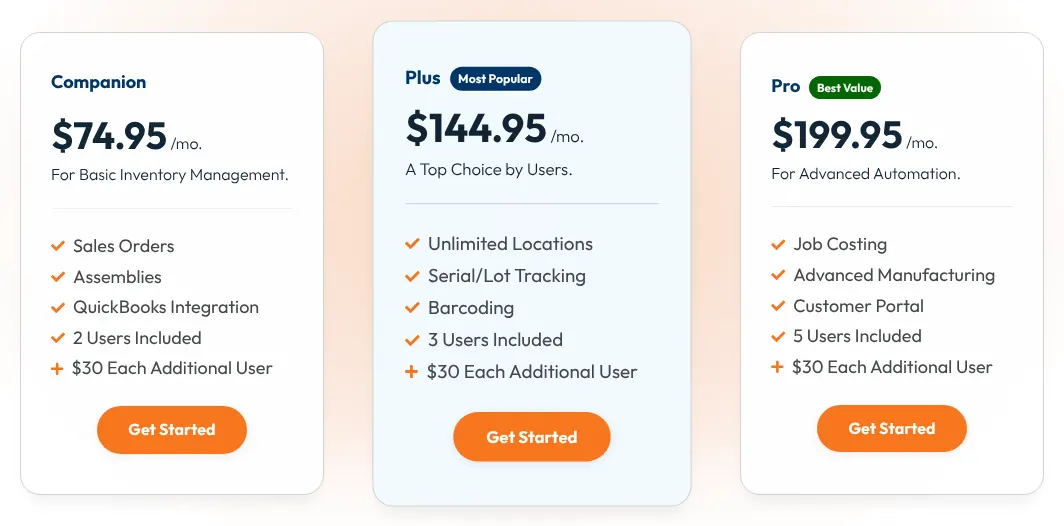
    SOS Inventory plans on monthly billing: Companion at $74.95, Plus in the middle and Pro at $199.95 a month, each with its included users and the price of an additional user.
    Companion shows $74.95 a month with 2 users; barcoding, serial and lot tracking and unlimited locations appear only from the Plus card. Source: sosinventory.com, captured on 18 Nov 2026.
  4. 4. inFlow Inventory

    inFlow Inventory suits a business that resells finished goods from one site, and its add-ons and setup fee raise the bill above the plan price.

    Score
    97/100
    Best for
    A wholesaler or shop that wants inventory and orders in one app
    From
    $129/mo
    Free plan
    No · 14-day trial

    inFlow Inventory covers 19 features in full and leaves two to a sister product. Kits and bills of materials (the list of parts that go into a finished product) are sold in inFlow Manufacturing, a separate product from $199 a month. A business that assembles what it sells pays for that product instead.

    Paid month by month, Lite costs $129; billed yearly, it falls to $99 a month. It includes 2 team members and one location. Each extra team member costs $29 a month and each extra location $39. Core, at $379, includes 5 team members and 5 locations.

    Several features are add-ons (options paid on top of the plan). Serial numbers and lot numbers cost $39 a month each until the Max plan. The API costs $49 a month on Lite and Core. Core, Pro and Max also require an onboarding package of $499, paid once. Products, sales and purchases are unlimited on every plan.

  5. 5. Fishbowl Inventory

    Fishbowl Inventory suits a QuickBooks or Xero business ready for a yearly commitment, and its first plan leaves out most selling features.

    Score
    97/100
    Best for
    A business that keeps its accounts in QuickBooks Online or Xero
    From
    $229/mo, billed annually
    Free plan
    No · demo only

    Fishbowl Inventory publishes yearly billing only. Essentials costs $229 a month, billed annually, with 2 users and sync to QuickBooks Online and Xero. An implementation package comes with every purchase, at a price the page does not show.

    Essentials is a narrow plan. It has no online store channel, no kits and no serial or lot tracking. Growth, at $429 a month billed annually, adds one store channel, picking and shipping, and lot and serial tracking, with 5 users. Demand planning is an add-on on Growth. Scale, at $729, includes it and adds lot traceability, which follows a lot back to its supplier and on to each customer.

    Bills of materials need Fishbowl Advanced Manufacturing, which the vendor calls a separate platform, from $675 a month billed annually. Stock is valued at average cost. The vendor's blog says the average changes only when new stock arrives, so a sale never changes the cost of the stock left.

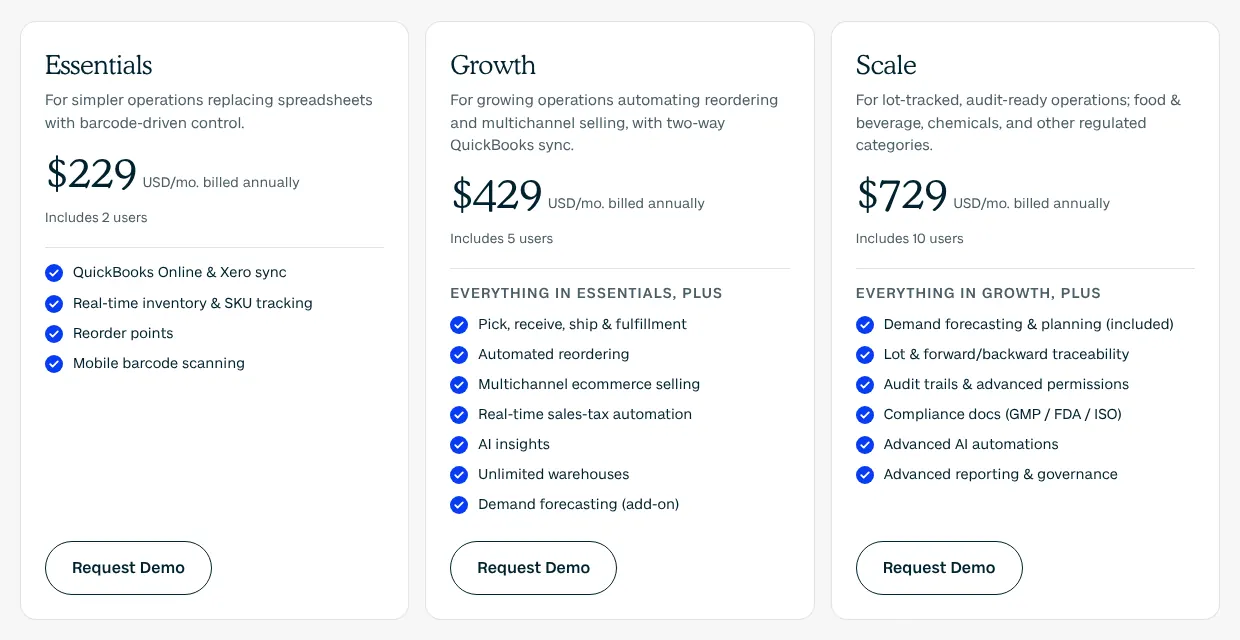
    Fishbowl Inventory plans billed annually: Essentials at $229 and Growth at $429 USD a month, Scale beside them, with included users and features under each.
    Essentials shows $229 a month billed annually with 2 users; online store selling and picking appear only from the Growth card. Source: fishbowlinventory.com, captured on 18 Nov 2026.
  6. 6. Finale Inventory

    Finale Inventory suits a multichannel seller ready to sign a contract of a year or more, at a starting price several times that of the cheapest plans here.

    Score
    97/100
    Best for
    An online seller with several channels and a busy warehouse
    From
    $499/mo
    Free plan
    No · demo on request

    Finale Inventory, which its site now calls Descartes Finale, covers 19 features and two more in part. Shipping labels are bought through ShipRush, another Descartes product with its own account. Dropshipping has no dedicated order, only a documented workaround.

    Essentials starts at $499 a month and Growth at $799. Growth adds the mobile barcode module, which is optional on Essentials at an unpublished price. Enterprise is quoted and adds the API. The page names no user count: users and integrations are hard limits set in each agreement. Orders above the agreed volume are billed as overage. Most customers sign for 12, 24 or 36 months.

    Stock value is computed by average cost only. The help centre says FIFO (first in, first out: the oldest stock is costed first) is not supported. A business whose accountant asks for FIFO should check this before signing.

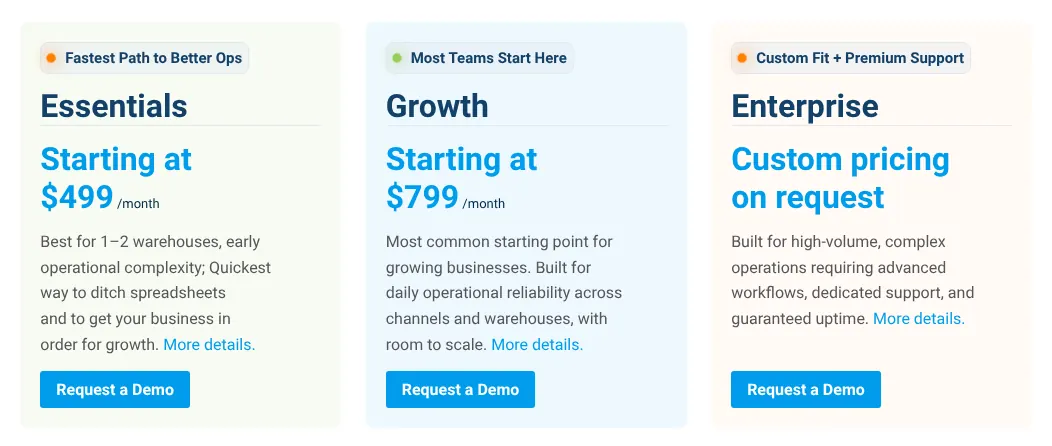
    Finale Inventory plans: Essentials starting at $499 a month, Growth starting at a higher monthly price and Enterprise at custom pricing on request.
    Essentials starts at $499 a month; every plan leads to a demo request, and Enterprise has no published price. Source: finaleinventory.com, captured on 18 Nov 2026.
  7. 7. Unleashed

    Unleashed suits a small business that needs batch tracking from day one, and its second plan costs four times its first once the offer ends.

    Score
    96/100
    Best for
    A business that buys, makes and sells, with batch and expiry tracking
    From
    $99/mo
    Free plan
    No · 14-day trial

    Unleashed tracks batches and expiry dates on every plan, which matters for food and other perishable goods. Three features come only in part. Label printing is a paid module sold in the UK only, and dropshipping is a workaround. The Amazon connector is a paid add-on (an option bought on top of the plan) at £30 a month.

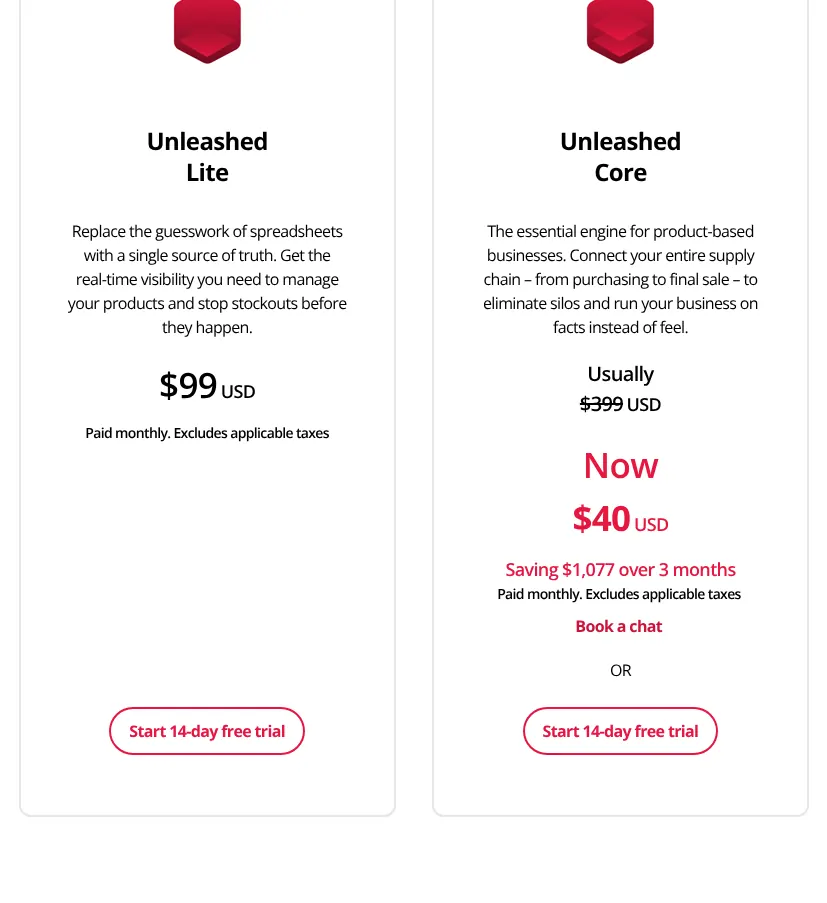
    Lite is priced at $99 USD per month, paid monthly, with 3 users. It handles 100 sales orders a month, and $70 a month raises that to 500. Lite has no multi-warehouse management, which starts on Core. Core costs $399 a month at the usual price. The US page shows an offer until 30 November 2026: 90% off the first three months on Core and Pro. The large $40 in red is that offer, and $399 applies afterwards.

    Each extra user costs $69 a month on Lite and Core. On Core, production costs $69 a month more, and forecasting and the warehouse app are paid modules too. Onboarding starts at a one-off $449.

    Unleashed plans: Lite at $99 USD paid monthly, and Core usually $399 USD, struck through, above a lower offer price in red.
    Lite shows $99 a month with no offer; on Core, the line to read is the usual price of $399, since the red figure covers only the first 3 months. Source: unleashedsoftware.com, captured on 18 Nov 2026.
  8. 8. Cin7 Core

    Cin7 Core suits a team of five or more that sells through two channels, and the price of its forecasting and API add-ons has to be asked.

    Score
    96/100
    Best for
    A team of five that sells wholesale and online
    From
    $349/mo
    Free plan
    No · 14-day trial

    Cin7 Core includes 5 users in its first plan, where Zoho Inventory and Unleashed include 3. Three features cost extra or depend on another service. Forecasting and the API are add-ons on every plan, at prices the page does not publish. Shipping labels come through a connected service such as ShipStation, which uses one of the plan's integrations.

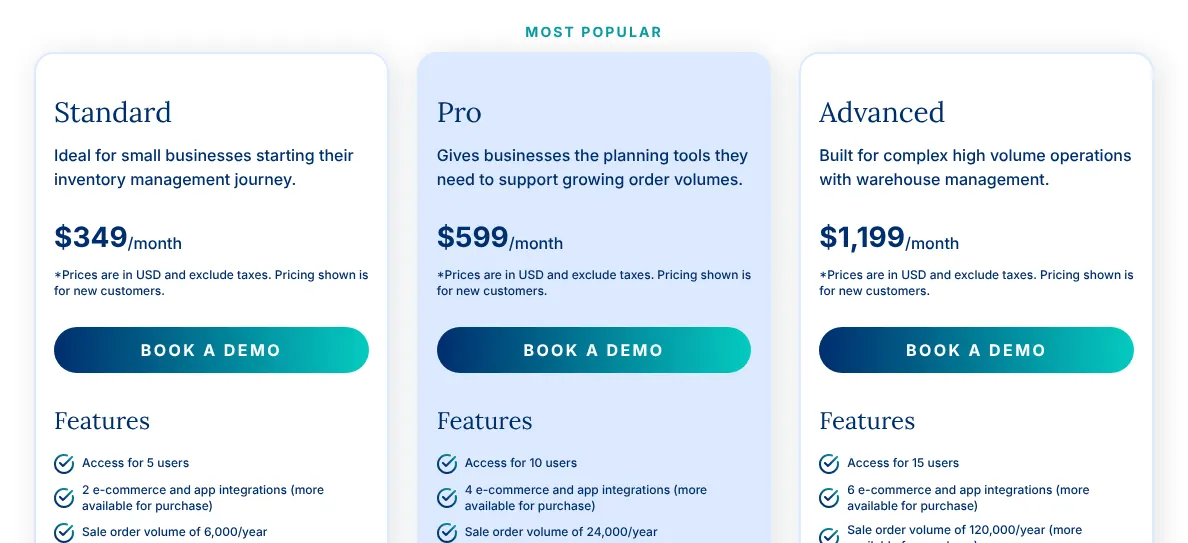
    Standard costs $349 a month. It allows 6,000 sale orders a year, unlimited locations and 2 integrations (connections to a store, a marketplace or another app). The pricing page shows one price without saying how it is billed. The help centre says billing can be monthly or annual. Pro costs $599 for 10 users and 24,000 orders a year.

    For one person, Standard costs more than most first plans here. For five people, the price stays at $349 with no extra user to buy. Cin7 also sells Cin7 Omni, a larger product priced on quote.

    Cin7 Core plans: Standard at $349 a month, Pro in the middle and Advanced at $1,199 a month, with users, integrations and yearly order volume under each.
    Standard shows $349 a month with access for 5 users, 2 integrations and 6,000 sale orders a year. Source: cin7.com, captured on 18 Nov 2026.
  9. 9. MRPeasy

    MRPeasy suits a manufacturer that needs production planning first, and the warehouse features most sellers want start on its third plan.

    Score
    95/100
    Best for
    A small manufacturer that plans production
    From
    $49/user/mo
    Free plan
    No · 15 + 15-day trial

    MRPeasy is production planning software for manufacturers of up to 200 employees, with inventory built in. Dropshipping is absent from its feature list. Shipping labels go through ShipStation and Amazon orders through Zapier (a service that links apps), so both count in part.

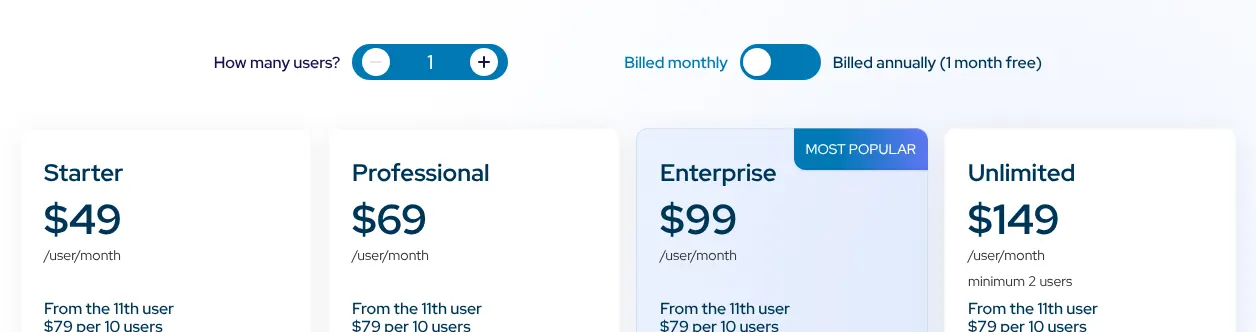
    Starter is $49 per user per month, and paying for a year upfront gives one month free. The plan gates matter more than the price. Several warehouses, barcodes, packing and sales forecasting start on Enterprise, at $99 per user. The API is only on Unlimited, at $149 per user with two users at least. Starter also stops at 1,000 products, counted as SKUs (stock keeping units, one per product variant).

    A team of five on Enterprise pays $495 a month. From the 11th user, each block of ten more users costs $79 a month.

    MRPeasy plans with the Billed monthly switch on: Starter at $49 and Professional at $69 per user per month, Enterprise and Unlimited beside them.
    Billed monthly is selected: Starter shows $49 and Professional $69, each per user per month. Source: mrpeasy.com, captured on 18 Nov 2026.
  10. 10. Linnworks

    Linnworks suits a high-volume marketplace seller ready to negotiate a contract, and its cost stays unknown until the vendor quotes it.

    Score
    95/100
    Best for
    A seller with many marketplaces and high order volume
    From
    On quote
    Free plan
    No · demo on request

    Linnworks publishes no price at all: its pricing page asks visitors to speak to a specialist. It is built for online sellers who list on many marketplaces. Pricing is tiered on monthly orders, and orders above the agreed volume cost extra. Add-on modules and a contract come on top, and the vendor recommends a paid onboarding, charged once.

    Forecasting, the QuickBooks Online link and assembly each come with a limit. Forecasting is a paid add-on. QuickBooks Online connects only through an app in open beta that sends data one way. Assembly needs a separate Product Assembly app. Serial numbers live in SkuVault Core, another product sold only in North America.

    Without a price, Linnworks cannot be compared on cost with the other nine. A business that wants it gets a figure only after a call.

Summary table

The table puts the ten tools side by side. Each price is that of the first paid plan, per month, at the usual price. The last column says how many people that plan includes.

The 10 inventory tools side by side: score, entry price per month, billing, free plan and the users of the entry plan
ToolScoreEntry price per monthBilling of that priceFree planUsers on the entry plan
01Odoo Inventory100$38.90 per userMonthly, after a first-year discountYes · Inventory app alonePer user
02Zoho Inventory99$39MonthlyYes · 50 orders3 users, $9 per extra user
03SOS Inventory97$74.95MonthlyNo · 14-day trial2 users, $30 per extra user
04inFlow Inventory97$129MonthlyNo · 14-day trial2 team members, $29 per extra
05Fishbowl Inventory97$229Annual onlyNo · demo2 users
06Finale Inventory97From $499Contract, usually 12 to 36 monthsNoSet in the agreement
07Unleashed96$99MonthlyNo · 14-day trial3 users, $69 per extra user
08Cin7 Core96$349Not stated on the pageNo · 14-day trial5 users
09MRPeasy95$49 per userMonthlyNo · 15 + 15-day trialPer user
10Linnworks95On quoteContractNoNot published

Prices in USD, read on vendor pages on 18 November 2026, before taxes. SOS Inventory: the plan cards say $30 per extra user and the FAQ of the same page says $25. Cin7 Core: the help centre says billing is monthly or annual; the page does not say which one the $349 needs.

What inventory management software costs for your team

For one person, the ten range from $38.90 a month on Odoo to $499 on Finale, with Linnworks on quote. Five people reorder the list. Zoho Inventory stays at $57 because users are cheap to add. Cin7 Core stays at $349 because five users are included. Odoo and MRPeasy multiply by five. Taxes, setup fees and add-ons are left out.

Monthly price for one person and for five people, at the usual price
ToolPlan for 1 person1 person, per monthPlan for 5 people5 people, per month
01Odoo InventoryStandard$38.90Standard × 5 users$194.50
02Zoho InventoryStandard$39Standard + 2 users$57
03SOS InventoryCompanion$74.95Companion + 3 users$164.95
04inFlow InventoryLite$129Lite + 3 team members$216
05Fishbowl InventoryEssentials, billed annually$229Growth (5 users), billed annually$429
06Finale InventoryEssentialsFrom $499EssentialsUsers not published
07UnleashedLite$99Lite + 2 users$237
08Cin7 CoreStandard$349Standard (5 users)$349
09MRPeasyStarter$49Starter × 5 users$245
10LinnworksOn quote—On quote—

Monthly billing except Fishbowl, which bills yearly only, and Finale, whose users and orders are set in each contract. MRPeasy Starter has one warehouse and no barcodes; the same five people on Enterprise pay $495. SOS Inventory at $30 per extra user, the plan card price.

How we rank

  1. The ten tools are ranked by a category score out of 100. The score measures how many of 21 features expected of inventory management software each vendor documents on its own site. It does not measure ease of use, reliability or support.Tracking stock 39% · 6 featuresBuying and making 16% · 4 featuresSelling and shipping 13% · 4 featuresConnections 16% · 4 featuresCosts and team 16% · 3 features
  2. The 21 features form a grid in five groups: tracking stock, buying and making, selling and shipping, connections, costs and team. Four define the category and weigh 3: real-time stock levels, several warehouses or locations, barcode scanning and purchase orders. Nine weigh 2, including sales orders, online store sync and a phone app. Eight weigh 1, including dropshipping, demand forecasting and a public API. A tool receives 1 for a feature documented as built in, on at least one plan. It receives 0.5 for a partial feature: a stated limit, a paid add-on, a separate product of the same vendor, or an outside app the vendor documents. A feature that is absent, or that could not be found on the vendor's site, counts 0. The score is the weighted sum divided by the total weight, 38, rounded to the nearest whole number.
  3. At equal scores, the lower entry price ranks first. Four tools share 97: SOS Inventory at $74.95, then inFlow Inventory at $129. Fishbowl Inventory follows at $229, billed annually, and Finale Inventory at $499. Unleashed ($99) ranks ahead of Cin7 Core ($349) at 96. MRPeasy ($49 per user) ranks ahead of Linnworks at 95, because Linnworks publishes no price. Sixteen tools were scored. Ordoro (91), Katana (91), Veeqo (89), Stocksmith, formerly Craftybase (76), Sortly (72) and BoxHero (68) score below the ten.
  4. The Odoo and inFlow pricing pages refuse the browser used by this site, so they carry no image; their prices were read in the page text. Linnworks publishes no price to show. All prices, limits and features were read on vendor pages on 18 November 2026.
  5. No entry on this page is sponsored. A sponsored entry is marked Sponsored and holds the position paid for; its score stays the computed one.

FAQ

Is there free inventory management software?

Yes, with limits. Odoo gives its Inventory app alone for free to unlimited users, but without purchases, sales or barcodes. Zoho Inventory has a free plan for 50 orders and one user. Outside the ten, Sortly is free for 100 items, BoxHero for 100 items and one member, and Katana for 30 SKUs. Pick a free plan only if your product count fits under its cap for the next year.

Why are Katana, Veeqo and Sortly not in the ten?

They score lower on the 21 features. Katana scores 91: its warehouse app runs in a browser, not as a phone app, and its paid plan is a custom annual contract. Veeqo scores 89: it has no dropshipping and no bills of materials, though its inventory plan starts at $19 a month for 300 orders. Sortly scores 72: it is built to track items and assets, with no store sync and no sales orders. Consider Veeqo if you mainly ship Amazon orders.

Which tool fits a business that makes its own products?

Look at MRPeasy, Odoo and Unleashed. MRPeasy is built for production planning, from $49 per user. Odoo includes manufacturing in its Standard plan. Unleashed adds production for $69 a month on Core and includes it on Pro. inFlow and Fishbowl sell manufacturing as separate products. If you assemble kits from a few parts, a bundle feature (one product sold as a set of several items) may be enough.

Do I still need inventory software if I use QuickBooks Online?

QuickBooks Online keeps the books; these tools track where each unit is and what to reorder. SOS Inventory was built to work with it, and Fishbowl syncs with it from its first plan. Zoho Inventory and Cin7 Core connect to it too. If you hold stock in one place with a few dozen products, test whether QuickBooks alone is enough before you add a second subscription.

Can these tools sync stock with Shopify and Amazon?

All ten sync with an online store, but not all on the entry plan. Cin7 Core Standard includes 2 integrations, and Fishbowl Essentials includes no store channel. For Amazon, SOS Inventory names no connector and MRPeasy goes through Zapier. List your sales channels and check each one on the plan you price.