top10alternative

Top 10 Shopify Alternatives (2026)

The closest alternative to Shopify is Wix. It does 22 of the 23 Shopify features compared here in full, and the last one in part. Ecwid and Lightspeed eCom score the same and come next. Ecwid starts at $5 a month, against $39 for Shopify Basic.

Short answer · top 3 of 10

See all 10 ↓
  1. WixClosest match
    99%From $29/mo, billed yearlyMigration Medium
    Visit
  2. EcwidCheapest
    99%From $5/moMigration Medium
    Visit
  3. 99%From $89/mo, billed yearlyMigration Medium
    Visit

Ranked by similarity to Shopify on 23 Shopify features. Prices in USD, billed monthly unless stated.

Shopify in three lines

What it is
A hosted commerce platform: Shopify runs the online store, takes card payments and links the same catalogue to social channels and a shop till. Every plan sells unlimited products.
Price
Basic costs $39 a month billed monthly, or $29 a month billed yearly. Grow costs $105 and Advanced $399. Online card payments cost 2.9% + 30¢ each on Basic.
Used for
Selling physical and digital products online, in person and on social media, with apps from the Shopify App Store for anything the store does not do on its own.

Why teams look for a Shopify alternative

Four costs explain most searches for a Shopify alternative. Each one is written on Shopify's own pricing page, and each has tools on this page that avoid it.

$39 a month before the first sale

Basic costs $39 billed monthly, or $29 billed yearly. A new store pays that whether it sells or not. Square Online has a free plan that charges only a fee on each online payment. Big Cartel starts at $15 a month, and Ecwid at $5 for up to 10 products.

A 2% fee on outside payment providers

Shopify adds 2% to each Basic order paid through a provider other than Shopify Payments. A store that keeps PayPal or another processor pays that on top of the card fee. Ecwid, Big Cartel and WooCommerce charge no fee of their own on payments.

No staff logins on Basic

Basic lists no additional staff accounts: Grow, at $105, adds five. A store with a helper or a bookkeeper moves up a plan to give them a login. Wix Core includes 5 collaborators, and Squarespace Core allows unlimited contributors.

Selling in a shop costs extra

Shopify POS Pro, the version for a physical shop, costs $89 a month per location on top of the plan. Square Online comes from Square, a maker of shop tills, and its free plan already takes in-person payments. Lightspeed eCom is bundled with the Lightspeed till.

How to choose a Shopify alternative

Five checks bring the ten tools down to two or three. They come in the order that rules out the most tools first.

1. Decide who looks after the hosting

Start here, because it splits the list in two. WooCommerce and the free edition of Shopware run on a server you rent and maintain. WooCommerce puts that hosting at $25 to $350 a month. The eight other tools host the store for you, as Shopify does.

2. Count your products

Product limits rule out the cheap plans fast. Ecwid Starter holds 10 products and Big Cartel Platinum 50. Volusion Personal holds 100. Shopify, Squarespace, BigCommerce and WooCommerce have no product limit.

3. Check your yearly sales against the plan limits

Two tools cap sales on their entry plan. BigCommerce Core covers $30K over the last 12 months, then moves you to Growth at $105. Volusion Personal stops at $50K a year. A store selling $3,000 a month already passes the BigCommerce limit.

4. Price your payments, not just the plan

On a small store, card fees cost more than the plan. Wix, Squarespace and Square Plus charge 2.9% + 30¢ online, like Shopify Basic, and Stripe charges the same on Big Cartel. Square Free charges 3.3% + 30¢, and Squarespace Basic adds 2% on each sale. The cost table below works out one month at $2,000 of sales.

5. Check what moves from Shopify

Only BigCommerce documents a free tool that copies customers and orders as well as products. Squarespace and Big Cartel import Shopify's product file directly. Wix moves orders through Cart2Cart, a paid outside app. Elsewhere, you rework a CSV file or rebuild products by hand.

Which Shopify alternative for which situation

  • You want the store that resembles Shopify the mostWix · 22 of 23 features, Core $29 a month billed yearly
  • You sell a handful of products on a tight budgetEcwid · Starter $5 a month for 10 products
  • You run a physical shop with a tillLightspeed eCom · One stock count for till and website
  • The look of your site matters as much as the shopSquarespace · Shopify move guide, Core $39 a month
  • You want to start selling with no monthly feeSquare Online · Free plan, 3.3% + 30¢ per online payment
  • You want to keep your customers and order historyBigCommerce · Free migration app, same $39 price
  • You already run a WordPress websiteWooCommerce · Free software, hosting extra
  • You sell recurring products in the US, in one languageVolusion · Built-in recurring prices and gift cards
  • You run a large store in Germany or AustriaShopware · Open source, Rise from €600 a month
  • You are an artist or maker selling a few dozen itemsBig Cartel · Platinum $15 a month for 50 products

The 10 alternatives

by similarity to Shopify
What can you not lose?Tick the Shopify functions you need. The tools where a ticked function was not found fade, with the reason.
Building the store
Checkout and payments
Orders and shipping
Marketing and channels
Running the store

The ranks do not change: they measure how much of Shopify each tool replaces.

  1. Only partly: Automatic sales tax

    1. Wix

    Closest match
    Similarity to Shopify
    99%
    Starting price
    $29/mo, billed yearly−$10/mo · cheaper, billed yearly
    Migration effort
    MediumWix moves products, orders and coupons from Shopify through Cart2Cart, an outside app that charges for the move. Its free route imports products only, from a CSV file (a plain spreadsheet export).

    Same as Shopify

    • A store builder with themes, a blog and products with up to 1,000 variants each
    • Gift cards, product subscriptions and a store in more than one language, with Wix's own apps
    • Discount codes, abandoned cart emails, a point of sale and selling on social channels
    • Card payments through Wix Payments at 2.9% + $0.30 in the US, the same rate as Shopify Basic

    What you lose

    • Automatic sales tax on the entry plan: it starts on Business, through Avalara, an outside tax service, capped at 100 taxed sales a month
    • Monthly billing on the price list: the pricing page shows yearly prices only
    • A free plan that sells: the $0 plan and the $17 Light plan cannot take payments

    Switching from Shopify to Wix

    Wix is a website builder with a full store inside it. It does 22 of the 23 Shopify features compared here, and the last one in part. Its gift cards, subscriptions and multilingual store are made by Wix, not by outside apps.

    The plan to compare with Shopify Basic is Core, at $29 a month on yearly billing. It is the first Wix plan that accepts payments. Core includes 5 site collaborators, where Shopify Basic lists no extra staff account.

    Wix's pricing page lists yearly prices only, paid in full at purchase. A monthly option appears at checkout, without a published price. Automatic tax starts one plan up, on Business at $39 a month billed yearly.

    Choose it if
    You want the store and a full website in one builder, with gift cards and subscriptions without extra apps.
    Skip it if
    You want to pay month by month at a published price, or you need automatic sales tax on the cheapest store plan.
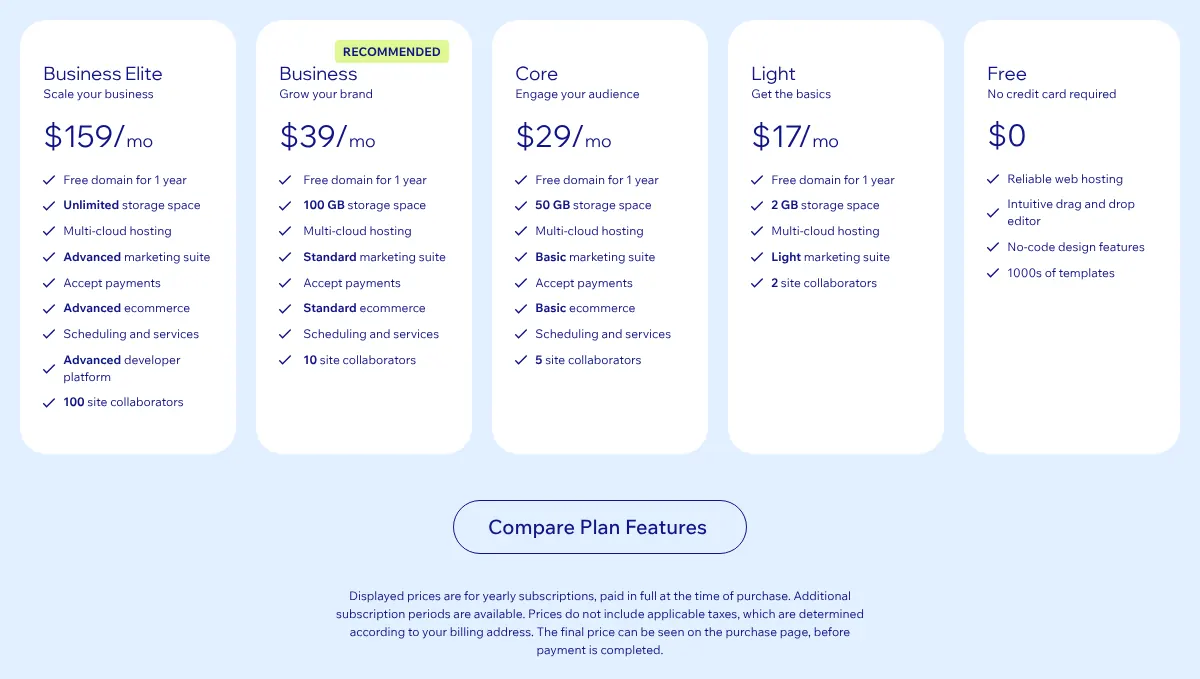
    Wix plan cards with yearly prices: Business Elite $159, Business $39, Core $29 and Light $17 a month, and a Free plan at $0, above a note on yearly subscriptions.
    Core at $29 a month is the first plan marked Accept payments; the note under the cards says the prices are for yearly subscriptions. Source: wix.com, captured on 20 Nov 2026.

    Verdict: Wix keeps almost everything a Shopify store uses, but its $29 Core price is for a year paid upfront, the same as Shopify Basic billed yearly.

  2. Only partly: Checkout in several currencies

    2. Ecwid

    Cheapest
    Similarity to Shopify
    99%
    Starting price
    $5/mo−$34/mo · cheaper
    Migration effort
    MediumEcwid documents moving products and customer data by CSV import, or with an app that uses its API (a link through which two programs exchange data). No Shopify importer is described on ecwid.com.

    Same as Shopify

    • Themes, products with variants, a blog and a store on its own Instant Site or on any website
    • Gift cards from Venture, plus subscriptions and a store in several languages from Business
    • Abandoned cart recovery, staff accounts and a point of sale, on the higher plans
    • No transaction fee on any plan, whichever payment provider the store uses

    What you lose

    • Payment in the shopper's currency: converted prices come from an outside app and are for display only
    • Room on the entry plan: Starter holds up to 10 products
    • Most features at the $5 price: coupons and automatic tax start on Venture, at $35 a month

    Switching from Shopify to Ecwid

    Ecwid is the cheapest way off Shopify on this list. Starter costs $5 a month and holds up to 10 products. Ecwid can add a store to a website that already exists, or build a new one on Instant Site, its own website builder.

    Of the 23 Shopify features compared here, Ecwid has 22 in full. The gap is currency: Ecwid shows converted prices through an outside app, but shoppers still pay in the store's own currency.

    The plans climb quickly. Venture costs $35 a month billed monthly and allows 100 products. Business, at $65, adds 2,500 products, subscriptions, a multilingual store, abandoned cart recovery and 2 staff accounts. Ecwid's site is signed Ecwid by Lightspeed: the same company makes Lightspeed eCom, third on this list.

    Choose it if
    You sell a short range of products and want the lowest monthly price, with no fee on each sale.
    Skip it if
    Your shoppers abroad expect to pay in their own currency, or you need more than 100 products on a small budget.
    Ecwid plan cards on monthly billing: Starter $5, Venture $35, Business $65 and Unlimited $149 a month, each with its product limit and the features it adds.
    Starter lists up to 10 products; Business adds subscriptions, a multi-lingual store and abandoned carts recovery. Source: ecwid.com, captured on 20 Nov 2026.

    Verdict: Ecwid matches nearly all of Shopify for a fraction of the price at small sizes, but costs more than Shopify Basic once a store needs Business, at $65 a month.

  3. Only partly: Checkout in several currencies

    3. Lightspeed eCom

    Similarity to Shopify
    99%
    Starting price
    $89/mo, billed yearly+$50/mo · dearer, billed yearly
    Migration effort
    MediumLightspeed documents a product import from a CSV file built on its own template. No move from Shopify is described on the pages read; customers and orders are not covered.

    Same as Shopify

    • One catalogue and one stock count for the shop till and the website
    • Gift cards that work in the shop and online, subscriptions and a store in several languages
    • Discount codes, abandoned cart emails, automatic tax and staff accounts
    • No Lightspeed fee on payments through outside providers

    What you lose

    • A store sold on its own in the US: eCom comes with a Lightspeed Retail till plan
    • The full store on the entry plan: Basic includes a limited version, without abandoned cart emails or coupons
    • Payment in the shopper's currency: converted prices come from apps and are for display only

    Switching from Shopify to Lightspeed eCom

    Lightspeed eCom is the online store of Lightspeed, a Montreal company that makes tills for shops. Its North American version, eCom E-Series, is the former Ecwid, which explains why it has the same 22 Shopify features in full as Ecwid.

    The difference is how it is sold. In the US, eCom comes inside a Lightspeed Retail till plan. Basic lists $89 a month on yearly billing and includes a limited store. Core, at $149, includes the full store.

    The pricing page opens on yearly billing, which saves up to 18%, so monthly billing costs more. For a business that sells only online, that means paying for a till it does not use.

    Choose it if
    You run a physical shop and want the till and the website to share one stock count.
    Skip it if
    You only sell online: Ecwid gives the same store features without a till plan.
    Lightspeed Retail plans on yearly billing: Basic 89 USD, Core 149 USD and Plus 289 USD a month, with Built-in Lightspeed eCommerce marked Basic on the Basic plan.
    The Annually tab is selected; the Built-in Lightspeed eCommerce row shows Basic on the Basic plan and a tick on Core and Plus. Source: lightspeedhq.com, captured on 20 Nov 2026.

    Verdict: Lightspeed eCom suits a shop with a till that also sells online, not a store that only sells on the web.

  4. Only partly: Email campaignsStorefront in several languages

    4. Squarespace

    Similarity to Shopify
    98%
    Starting price
    $25/mo−$14/mo · cheaper
    Migration effort
    LowSquarespace has a guide for leaving Shopify: products and contacts move by CSV file. Layout, design and fonts do not move, and orders are not mentioned.

    Same as Shopify

    • Designer templates, unlimited products and a built-in blog
    • Gift cards and subscription products, sold through Squarespace Payments or Stripe
    • Abandoned cart emails on every plan, and automatic tax and carrier shipping from Core
    • A point of sale, selling on social channels and staff logins

    What you lose

    • Email campaigns in the plan: Email Campaigns is a separate paid subscription
    • A store in several languages without an outside service: it goes through Weglot, free for one extra language and 2,000 words
    • Selling tools on Basic: discounts, automatic tax and carrier shipping start on Core

    Switching from Shopify to Squarespace

    Squarespace is a website builder known for its templates, with a store built in. Squarespace covers 21 of the 23 Shopify features in full and two in part.

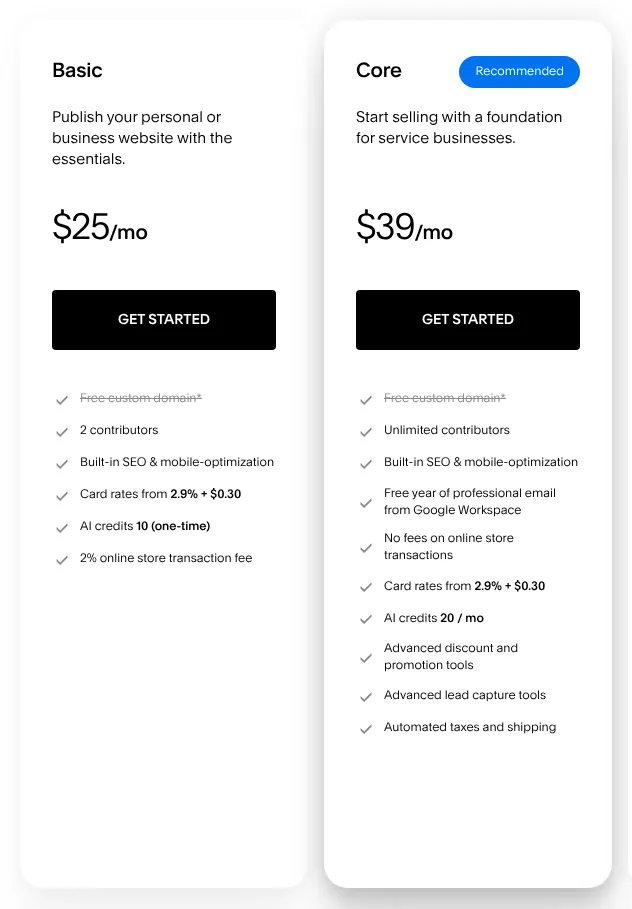
    Basic costs $25 a month billed monthly, $14 less than Shopify Basic. It also takes a 2% fee on each store sale. On $2,000 of monthly sales, that fee adds $40.

    Core, at $39 billed monthly, drops the fee and adds discounts, automatic tax and carrier shipping. It costs the same as Shopify Basic. Core also allows unlimited contributors, where Basic allows 2.

    Choose it if
    Your store sells a small range and the look of the site matters as much as the shop.
    Skip it if
    You rely on discount codes and automatic tax but want to stay on the cheapest plan.
    Squarespace Basic and Core plan cards on monthly billing: Basic at $25 a month with a 2% online store transaction fee, Core at $39 a month with no fees on online store transactions.
    Basic costs $25 a month and lists a 2% online store transaction fee; Core, at $39, lists no fees on online store transactions. Source: squarespace.com, captured on 20 Nov 2026.

    Verdict: Squarespace keeps nearly all of Shopify and is the easier move for a small catalogue, as long as the store pays for Core.

  5. Not found on Square Online's site: Checkout in several currenciesOnly partly: Digital downloadsStorefront in several languages

    5. Square Online

    Similarity to Shopify
    95%
    Starting price
    $49/mo+$10/mo · dearer
    Migration effort
    MediumSquare documents an item import from a spreadsheet or CSV file, so a Shopify product export can be reworked into Square's format. No move of customers or orders from Shopify is described.

    Same as Shopify

    • A free plan that sells online, with pickup, local delivery and shipping
    • Gift cards, subscriptions, discount codes and stock tracking
    • In-person payments with Square's tills, on the same catalogue as the website
    • Abandoned cart emails and a custom domain, from the Plus plan

    What you lose

    • Payment in several currencies: no such option appears in the Square Online plans
    • Automatic delivery of digital files: the seller sends each file to the buyer by hand
    • Gift cards on the store's own domain: Square says its eGift cards do not work with custom domains

    Switching from Shopify to Square Online

    Square Online is the store that comes with Square, a payments company known for its card readers. Twenty Shopify features are there in full, and two more in part.

    Its free plan has no monthly fee. Square takes 3.3% + 30¢ on each online card payment. Plus lowers that to 2.9% + 30¢. A store selling $2,000 a month in 40 orders pays $78 in fees on the free plan. The same month costs $109 on Shopify Basic.

    The free plan has limits that matter: no connection of a custom domain (a web address the store owns, such as yourshop.com) and no abandoned cart emails. Both start on Plus at $49 a month. Cards issued outside the US cost 1.5% more.

    Choose it if
    You sell in a shop or at markets as well as online, and want one company for the till, the website and the payments.
    Skip it if
    You sell digital files or ship to shoppers who pay in other currencies.

    Verdict: Square Online is the cheapest way to sell both in person and online, but it gives up multi-currency checkout and automatic file delivery.

  6. Only partly: Automatic sales taxSubscription productsIn-person sales (point of sale)Email campaigns

    6. BigCommerce

    Easiest to switch to
    Similarity to Shopify
    94%
    Starting price
    $39/mo= $0/mo · same price
    Migration effort
    LowBigCommerce's free Data Migration app brings products, customers and orders from Shopify, up to 500,000 records in all. Customer passwords do not move.

    Same as Shopify

    • Unlimited products, themes and a built-in blog
    • Gift certificates and a storefront in several languages, built in
    • Discount codes, stock tracking, carrier shipping and selling on social channels
    • No platform fee with its embedded payment providers

    What you lose

    • Built-in subscriptions, email campaigns and a point of sale: each needs an outside app
    • Automatic tax lookup without an outside tax service
    • Room to grow on Core: above $30K of sales over 12 months, the store moves to Growth at $105

    Switching from Shopify to BigCommerce

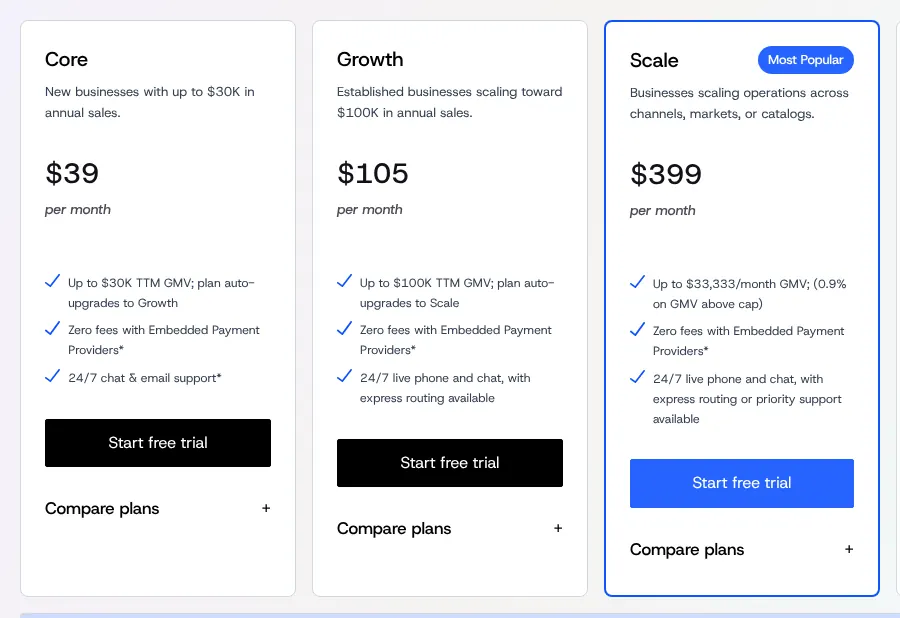
    BigCommerce costs the same as Shopify: Core is $39 a month billed monthly, or $29 billed yearly. Nineteen Shopify features are built in, and four more come with limits or through apps.

    It is the only tool on this list with a free app that copies a Shopify store's customers and orders as well as its products. That makes it the move with the least retyping.

    The catch is the sales limit. Core covers up to $30K of sales over the last 12 months. Above that, BigCommerce moves the store to Growth at $105. Abandoned cart emails also start on Growth. Payments through an outside provider cost an extra 2% on Core.

    Choose it if
    You want to keep your order history and customer list, and you sell less than $30K a year or plan to pay for Growth.
    Skip it if
    You sell subscriptions or in a physical shop, and do not want to add outside apps for them.
    BigCommerce Core, Growth and Scale plan cards billed monthly: Core $39, Growth $105 and Scale $399 per month, with the sales limit of each plan.
    Core costs $39 per month for up to $30K in yearly sales and moves up to Growth, at $105, above that. Source: bigcommerce.com, captured on 20 Nov 2026.

    Verdict: BigCommerce is the easiest place to move a whole Shopify store, at the same price, as long as yearly sales stay under its Core limit.

  7. Only partly: Gift cardsSubscription productsSEO settingsStorefront in several languages

    7. WooCommerce

    Open source
    Similarity to Shopify
    94%
    Starting price
    Free−$39/mo · cheaper, before hosting
    Migration effort
    HighWooCommerce has a built-in CSV importer for products. The store must first be set up on WordPress and on hosting bought elsewhere; customers and orders need extra tools.

    Same as Shopify

    • Unlimited products, themes, a blog and a point of sale
    • Discount codes, abandoned cart emails, automatic tax and checkout in several currencies
    • An extension marketplace, and no WooCommerce fee on payments
    • Full control of the store's code and data, since the software runs on the store's own server

    What you lose

    • Gift cards and subscriptions without a paid extension: they cost $79 and $279 a year
    • A store in several languages without an outside extension
    • Hosting and upkeep handled for the store: WooCommerce puts hosting at $25 to $350 a month

    Switching from Shopify to WooCommerce

    WooCommerce is open source software (its code is public and free to use) that turns a WordPress website into a store. The free core covers 19 Shopify features; four more need paid or outside extensions.

    The software is free, but the store needs hosting (a rented server that keeps the site online). WooCommerce itself puts that at $25 to $350 a month for most stores. Extensions cost $29 to $299 a year each.

    Shopify includes hosting, updates and security in its price. On WooCommerce, the store owner or a developer handles them.

    Choose it if
    You already run a WordPress site, or you want to own the code and choose every piece of the store.
    Skip it if
    Nobody on your team wants to look after hosting, updates and backups.
    WooCommerce pricing summary: core platform free with no monthly subscription, hosting $25 to $350 a month for most stores, extensions $29 to $299 a year each, payments at the processor's fees.
    The core platform is free; hosting is listed at $25 – $350/month and extensions at $29 – $299/year each. Source: woocommerce.com, captured on 20 Nov 2026.

    Verdict: WooCommerce is the free, open source route off Shopify, paid for in hosting, extensions and upkeep.

  8. Not found on Volusion's site: Storefront in several languagesMobile admin appOnly partly: Abandoned cart emailsAutomatic sales taxCheckout in several currencies

    8. Volusion

    Similarity to Shopify
    90%
    Starting price
    $35/mo−$4/mo · cheaper
    Migration effort
    MediumVolusion imports products from CSV files, one table at a time. Its pricing table marks import and export as starting on Professional, at $79 a month.

    Same as Shopify

    • Themes, products with variants, a blog and stock tracking
    • Gift cards and recurring prices on products, built in
    • Discount codes, shipping rates and selling on social channels
    • Staff accounts, sales reports and an app marketplace

    What you lose

    • A store in several languages: Volusion's help says parts of the platform are hard-coded in English
    • A mobile app to run the store: none was found on Volusion's site
    • Automatic abandoned cart emails: reminders go out by hand, cart by cart

    Switching from Shopify to Volusion

    Volusion is a hosted store builder from Austin, Texas, founded in 1999. Volusion offers 18 of the Shopify features compared here, plus three in part.

    Personal costs $35 a month, $4 less than Shopify Basic. It is capped at 100 products, $50K of yearly sales and 1 staff account. Professional costs $79 and raises the limits to 5,000 products and $100k of sales.

    Import and export of data, product reviews and abandoned cart reports also start on Professional. A store that pays through a gateway other than Volusion Payments or PayPal pays a 2% fee on Personal.

    Choose it if
    You sell in one language, mainly in the US, and want gift cards and recurring prices without extra apps.
    Skip it if
    You sell to shoppers in other languages, or you run the store from your phone.
    Volusion plan headers: Personal $35 a month, Professional $79 a month, Business $299 a month with an asterisk, and Prime based on GMV with a Contact Sales button.
    Personal costs $35 a month; under the cards, the page explains that the asterisk on Business means a price paid yearly, and Prime is priced on sales volume. Source: volusion.com, captured on 20 Nov 2026.

    Verdict: Volusion is slightly cheaper than Shopify on paper, but the useful tools, import included, start on its $79 plan.

  9. Only partly: Built-in blogAbandoned cart emailsAutomatic sales taxGift cardsIn-person sales (point of sale)Email campaignsMobile admin app

    9. Shopware

    Open source
    Similarity to Shopify
    89%
    Starting price
    From €600/mo± Not comparable · priced in euros
    Migration effort
    HighShopware's free Migration Assistant covers Shopware 5, Shopware 6 and Magento, not Shopify. Products, customers and orders can be imported from CSV files.

    Same as Shopify

    • A storefront in several languages and currencies, with themes and a page builder
    • Products with variants, stock tracking, discount codes and staff accounts
    • Subscriptions, on the Beyond plan
    • An open source edition that the store can host and change itself

    What you lose

    • A blog, abandoned cart emails and email campaigns without outside extensions
    • A Shopware till and a Shopware mobile app: both come from other companies' extensions
    • A published price for the hosted plans: Rise starts at €600 a month and depends on sales volume

    Switching from Shopify to Shopware

    Shopware is a German open source commerce platform, based in Schöppingen. Shopware has 16 Shopify features in its core, and seven more mostly through other companies' extensions.

    It comes in two forms. The Community Edition is free and self-hosted (installed on a server the store rents and runs). Hosting, setup and maintenance are then the merchant's job.

    The paid plans start with Rise, from €600 a month before VAT, with the first 30 days free. The final price depends on sales volume and is quoted by Shopware's sales team. Shopware Payments, its own card service, is offered in Germany and Austria.

    Choose it if
    You run a large store in Germany or Austria, with a developer or an agency to build it.
    Skip it if
    You want a store running in an afternoon, or you sell less than a few thousand euros a month.
    Shopware plans: Community Edition free at €0, Rise from €600 a month excluding VAT with the first 30 days free, Evolve from €2,400, and Beyond on custom pricing.
    The Community Edition costs €0; Rise starts at €600 a month excluding VAT, with the first 30 days free. Source: shopware.com, captured on 20 Nov 2026.

    Verdict: Shopware is a project for a larger European store with technical help, not a quick swap for a small Shopify shop.

  10. Not found on Big Cartel's site: Checkout in several currenciesStorefront in several languagesStaff accounts with permissionsOnly partly: Built-in blogGift cardsSEO settingsEmail campaigns

    10. Big Cartel

    Similarity to Shopify
    86%
    Starting price
    $15/mo−$24/mo · cheaper
    Migration effort
    LowBig Cartel's Product Import takes the CSV export of a Shopify store. Products arrive hidden, up to the plan's product limit; customers and orders do not move.

    Same as Shopify

    • Themes, products with variants and stock tracking
    • Monthly subscriptions, digital products and selling in person from a phone
    • Discount codes, automatic sales tax and abandoned cart recovery, the last on Diamond
    • No Big Cartel fee on orders, on any plan

    What you lose

    • Room for a large catalogue: Platinum holds 50 products and Diamond 500
    • Staff logins: one owner email has admin access
    • Checkout in several currencies and a store in several languages: prices show in one currency, and the shop's text is translated into one chosen language

    Switching from Shopify to Big Cartel

    Big Cartel is an online shop builder for independent artists and makers, running since 2005. Sixteen Shopify features are built in, and four more come through apps or with limits.

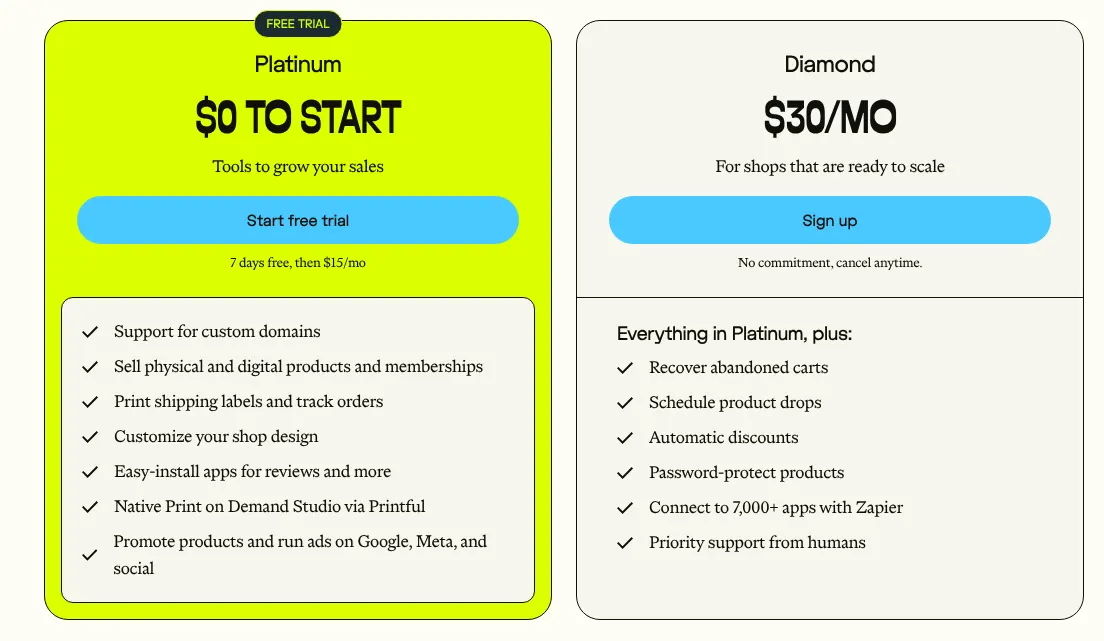
    Platinum costs $15 a month, $24 less than Shopify Basic, and holds 50 products. Diamond, at $30, holds 500 and adds abandoned cart recovery. A free Gold plan holds 5 products.

    Its pricing page shows Platinum as $0 to start: that is a 7-day trial, then $15 a month. Big Cartel takes no fee on orders. Stripe's card rate, which Big Cartel lists, is 2.9% + $0.30 in the US.

    Choose it if
    You sell a few dozen products of your own making and run the shop alone.
    Skip it if
    Your catalogue passes 500 products, or someone else needs a login to the shop.
    Big Cartel plan cards: Platinum shown as $0 to start with a 7-day free trial then $15 a month, and Diamond at $30 a month, each with its feature list.
    The $0 on Platinum is the trial: the line under the button reads 7 days free, then $15/mo. Source: bigcartel.com, captured on 20 Nov 2026.

    Verdict: Big Cartel is a cheap, simple home for a small maker's shop, but it caps products and has one login.

Comparison table: the 10 alternatives vs Shopify

The table sets the ten tools side by side on the points that decide most moves: the entry price, the product limit, what moves from Shopify and the fee on outside payment providers.

The 10 Shopify alternatives compared with Shopify
ToolMatchEntry planProducts on entry planWhat moves from ShopifyFee with an outside payment provider
REFShopify100%$39/mo (Basic)Unlimitedn/a2% on Basic
01Wix99%$29/mo billed yearly (Core)50,000Products, orders, coupons through Cart2Cart (paid)None from Wix
02Ecwid99%$5/mo (Starter)10 on StarterProducts and customers by CSVNone
03Lightspeed eCom99%$89/mo billed yearly (Retail Basic)Not statedProducts by CSVNone
04Squarespace98%$25/mo (Basic)UnlimitedProducts and contacts from Shopify CSV2% store fee on Basic
05Square Online95%$49/mo (Plus); free planNot statedItems by spreadsheetHigher card rate on Free
06BigCommerce94%$39/mo (Core)UnlimitedProducts, customers, orders (free app)2% on Core
07WooCommerce94%Free software, hosting extraUnlimitedProducts by CSVNone
08Volusion90%$35/mo (Personal)100 on PersonalCSV, from Professional2% on Personal
09Shopware89%From €600/mo (Rise)Not statedCSV import; no Shopify assistantNot stated
10Big Cartel86%$15/mo (Platinum)50 on PlatinumProducts from Shopify CSVNone

Prices read on each vendor's site on 2026-11-20, billed monthly unless stated. Entry plan: the first paid plan that sells online. Fee with an outside payment provider: the platform's own fee when the store keeps a processor other than the vendor's. Not stated: no figure on the pages read.

What a Shopify alternative really costs

For a small store, the card fees often cost more than the plan. The table takes a store with $2,000 of online card sales a month, in 40 orders of $50. It adds the entry plan and the vendor's own card rate.

On Shopify Basic billed monthly, that month costs $109. The plan costs $39 and the card fees $70. Big Cartel comes to $85 and Square Online's free plan to $78. Squarespace Basic adds a 2% fee on each store sale and reaches $135.

Ecwid, Lightspeed and Volusion do not publish an online card rate on their pricing pages, so their month cannot be totalled. Shopware prices its paid plans in euros and on quote.

One month at $2,000 of online card sales (40 orders of $50), entry plan and the vendor's own card rate
ToolPlan usedOnline card rateMonth at $2,000 of sales
REFShopifyBasic, $39/mo2.9% + 30¢$109
01WixCore, $29/mo billed yearly2.9% + $0.30$99
02EcwidStarter, $5/moSet by the chosen providerNot published
03Lightspeed eComBasic, $89/mo billed yearlyNot published onlineNot published
04SquarespaceBasic, $25/mo2.9% + $0.30, plus 2% store fee$135
05Square OnlineSquare Free, $0/mo3.3% + 30¢$78
06BigCommerceCore, $39/moFrom 2.89% + $0.29$108.40
07WooCommerceFree software, hosting extraAbout 2.5% to 2.9% + 30¢$87 to $420
08VolusionPersonal, $35/moNot publishedNot published
09ShopwareRise, from €600/moShopware Payments, in eurosNot comparable
10Big CartelPlatinum, $15/mo2.9% + $0.30 (Stripe)$85

Prices and rates read on each vendor's site on 2026-11-20, US rates in US dollars. Plans billed monthly, except Wix, whose pricing page lists yearly prices only. Totals add the plan, the percentage fee on $2,000 and the fixed fee on 40 orders. They leave out tax, shipping, apps and domain names. WooCommerce runs on hosting bought elsewhere, which WooCommerce puts at $25 to $350 a month for most stores; its card rate is about 2.5% to 2.9% + 30¢.

How to migrate from Shopify in five steps

The move takes five steps, and the Shopify store stays open until the last one. Nothing is lost if the new store takes longer to build.

  1. Export your data from Shopify

    Export products, customers and orders as CSV files (plain spreadsheet files) from the Shopify admin. Keep a copy even if the new tool imports directly: it is your backup.

  2. Build the new store and import products

    Use the new tool's own import: BigCommerce's migration app, Squarespace's or Big Cartel's Shopify import, or a CSV file elsewhere. Check variants, prices and photos on ten products before you import the rest.

  3. Replace what your Shopify apps did

    List every app the store uses, such as reviews, email or subscriptions. Find the built-in feature or the extension that replaces each one on the new tool.

  4. Set up payments, tax and shipping, then test

    Connect the payment provider, set tax and shipping zones, and place a real order. Refund it once it has gone through.

  5. Move the domain, then close Shopify

    Point your domain to the new store and add redirects (rules that send visitors from an old page address to the new one). Close the Shopify store only after the last open order has shipped.

When it is better to stay on Shopify

Staying on Shopify is the better choice in four situations. The ranking on this page measures how closely a tool resembles Shopify, not which one suits a given store.

  • The store depends on several apps. Shopify's pricing page lists integrations with thousands of apps. Each app the store uses must be replaced, one by one, before a move.
  • Shoppers pay in many currencies. With Shopify Payments, shoppers pay and get refunds in their local currency. Ecwid, Lightspeed eCom and Volusion only show converted prices, and Square Online and Big Cartel charge in one currency.
  • The store sells in several languages. Shopify Basic sells in up to 20 languages through Translate & Adapt, Shopify's own free app. Squarespace, Square Online and WooCommerce need an outside service for that. Volusion and Big Cartel show the store in one language.
  • Yearly billing is an option. Shopify Basic costs $29 a month billed yearly, $10 less than monthly. That is the price of Wix Core, also billed yearly.

The 2% fee on outside payment providers disappears on Shopify Payments. A store that switches its processor to Shopify Payments removes one of the main reasons to leave.

How we rank

  1. The order of this page is a similarity index: the share of Shopify's features that each tool reproduces. It measures resemblance, not speed, design quality or support.Building the store 23% · 4 featuresCheckout and payments 28% · 7 featuresOrders and shipping 18% · 4 featuresMarketing and channels 15% · 4 featuresRunning the store 18% · 4 features
  2. The comparison uses a grid of 23 Shopify features read on shopify.com, worth 40 points in total, in five groups: building the store, checkout and payments, orders and shipping, marketing and channels, and running the store. Four features weigh 3: store themes and a visual editor, products with variants, card payments at checkout, and an app store. Nine weigh 2 and ten weigh 1. A tool gets 1 for a feature documented as built in on at least one plan, or through a free extension by the same vendor. A partial feature counts half: a documented limit, a paid add-on (an extra the vendor sells on top of a plan), or an outside app the vendor documents. It gets 0 when the feature is absent or could not be found on the vendor's own site.
  3. Fifteen candidates were scored, and the ten highest are listed. Weebly (84%), PrestaShop (81%), Hostinger, Sellfy and Webflow (78%) score lower. Wix, Ecwid and Lightspeed eCom tie at 99%, and BigCommerce and WooCommerce at 94%. Ties go to the smaller gap between entry prices and Shopify Basic's $39, then to alphabetical order. Price, migration effort and labels do not change the rank.
  4. All sources were read on 20 November 2026; the features of the fifteen candidates were first read on 18 November and re-checked that day. Ecwid's help centre refused to be read, so its features come from ecwid.com.
  5. No entry on this page is sponsored. A sponsored entry is marked Sponsored and holds the position paid for; its percentage stays the computed one.

FAQ

Is there a free alternative to Shopify that can take payments?

Yes. Square Online's free plan sells online with no monthly fee and charges 3.3% + 30¢ per online card payment. Big Cartel's free Gold plan holds 5 products. WooCommerce is free software, but you pay for hosting. Wix's free plan cannot take payments.

Can I keep my domain name when I leave Shopify?

Yes. All ten tools on this page let you connect a domain you own. On Square Online, that starts on the Plus plan. Moving the domain's registration away from Shopify is a separate step from pointing it to the new store.

Will my customers' passwords move to the new store?

No. BigCommerce, which moves the most data, says customer passwords cannot be transferred. Customers set a new password on their first visit, so tell them before the switch.

Which alternative also runs a shop till?

Square Online and Lightspeed eCom come from till makers, so the shop and the website share one stock count. Wix, Squarespace, Ecwid, Volusion, WooCommerce and Big Cartel also sell in person. BigCommerce and Shopware need a till from another company.

How long can I try these tools before paying?

Trials range from 7 to 30 days. Square Plus and Shopware Rise give 30 days, BigCommerce 15 and Squarespace 14. Volusion also gives 14 days, and Big Cartel Platinum 7. Shopify itself gives 3 days, then $1 a month for 3 months.