Why Teams Leave Shopify (2026)
Support is the reason cited most often for leaving Shopify: 9 of the 27 sources read for this page raise it. Payouts held by Shopify Payments come next, with 8. Cost, then renewals and refunds, follow with 6 each. Features that Shopify removed and the limits on customization close the list.
The reasons, ranked
- Cited in 9 of 27 sources
- Cited in 8 of 27 sources
- Cited in 6 of 27 sources
- Cited in 6 of 27 sources
- Cited in 4 of 27 sources
- Cited in 4 of 27 sources
Ranked by the number of sources citing each reason, out of 27 read on November 20, 2026. Cost and billing have the same count, as do removed features and customization limits; in each pair, the reason raised by more merchants and reviewers comes first, then alphabetical order. No published source gives a percentage share, so none is shown.
1. Support that is slow when a store is stuck
Support is the reason raised most often: 9 of the 27 sources read for this page mention it. Every Shopify plan lists support 24/7, but the channel depends on the plan (Shopify pricing). Basic and Grow get live chat. Advanced gets enhanced live chat, and Plus gets priority support. The pricing page does not say what enhanced live chat adds.
Most complaints come from stores whose payments are blocked, so each day of waiting costs sales. In October 2025, a merchant on Shopify for more than ten years wrote that customers could not buy anything because of a payment problem. Ten days after opening a ticket (a support request), the merchant had contacted support four more times and was considering another platform. In July 2026, a merchant whose payouts were held wrote that support kept opening new tickets and closing them.
Answers without a date are the other complaint. In June 2026, a merchant was told each time that the case sat with a Shopify team called the trust team, which had no timeline. In April 2026, another merchant was told not to follow up and to wait for an email. In October 2026, five support advisors confirmed to a merchant that a case was escalated, with no timeframe for a decision. In November 2025, a seller who had moved from Big Cartel wrote on the forum that identity verification had been stuck for more than 21 days.
Reviews are more mixed. On Capterra, a software review site, a reviewer wrote in June 2026 that Shopify replies quickly but slows down in busy periods. Another wrote in February 2026 that support can be slow.
Signs this applies to you
- Your store has an open ticket, and each new agent tells you the case is escalated.
- Your payments or payouts are blocked, and support gives you no date.
- You are on Basic or Grow, where the pricing page lists live chat as your support channel.
Alternatives that answer it

BigCommerce
BigCommerce includes phone support on Growth, at $105 a month, and on higher plans. Chat and email support are on every plan.

Square Online
Square Premium lists 24/7 phone support, at $149 a month per location. Square Online, Square's store builder, comes with every Square plan.

Ecwid
Ecwid adds live chat support on Venture, at $35 a month billed monthly. Phone support starts on Business, at $65.
2. Payouts held, and Shopify Payments switched off
Held payouts come second, with 8 of the 27 sources. Shopify Payments is Shopify's own way of taking card payments. Shopify then sends the money, called a payout, to the store's bank account. Shopify's help center says that payouts can be held while an account is under review (Shopify help). The causes it lists include chargebacks, customer complaints, fulfillment issues (problems shipping orders) and requests for documents. A chargeback is a payment that the customer's bank takes back after a dispute.
Shopify can also set a reserve: part or all of the sales, held for a set period to cover future refunds and disputes (Shopify help). The help center gives the example of 10% of each sale held for 120 days. The terms of a reserve arrive by email. Changing the bank account that receives payouts pauses them for 3 to 5 business days.
Merchants describe holds with no end date. In January 2026, a store had Shopify Payments turned off and its payouts held for 120 days. Its owner counted 10 chargebacks on more than 2,500 orders. In October 2026, a merchant had £2,780 on hold for 12 days. An identity check had been accepted four days into the hold.
In July 2026, a merchant followed support's advice to turn Shopify Payments off and on again, to move it to a new company. Shopify then held the payouts and switched Shopify Payments off, with the livelihoods of 11 people at stake. Four days later, after about six calls to priority support, the payouts were released, but Shopify Payments stayed off. In June 2025, another merchant was still waiting for funds after the 120 days Shopify had asked for.
Signs this applies to you
- Your admin or your email mentions a payout hold or a reserve.
- You changed your bank account or your business details, and payouts stopped.
- All your card sales go through Shopify Payments, so a hold stops all your income.
Alternatives that answer it

WooCommerce
WooCommerce charges no fee on top of the payment provider's. A second provider kept ready for a hold adds no platform fee.
BigCommerce
BigCommerce charges no platform fee with its embedded payment providers, on every plan. Other providers cost 2% of each order on Core.
Ecwid
Ecwid charges no setup or transaction fees on any of its plans.
3. Costs that add up: the plan, the fees and the apps
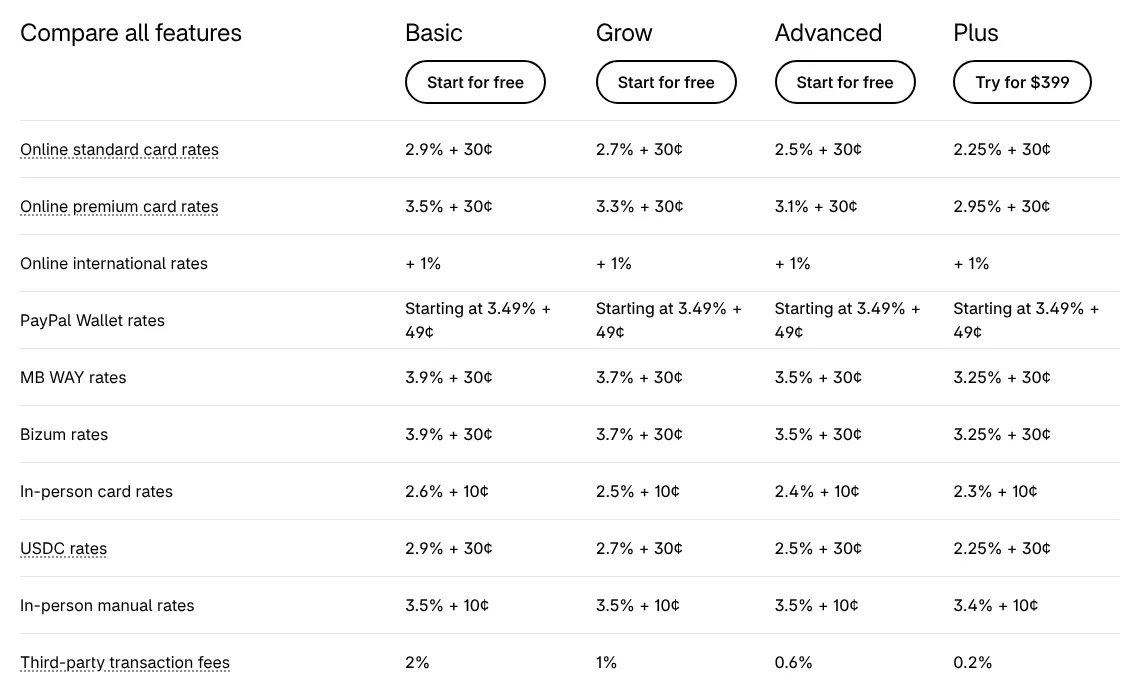
Cost comes third, with 6 of the 27 sources. Basic, the first plan, costs $39 a month billed monthly, or $29 a month billed yearly (Shopify pricing). Grow costs $105 and Advanced $399 a month, billed monthly. On top of the plan, each online card sale through Shopify Payments costs 2.9% + 30¢ on Basic.
Two more fees apply in some cases. A store that takes payments through another provider pays Shopify a fee on each order. The fee is 2% on Basic and 1% on Grow, and falls to 0.6% on Advanced. On $1,000 of sales on Basic, that is $20, on top of the provider's own fee. Shopify also lists a tax calculation fee of 0.35% on Basic, Grow and Advanced, up to $0.99 a sale. Shopify covers it on the first $100K a store sells.
Both fees drive complaints. In September 2023, a merchant who had just opened three shops wrote that Shopify's payment service was not available in their country. The 2% fee on every order, the merchant wrote, forced a move of the shops to another platform. In June 2025, a merchant called the tax fee charged on each sale "a cash grab from stores".
Apps are the third layer. A July 2026 thread on the Shopify Community, Shopify's forum for merchants, asked which paid app merchants use for a single feature. Its author wrote that many merchants pay the price of a full app for a single feature. In October 2026, a Capterra reviewer wrote that subscription fees, transaction fees and paid apps make Shopify expensive for a small business. In November 2026, another reviewer wrote that Shopify kept a $268.16 fee on a refunded order of $8,117.04.
Signs this applies to you
- You pay for several apps, and some of them do one small thing.
- You take payments through another provider, and Shopify's fee shows on each bill.
- You pay Basic monthly: billed yearly, the same plan costs $29 a month instead of $39.
Alternatives that answer it
WooCommerce
The WooCommerce software is free, with no monthly subscription. Hosting is paid separately: $25 to $350 a month for most stores, according to WooCommerce.
Ecwid
Ecwid starts at $5 a month billed monthly, for up to 10 products. It charges no transaction fees on any plan.

Squarespace
Squarespace Core costs $39 a month billed monthly, like Shopify Basic, with no transaction fee on store sales.
4. Renewals, refunds and charges after closing
Billing comes fourth, also with 6 sources, but more of them are Shopify's own pages. The rule behind most complaints is one line of Shopify's Terms of Service: "Shopify does not provide refunds." (Shopify terms). Plans are billed every 30 days. A store that switches to yearly billing during the introductory offer pays the full year upfront when the offer ends (Shopify help).
Closing a store does not stop every charge at once. The subscription ends at the end of the billing cycle already paid (Shopify help). Pending charges, such as app usage and transaction fees, are billed at cancellation. Domain renewals are not cancelled with the store.
Forum threads show what a missed date costs. In November 2026, a merchant who believed a store was cancelled was charged $384.19 for a yearly renewal. Support approved a refund of $342.24 as a goodwill exception, meaning a favour outside the rules. In September 2026, a merchant found a yearly plan charged a year earlier to a second store that was never used. In August 2026, another found at least six months of charges for a store not touched since the first day.
A refund that support agrees to can still take time. In November 2025, a merchant was still waiting for a $381 refund that support said had been processed on October 31.
Signs this applies to you
- You have a second store you do not use, and it is still on a paid plan.
- Your plan renews yearly, and you do not know the date.
- You plan to close your store, and your domain was bought through Shopify.
Alternatives that answer it
BigCommerce
BigCommerce Core, Growth and Scale need no contract and can be cancelled at any time in the control panel. A 15-day free trial comes first.
Ecwid
All Ecwid plans are month-to-month, with no long-term commitment.
5. Features that Shopify removed or changed
Changes imposed by Shopify come fifth, with 4 sources. The largest is the end of Stocky, an app for managing stock in physical shops. Stocky tracked stock levels, forecast needs and suggested what to order (Shopify help). It came with Shopify POS Pro, an add-on (an extra sold on top of the plan) for Shopify's point-of-sale system, the till of a physical shop. On Basic, Grow and Advanced, POS Pro costs $89 a month per location.
Shopify's help center says that Stocky is no longer available after August 31, 2026. Stores are told to move to the stock features of the Shopify admin. The author of a February 2026 thread on the end of Stocky used it for purchase orders, average costs, price labels and stock counts. The author wrote that Shopify "does not offer all that Stocky does".
For some, it ended the relationship. In June 2026, a store owner called the end of Stocky "the last straw". By September, the owner had switched to another point-of-sale system for in-person sales. The same owner did not want to pay extra for the most basic functions of a point-of-sale system. Smaller changes count too. In May 2026, a merchant wrote that a new screen for adjusting stock added steps to a frequent task, and asked for it to be optional.
Signs this applies to you
- You used Stocky for purchase orders or stock counts.
- You run a physical shop on Shopify POS and pay POS Pro for each location.
- An update changed a screen your team uses every day, with no way back.
Alternatives that answer it

Lightspeed eCom
Lightspeed runs the online store from the same stock, orders and prices as its Retail point-of-sale system. Retail Basic costs 89 USD a month billed yearly, with a limited version of eCom.
Square Online
Square Free has no monthly fee, and Square Online comes with it. In person, a card payment costs 2.6% + 15¢. Online, it costs 3.3% + 30¢.
6. Limits on changing the checkout and the code
Customization limits close the list, with 4 sources. The checkout is the page where the customer pays. Shopify's pricing page lists checkout customization as "Limited" on Basic, Grow and Advanced, and "Full" only on Plus (Shopify pricing). Plus starts at $2,300 a month, a price Shopify gives for a three-year subscription.
In June 2026, a store on Advanced asked how to hide the discount code field at checkout. A reply said that it could only be hidden on Plus. Capterra reviewers point to other limits. One wrote in November 2026 that rigid URL structures for blog posts and pages make technical SEO hard. SEO is the work done to rank in search engines. Another regretted in July 2026 not having full access to the HTML (the code of the pages) for SEO updates.
Developers say the same. In December 2022, a commenter on Hacker News, a discussion site, wrote that their agency had moved to headless Shopify sites. Headless means building the storefront separately and using Shopify only behind it. The reason given was constant client requests for things not possible in Shopify alone.
Signs this applies to you
- You need to change the checkout, and every answer points to Plus.
- Your search engine work stops at the URLs that Shopify sets.
- You pay a developer to work around the theme for each new request.
Alternatives that answer it
WooCommerce
WooCommerce is open source (its code is public and can be changed) and runs on WordPress. WooCommerce says it gives full control of the checkout, the data and the costs.

Shopware
Shopware Community Edition is open source and has no licence fee. Hosting, set-up and maintenance are paid separately.
Before you leave: can it be fixed inside Shopify?
Billing and cost can be managed inside Shopify. Payouts and support depend on Shopify's teams, and full checkout changes need Plus. Stocky does not come back.
Support
Partly, by plan. Advanced lists enhanced live chat, and Plus lists priority support. In July 2026, a merchant with held payouts started a Plus trial to reach priority support. The payouts were released after two days of calls.
Held payouts
Partly. The terms of a reserve, and how to appeal it, are in the email Shopify sends. An appeal is a reply to that email within the stated time, and some reserves cannot be appealed. Switching the payout destination to Shopify Balance, the account Shopify offers to manage a store's money, avoids the pause that follows a bank account change. On the forum, a reply to a merchant with held payouts suggested switching payment providers until the review ends. On Basic, another provider costs Shopify's 2% fee on each order.
Cost
Yes, in part. Yearly billing brings Basic from $39 to $29 a month, which saves $120 a year. The fee on another provider's orders applies only when Shopify Payments is not used. Paid apps can be checked one by one against the feature each one provides.
Renewals and refunds
Yes, with dates. A move to a lower plan takes effect at the end of the current billing cycle, because plans are paid in advance. A store closed before its renewal date ends with the period already paid. Refunds are not part of the terms, so the date matters more than any request.
Features removed
No. Shopify's answer to the end of Stocky is the stock features of the Shopify admin. The author of the Stocky thread wrote that these do not cover everything Stocky did.
Customization
Only with Plus. Full checkout customization is listed on Plus alone, from $2,300 a month on a three-year subscription. That is 59 times the monthly price of Basic.
What a move off Shopify involves
A move takes five steps, and the billing date sets the order. Shopify bills every 30 days and does not give refunds, so the move is planned before the next charge. The steps follow Shopify's help center and the guides of WooCommerce and BigCommerce. How long a full move takes is not documented, and is not estimated here.
Find your next billing date
Check when your plan renews. Shopify bills every 30 days, or once a year on yearly billing, and does not give refunds. If you are on Plus, a Plus agreement cannot be cancelled from the Shopify admin, and a 1- or 3-year term runs until it expires.
Export your data
Export your products, customers and orders as CSV files (spreadsheet files that most platforms can import). A customer file is limited to 15 MB. If you bought a theme, download a backup: a theme is licensed only to the store it was bought for.
Import into the new platform
WooCommerce imports the product CSV from Shopify with its built-in importer. For customers and orders, WooCommerce recommends one of two extensions. BigCommerce has a Data Migration app for up to 500,000 records across products, customers and orders. Passwords cannot be migrated to BigCommerce, so your customers will need new ones.
Settle payouts before you close
After you close the store, pending Shopify Payments payouts are still sent on your usual schedule. If a payout fails, you cannot fix it without reopening the store. You cannot answer chargebacks after closing either.
Close the store and the extras
When you cancel, all apps are uninstalled, and pending charges such as app usage and transaction fees are billed. Domain renewals are not cancelled with the store, so deal with your domain separately. Shopify keeps the store's information for 2 years after deactivation.
FAQ
Why do merchants leave Shopify?
Support comes first, raised by 9 of the 27 sources read for this page. Held payouts follow with 8, then cost and billing with 6 each. No source gives a share of departures, so the ranking counts sources.
Does Shopify give refunds?
Its Terms of Service say that Shopify does not provide refunds. Support still approved refunds for some merchants in the threads read for this page. One was approved $342.24 on a $384.19 yearly renewal, as a goodwill exception.
Can Shopify hold your money?
Yes. Shopify can hold payouts while it reviews an account, and it can keep part or all of your sales in a reserve for a set period. Its help center gives the example of 10% of each sale held for 120 days. The terms come by email.
What happens to your store data after you close Shopify?
Shopify keeps the store's information for 2 years after deactivation, but you lose access to the admin. Export your products, customers and orders as CSV files before you close.
Is Stocky still available?
No. Shopify's help center says that Stocky is no longer available after August 31, 2026. Shopify points stores to the stock features of the Shopify admin.
How can you avoid Shopify's transaction fee?
Take payments with Shopify Payments. The third-party fee, 2% of each order on Basic, applies only when another payment provider takes the payment. Shopify Payments has its own card rates, from 2.9% + 30¢ online on Basic, and it is available only in certain countries.