Why Teams Leave Trustpilot (2026)
Pressure to pay is the reason cited most often for leaving Trustpilot: 11 of the 16 sources read for this page raise it. Fake reviews come next, with 9, then a public page that a business cannot remove, with 7. A 12-month contract that renews by itself and the price of the paid plans close the list. The sources are Trustpilot's own pages, two pages of user reviews on Capterra, a software review site, press articles and three comments on Hacker News, a discussion site. All were read on November 15, 2026. None of them gives a share of departures per reason, so the ranking counts how many sources cite each one.
The reasons, ranked
- Cited in 11 of 16 sources
- Cited in 9 of 16 sources
- Cited in 7 of 16 sources
- Cited in 5 of 16 sources
- Cited in 3 of 16 sources
Ranked by the number of sources citing each reason, out of 16 read on November 15, 2026. No published source gives a percentage share, so none is shown.
1. Pressure to pay, and doubts about who the score favours
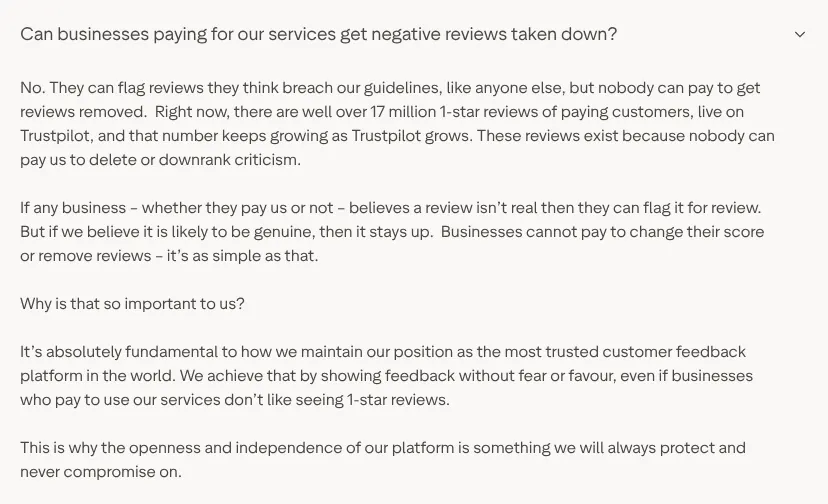
Pressure to pay is the reason raised most often: 11 of the 16 sources read mention it. Part of it is plain sales pressure. The other part is a suspicion that paying businesses get better treatment. Trustpilot can be used for free. A business that claims its page can reply to reviews and send 50 automated review invitations a month, at no cost. A paid plan adds more invitations, tools to read feedback and the licensed use of Trustpilot's stars and widgets in marketing. A widget is a small box that shows a business's rating on its own website.
The doubts made headlines in December 2025. On December 4, Grizzly Research, a US short-selling firm, published a report against Trustpilot. Grizzly held a short position, a bet that makes money when the share price falls. According to City AM, the report accused Trustpilot of "creating unsolicited review profiles" to push businesses into subscriptions. It also claimed that some businesses saw their rating rise from two stars to four after paying. IBTimes reported that Trustpilot's shares fell more than 30% that day.
Trustpilot rejects the claims. Its statement of December 4, 2025 calls the report "selective, misleading and framed to support a predetermined narrative". On its own site, Trustpilot says that nobody can pay to get reviews removed (How Trustpilot works). It adds that well over 17 million 1-star reviews of paying customers are live on Trustpilot. No regulator decision or court ruling on Grizzly's claims was found in the sources read.
Users describe the pressure in their own words. A Capterra reviewer wrote in July 2025 that Trustpilot is "quite pushy" about buying a paid plan. Capterra is a site where software users review the tools they pay for. Another reviewer wrote in January 2025 that they "Felt pressure to upsell often". In May 2025, a Hacker News commenter claimed that Trustpilot flags a website with a notice when the business sends its own review links, unless it pays. Trustpilot's guidelines tie such a warning, called a Consumer Warning, to misuse of the platform, for example inviting only chosen customers. They also say the same rules apply whether a business pays or not.
Signs this applies to you
- Trustpilot's sales team contacts you often, while the free plan covers what you use.
- Your rating changed after you started or stopped paying, and you cannot tell why.
- Customers or partners ask you whether your stars were bought.
Alternatives that answer it

Feefo
Feefo only publishes reviews from customers who received a request: a reviewer cannot create an account and post on their own. Plans start from $200 a month, and contracts renew for 12 months with 90 days' notice to cancel.

Trustindex
Collecting and managing reviews is free on Trustindex, with no plan to buy. Showing widgets on your website needs a paid package, from $65 a year, billed annually.
2. Fake reviews, and genuine ones that disappear
Fake reviews come second, raised by 9 of the 16 sources. The complaint runs both ways. Businesses see fake or spam reviews stay online, and some see genuine reviews from their customers removed. Trustpilot says it removed 4.5 million fake reviews in 2024, about 7% of the reviews posted that year.
A UK consumer group showed the gap in a report of July 2022. It bought reviews from a fake review broker for a business that did not exist. Within three weeks, that business had 19 five-star reviews and a TrustScore of 4.6. The TrustScore is Trustpilot's overall rating of a business, out of 5. Trustpilot told the group that it then removed suspected fake reviews from the businesses linked to this investigation. In November 2025, the same group found the problem again on the pages of financial firms. In one case, one person had written 93 reviews in a single day. Trustpilot then removed more fake reviews and placed permanent warnings on those firms' pages.
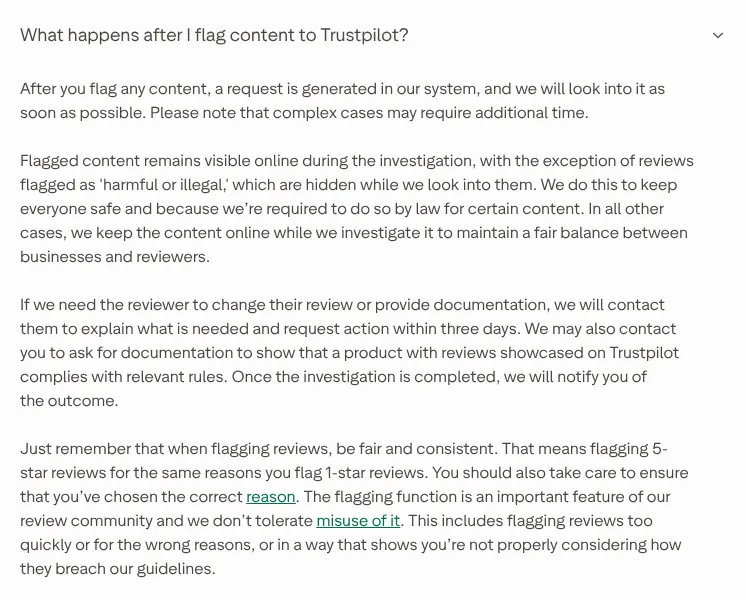
For a business, the frustration is the process. Trustpilot's guidelines say that it does not remove a review just because a business finds it unfair or critical (Guidelines for businesses). A flagged review stays online while it is checked, unless it is flagged as harmful or illegal. A review flagged as not based on a real experience goes through detection software. If no breach of the rules is confirmed, it stays online.
Users and critics push the point further. A Capterra reviewer wrote in March 2025 of "Many fake reviews that can lose trust with customers." Another, in May 2026, found disputing reviews that look inaccurate or unfair "challenging". A class action of 2021 and Grizzly's 2025 report both claimed that fake positive reviews stayed up for some paying businesses. Trustpilot says the same rules, fraud detection and moderation apply to everyone.
Signs this applies to you
- You flagged reviews you believe are fake, and they are still online.
- Customers tell you that the review they wrote has been removed.
- A competitor's page shows bursts of five-star reviews from people who never reviewed anything else.
Alternatives that answer it
Feefo
Feefo sends each review request itself on behalf of the business, so every review comes from a customer the business invited. A stranger cannot post a review on your page.

REVIEWS.io
REVIEWS.io collects reviews from invited customers. Its public page also accepts reviews without an invitation, but those do not count toward Google's seller ratings, the stars Google can show next to a shop's ads. Plans start at $29 a month, month to month.
3. A public page that a business cannot remove
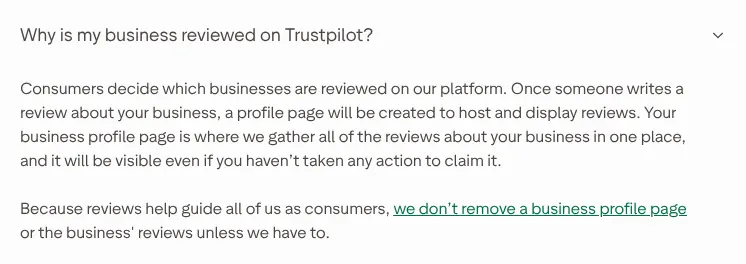
Any customer can put a business on Trustpilot, and the business cannot take it off. 7 of the 16 sources raise this. Trustpilot's guidelines say that consumers decide which businesses are reviewed (Guidelines for businesses). A page is created with the first review, and it stays visible even if the business never claims it. Trustpilot removes a business page or its reviews only when it has to.
Leaving a paid plan does not change this. Trustpilot's pricing page says that a business's reviews stay on its page when it stops using the service. Only the person who wrote a review can edit or delete it. When a subscription is not renewed, the business keeps the free plan, so it can still reply to reviews.
Some businesses see this as a trap. A Capterra reviewer complained in January 2026 that a business account cannot be deleted once created. Another regretted, in January 2025, having no control over the brand's reviews. Grizzly's 2025 report linked these pages to sales pressure, as reported by City AM and IBTimes. Trustpilot's position is that this openness is the point: businesses cannot stop consumers from leaving feedback.
Signs this applies to you
- Your business has a Trustpilot page that a customer created, not you.
- You plan to stop using Trustpilot and expected the page to disappear with the contract.
- A few old reviews sit at the top of a page you no longer manage.
Alternatives that answer it
Feefo
Feefo cannot remove the Trustpilot page either. What changes is where new reviews go: on Feefo, only customers you invite can review you.
4. A 12-month contract that renews by itself
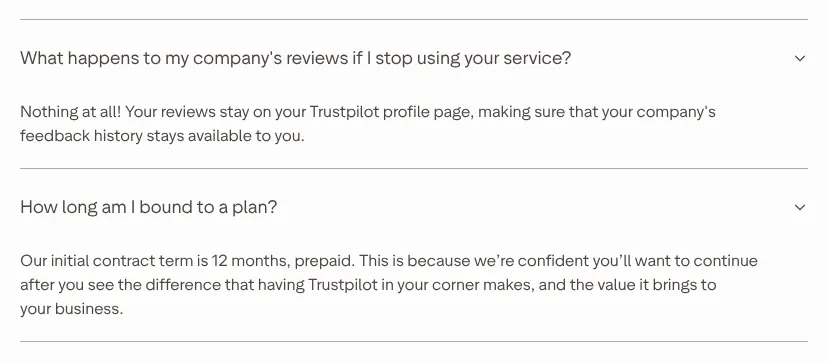
Paid plans are sold on a 12-month contract, paid in advance, and it renews unless the business cancels in time. 5 of the 16 sources raise this. Trustpilot's terms say that a subscription renews automatically for a further period (Terms for businesses). To stop it, the business must email cancellation@trustpilot.com at least 30 days before the end of the period. Trustpilot owes no refund or credit when a subscription ends under its terms.
The price can also change at renewal. The terms let Trustpilot raise the total price by up to 5% without telling the customer. A larger rise has to be announced at least 45 days before. A Capterra reviewer wrote in May 2025 that their bill went from $70 to $380 a month at renewal. Trustpilot replied to that review that cancellations must follow the terms of the agreement.
The complaint is not new. In 2021, a class action was filed in New York federal court against Trustpilot. A class action is a lawsuit brought on behalf of a whole group of customers. It claimed that Trustpilot's renewal emails were designed to land in junk folders. Its outcome is not documented in the sources read for this page. In July 2025, a Capterra reviewer still wrote of "unethical renewal practices".
Signs this applies to you
- Your renewal date is less than 30 days away, and you have not sent a cancellation email.
- Trustpilot's emails go to the colleague who signed the contract, not to you.
- Your renewal quote is higher than last year's price.
Alternatives that answer it
REVIEWS.io
All REVIEWS.io plans are month to month. It also offers to honour the rest of your current contract with another reviews provider, so you do not pay twice while you switch.

Okendo
Okendo offers to buy you out of a long contract for the time left on it. Check its own terms first: its platform and bundles normally require annual terms, while single products can be monthly.
5. The price of the paid plans
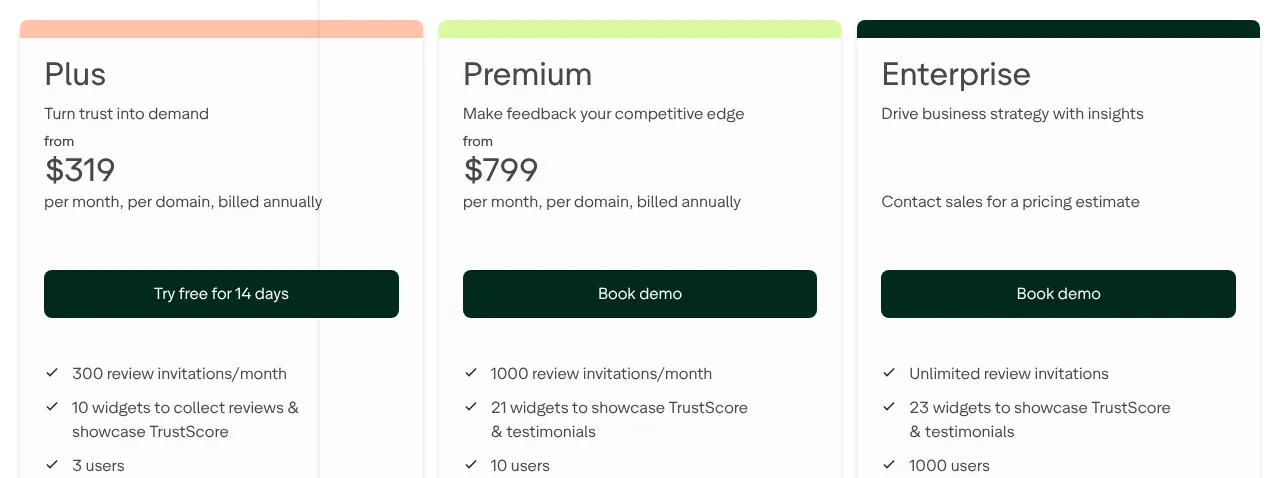
Paid plans start at $319 a month per domain for Plus, billed annually (Trustpilot pricing). 3 of the 16 sources raise the price. A domain is one website address, so a business with two websites pays for each. Plus includes 300 review invitations a month, 3 users and 10 widgets. Premium starts at $799 a month per domain, also billed annually, and Enterprise is priced on request.
Over a year, Plus costs at least $3,828 per domain, paid up front. Extra modules, such as product reviews, are sold on top, at prices the pricing page does not show. The free plan stays available, with 50 automated invitations a month.
Capterra reviewers find the price high for what they get. One wrote in July 2025 that the price had risen while features were taken away. A marketing chief wrote in December 2025 that "for smaller brands and startups, the pricing is quite prohibitive".
Signs this applies to you
- You send fewer than 50 invitations a month, so the free plan would cover your volume.
- You run several websites and pay for each domain.
- The widgets on your site are the main thing you use from your plan.
Alternatives that answer it
REVIEWS.io
The Essentials plan costs $29 a month for up to 300 review invites, billed monthly. That is the same invitation volume as Trustpilot Plus.
Trustindex
Trustindex starts at $65 a year for one company, billed annually, with a refund if you ask within 30 days. Collecting reviews stays free without a plan.
Before you leave: can it be fixed inside Trustpilot?
For some reasons, partly. Price and pressure to pay have an answer in the free plan. Fake reviews have a free process, slow and limited. The public page has no fix, and the contract terms can only be managed with dates.
Pressure to pay
The free plan answers it for small volumes. Any business can claim its page and reply publicly at no cost, and any business can flag reviews. According to Trustpilot, a subscription buys tools to read feedback, brand rights and insights, not a better score.
Fake reviews
Flagging is free but limited. A business can flag a review it believes is fake. It can also ask the reviewer for details, such as a name or an order reference. The guidelines ask for consistency, flagging 5-star reviews for the same reasons as 1-star ones. Misusing the flagging tool can lead to action against the business itself.
The public page
No fix. The page stays whether the business pays, stops paying or never claims it. Claiming it at least allows the business to reply.
The contract
Partly, with a date in the calendar. The terms allow cancellation by email at least 30 days before the end of the period. Where the business account offers the option, it can be done there too. After cancelling, the service continues until the end of the paid period, with no refund.
Price
Partly. The free plan sends 50 automated invitations a month. When they run out, the business waits for the next month, and its access continues. A business that needs more invitations has no published monthly price to compare: the pricing page mentions a monthly billing cycle, but every price it shows is billed annually.
What a move off Trustpilot involves
A move takes five steps, and the reviews are the hard part. They stay on Trustpilot, and a copy in another tool does not always count the same way. The steps follow the documentation of Trustpilot, REVIEWS.io, Okendo and Yotpo. How long a move takes is not documented, and is not estimated here.
Send the cancellation 30 days before the end
Start with the date, because a missed deadline means another year. Email cancellation@trustpilot.com at least 30 days before your period ends, or cancel in your business account if it offers the option. If you bought through a partner, tell the partner instead. Keep the confirmation: Trustpilot owes no refund once a period has started.
Export your reviews while you still pay
Trustpilot says that reviews can be exported, for example to study them in your own business intelligence tool (software for reports on company data). Its pages read for this page do not say which plan includes the export. Ask your account manager before the subscription ends.
Import them, knowing what does not carry over
REVIEWS.io imports Trustpilot reviews, but your customers must confirm them again before they are published, because Trustpilot owns the review data. Okendo's importer recognises Trustpilot export files. Okendo says Google does not allow imported reviews in its seller ratings, and Yotpo says they may not count. Count on Google's seller ratings being built from new reviews only.
Switch the review requests on the same day
Trustpilot can send a review request every time a customer completes an order. Turn that off and start the new tool's requests on the same day, so no customer is asked twice. Keep asking every customer, happy or not: Trustpilot's guidelines forbid choosing whom to invite, and the old page stays public.
Keep replying on the free plan
Your Trustpilot page stays online after you leave, with its reviews. When a subscription is not renewed, the free plan remains, and it still allows you to reply to reviews at no cost. Check the page from time to time and answer new reviews there.
FAQ
What is the most cited reason for leaving Trustpilot?
Pressure to pay: 11 of the 16 sources read for this page raise it, either as sales pressure or as a doubt about whether paying businesses get better treatment. Fake reviews come next, with 9. Several sources report the same event, the Grizzly Research report of December 2025, so they are not independent of each other.
Can a business delete its Trustpilot page?
No. Trustpilot's guidelines say that consumers decide which businesses are reviewed, and that the page stays visible even if you never claim it. Trustpilot removes a business page or its reviews only when it has to. Leaving a paid plan does not remove the page either.
Can a business pay Trustpilot to remove bad reviews?
Trustpilot says no: nobody can pay to get reviews removed, and every business can flag reviews it thinks break the rules. A 2021 class action and a 2025 short-seller report claimed that paying businesses got better treatment. Trustpilot rejects those claims, and no court or regulator finding was found in the sources read.
How do you cancel a Trustpilot subscription?
Email cancellation@trustpilot.com at least 30 days before the end of your subscription period, or cancel in your business account if the option is there. If you bought through a partner, tell the partner. You keep the service until the end of the period you paid for, with no refund.
Is Trustpilot free for businesses?
Yes, in part. A business that claims its page can reply to reviews and send 50 automated review invitations a month for free, with no credit card. Paid plans start at $319 a month per domain for Plus, billed annually on a 12-month contract.
When is it better to stay on Trustpilot?
Stay when your customers already read your Trustpilot page, or when the free plan covers your needs. Your page stays online whatever you decide, so leaving only ends the paid tools. If your reason is the contract or the price, the free plan may be enough: it keeps replies and 50 invitations a month.