top10alternative

Top 10 Landlord Property Management Software (2026)

Ten property management tools for landlords, ranked by how many of 22 features they cover, from tenant screening to owner portals, with the price of each first paid plan.

The best property management software for your situation

<p>Each line pairs a common landlord situation with the tool whose published facts fit it. The score on this page counts how many of 22 landlord features a tool covers. It measures coverage, not quality, and the ten score between 95 and 100.</p>

  • You manage for owners and want accounting, leasing and an owner portal in one toolYardi Breeze · $1 a unit a month, with a $100 monthly minimum on a yearly agreement.
  • You rent out a handful of units and want a fixed monthly billTenantCloud · Starter costs $25 a month for up to 10 leases.
  • Your company manages 50 units or moreAppFolio · Core starts at $1.49 a unit, on a quote, with a 50-unit minimum.
  • You want every feature and unlimited users on the first planDoorLoop · DoorLoop One costs $3.00 a unit a month, before a minimum that sales sets.
  • You want a published price whatever your sizeRentec Direct · Starter is a flat $25 for up to 10 properties; Pro is $2 a unit.
  • You want a full suite and a trial without a cardBuildium · Essential starts at $65 a month; the trial lasts 14 days.
  • You want to start free and pay once a year laterTurboTenant · The free plan has no time limit. Essentials costs $149 a year.
  • Your unit count keeps growingRentRedi · One price, $29.95 a month, for unlimited units.
  • You own a few units and want rent and tax-ready books in one appLandlord Studio · Go is free up to 3 units; Pro adds the Schedule E report for $15 a month.
  • You want to pay nothing and let tenants carry the payment feesInnago · Free for landlords; tenants pay $2 per bank payment by default.

How to choose property management software

All ten list vacancies, screen tenants, collect rent online and track repairs, so the score only builds the shortlist. Six checks narrow it to one or two tools. Each check rests on vendor pages read on 16 November 2026.

1. Count your units, then read how the price is built

Three pricing models sit side by side here, and your unit count decides which one is cheap. TenantCloud, Rentec Direct Starter and Buildium Essential charge a flat monthly price. AppFolio, DoorLoop and Yardi Breeze charge per unit, each with a minimum. Landlord Studio includes 3 units in Pro and adds $1.20 a month for each unit beyond. RentRedi charges one price for any number of units.

Take a landlord with 10 units on monthly billing. TenantCloud and Rentec Direct cost $25 a month, and Buildium $65. Yardi Breeze costs $100, because of its minimum. AppFolio bills at least 50 units. At 50 units, TenantCloud moves to Pro at $60 and Rentec Direct to Pro at $100. Price your size before you look at features.

2. Find out who pays each rent payment

Online rent is not free: each bank transfer, called an ACH payment in the US, carries a fee. The question is who pays it. On RentRedi, TenantCloud, DoorLoop One and Innago, the tenant pays that fee by default. On Landlord Studio, the landlord chooses who pays the $2.50. On Buildium, the landlord pays $2.35 per incoming payment on Essential. Yardi Breeze and Rentec Direct Pro charge $0 for a bank payment.

Ten tenants paying by bank each month cost a Buildium Essential landlord $23.50 a month in fees. That adds more than a third to the $65 subscription. If you want tenants to pay nothing extra, pick a tool where the bank payment is free or where you can absorb a small fee.

3. Decide whether the same tool keeps the books

Some tools only collect rent; others keep full books for tax time. Full books here means a bank feed, which brings the transactions of a bank account into the software, and a report for Schedule E. Schedule E is the US tax form where rental income and costs are declared.

Landlord Studio keeps both for Pro, at $15 a month; its free Go plan tracks income and expenses by hand. TurboTenant keeps both for Pro, at $199 a year for up to 10 units, against $149 for Essentials. TenantCloud keeps the bank feed for Pro, at $60 a month. Innago has no bank feed of its own: it points to Ledgre, a separate accounting app with its own subscription. If an accountant already keeps your books, the cheaper plans are enough.

4. Price the screening and the lease before the first tenant

Screening means ordering a credit, criminal or eviction report on an applicant. Every tool here offers it, at published prices from $10 to $55 a report. Rentec Direct Pro charges $10 to $18. Buildium charges $17 when the landlord pays. TurboTenant charges the renter $55 on the free plan and $45 on a paid plan.

Leases can cost extra too. Buildium Essential charges $5 for each signed document, so 10 leases a year cost $50. TurboTenant includes e-signatures from Essentials. If your state has its own lease rules, check the tool offers state-specific forms on your plan.

5. Check the owner portal if you manage for others

An owner portal is a login where the owner of a property sees rent, costs and statements without calling you. A landlord who only manages their own units does not need it. A manager who looks after other people's units usually does.

Buildium and DoorLoop include one on every plan, and AppFolio and Yardi Breeze offer one too. TenantCloud keeps it for Pro and Rentec Direct for PM. TurboTenant has none. RentRedi and Innago give owners a read-only login without statements. On Landlord Studio, owners serve only to filter reports. A manager with 20 units for owners pays $50 a month on Rentec PM, the plan's minimum.

6. Compare monthly and yearly billing

Yearly billing lowers most prices, but it asks for twelve months up front. RentRedi costs $29.95 a month billed monthly, or $144 a year billed yearly. TurboTenant sells its paid plans by the year only: the $12.42 on its pricing page is $149 divided by twelve.

A RentRedi landlord who pays monthly for a year spends $359.40, against $144 on the yearly plan. Yardi Breeze is billed monthly but signed for a year. Pay monthly while you try a tool, then switch to yearly once your tenants are set up.

The 10 Landlord property management software

by overall score
  1. 1. Yardi Breeze

    Yardi Breeze suits a landlord or manager past about 100 units, or one who accepts a $100 monthly floor for a full set of tools.

    Score
    100/100
    Best for
    Managers who want accounting, leasing and owner tools from one vendor
    From
    $1/unit/mo
    Free plan
    No · $100 monthly minimum

    Yardi Breeze is cloud property management software from Yardi, sold to owners and managers. It covers all 22 features on this page. Leasing runs through RentCafe, which Yardi includes: listings, online applications and a portal where residents pay and ask for repairs.

    Breeze costs $1 a unit a month, with a $100 monthly minimum. It is billed monthly, but on a yearly agreement. Any landlord under 100 units therefore pays $100 a month. There are no setup, training or support fees, and no charge to convert data from an old tool. The contract can be cancelled within its first 30 days.

    Some features wait for Breeze Premier, which has a $400 monthly minimum. State-based lease documents, a daily bank feed and two-way texting are among them. A bank feed brings the transactions of a bank account into the books automatically. Online rent by bank transfer costs $0. The price of a tenant screening and the card fee are not published.

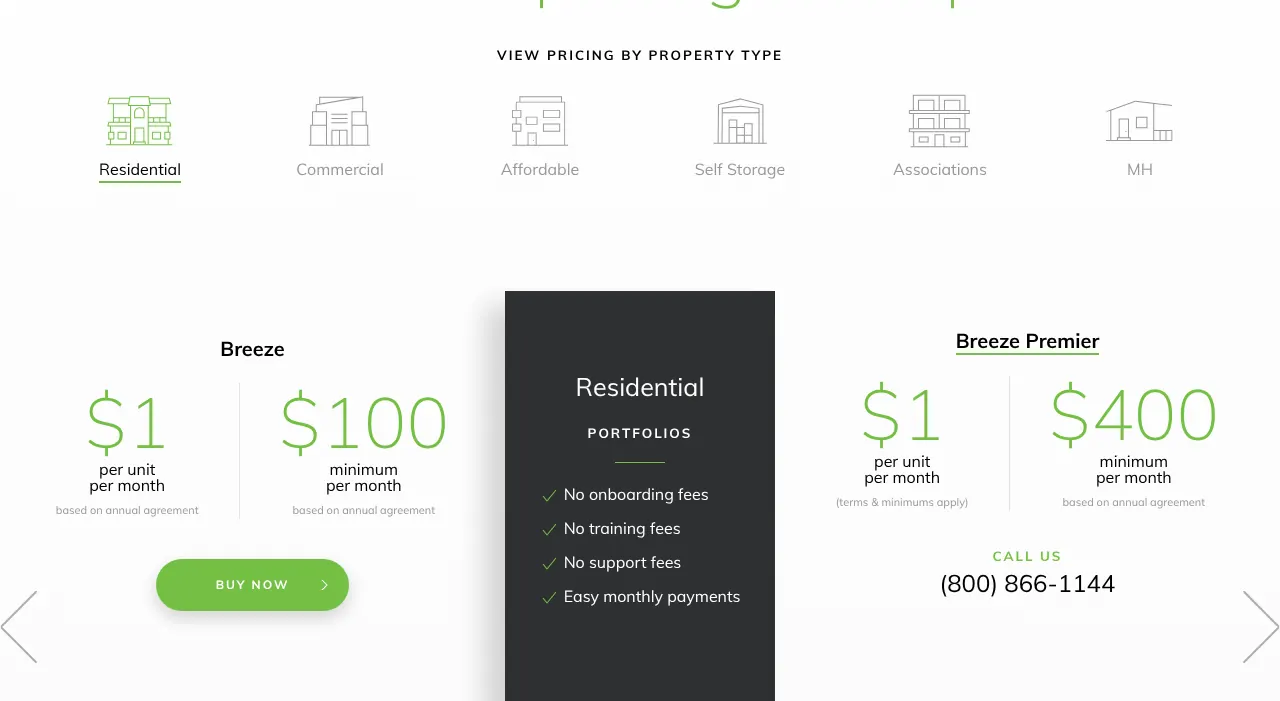
    Yardi Breeze residential pricing: Breeze at $1 per unit per month with a $100 minimum per month, Breeze Premier at $1 per unit with a $400 minimum, both on an annual agreement.
    The $100 minimum under Breeze sets the price for any portfolio under 100 units. Source: yardibreeze.com, captured on 16 Nov 2026.
  2. 2. TenantCloud

    TenantCloud fits a landlord with up to 10 leases who wants a fixed $25 bill, and moves to Pro only when the books or a co-manager require it.

    Score
    100/100
    Best for
    Small landlords who want a flat monthly price
    From
    $25/mo
    Free plan
    No · 14-day trial

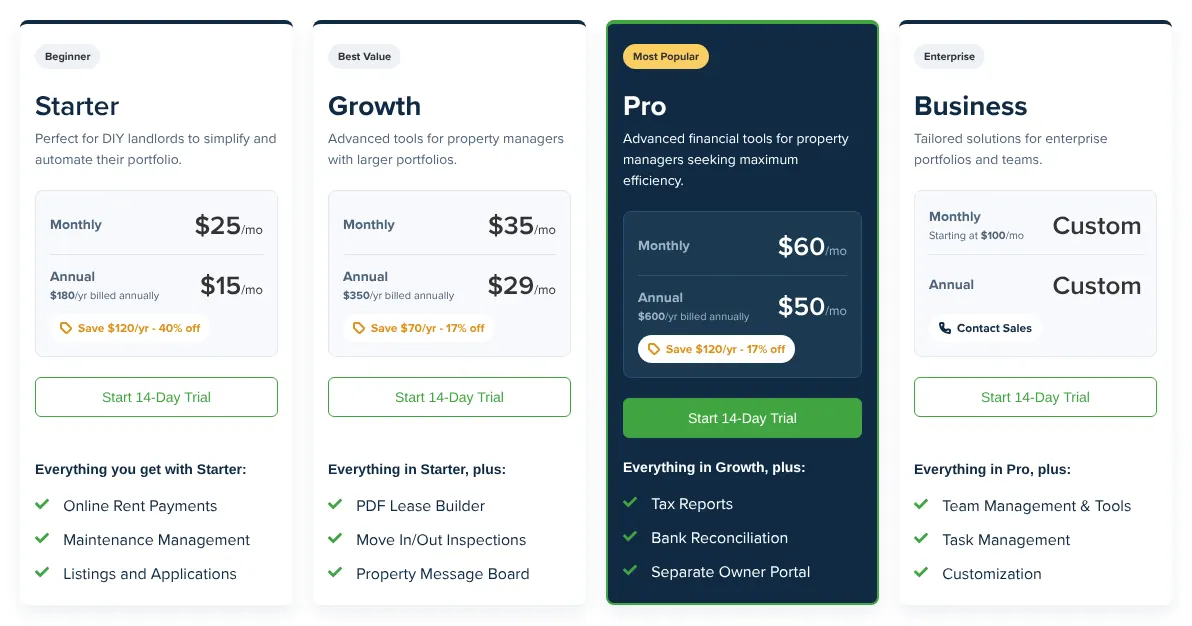
    TenantCloud prices by the number of leases, not by the unit. Starter costs $25 a month on monthly billing, for unlimited properties and up to 10 leases. Growth, at $35, allows 30 leases. Pro, at $60, allows 60. Billed yearly, Starter falls to $180 a year. Every plan starts with a 14-day trial.

    Starter already lists vacancies, takes applications, collects rent and tracks repairs. Tenants pay the payment fees: $1.95 per bank payment on Starter, and 3.5% + 30¢ by card. A screening report costs the applicant $39. Listings reach Realtor.com and Apartments.com for free. The Zillow network costs $30 for 30 days.

    The fuller tools sit on Pro. State-specific lease forms, the bank feed, the owner portal and the profit and loss report start there. Starter has no team member at all; Growth and Pro include one. A landlord who keeps the books elsewhere can stay on Starter.

    TenantCloud plans with monthly and annual prices: Starter $25 a month, Growth $35 and Pro $60, each with a 14-day trial button.
    Each card shows the monthly price on top and the yearly price below it; Starter reads $25 per month. Source: tenantcloud.com, captured on 16 Nov 2026.
  3. 3. AppFolio

    AppFolio fits a company with 50 units or more that wants one platform on a quote, and does not fit a landlord with a few doors.

    Score
    99/100
    Best for
    Portfolios of 50 units or more
    From
    $1.49/unit/mo
    Free plan
    No · demo only

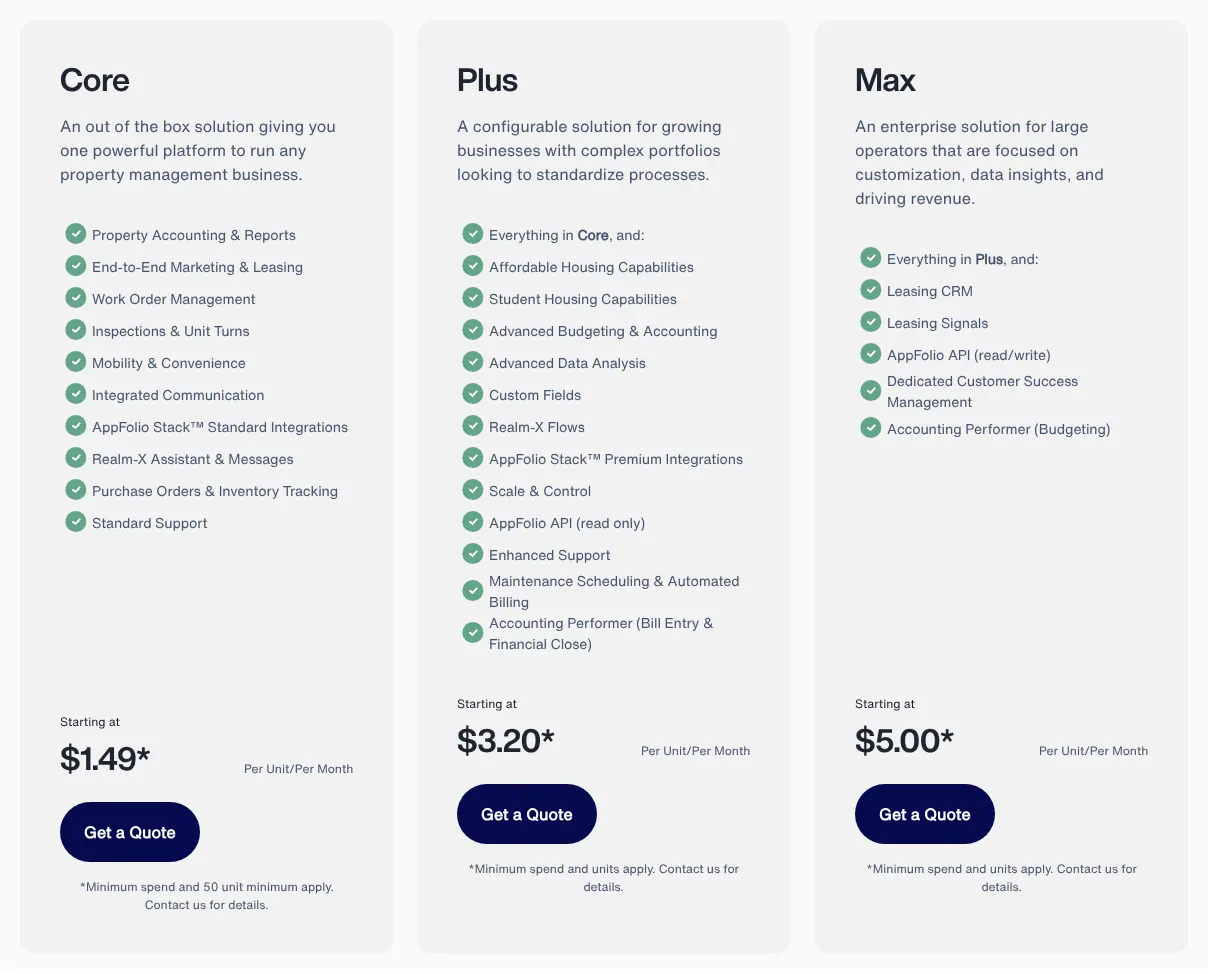
    AppFolio supports portfolios from 50 units, and its pricing says so. Core starts at $1.49 a unit a month, with a 50-unit minimum. A minimum spend applies on top, and its amount is not published. Plus starts at $3.20 a unit and Max at $5.00. Each plan is sold on a quote, after a demo; no free trial was found.

    AppFolio covers 21 of the 22 features in full. Residents pay rent, set up autopay and send repair requests through an app. Screening is built in, and a bank feed brings transactions into the books. Owners get their own portal. Only state-specific lease forms are missing: the lease templates are generic.

    The 50-unit minimum puts at least $74.50 a month on any account, before the minimum spend. The fees residents pay by bank or card are shown at payment, not on the website. AppFolio's team moves the data during setup; no self-service import is documented.

    AppFolio plans Core, Plus and Max: starting at $1.49 and $3.20 per unit per month, Max beside them, with a note that a minimum spend and a 50 unit minimum apply.
    The note under Core reads that a minimum spend and a 50 unit minimum apply to the $1.49 price. Source: appfolio.com, captured on 16 Nov 2026.
  4. 4. DoorLoop

    DoorLoop fits a growing portfolio that wants every tool from day one, once sales confirms the minimum for its size.

    Score
    99/100
    Best for
    Every feature on the first plan, with unlimited users
    From
    $3/unit/mo
    Free plan
    No · demo first

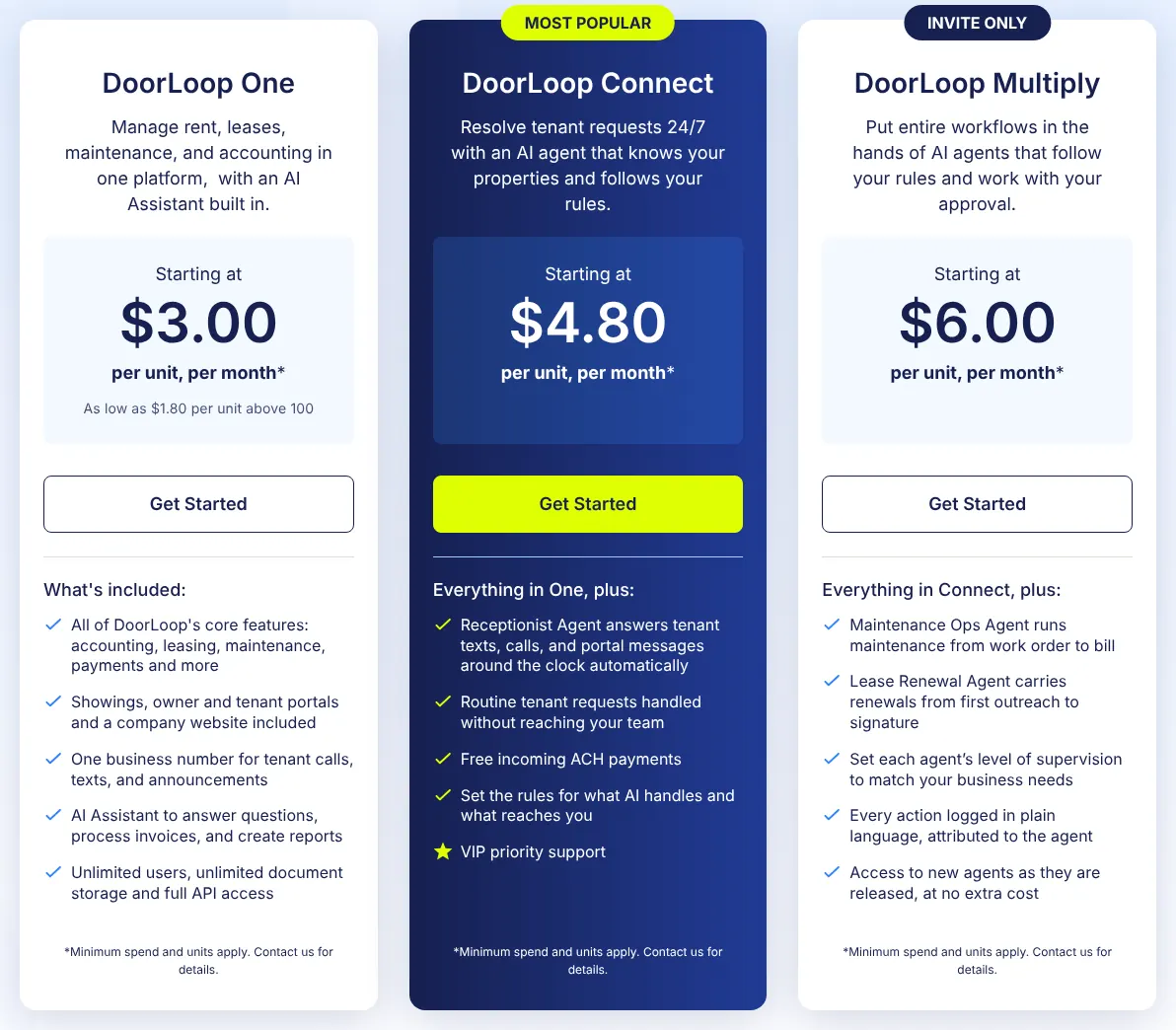
    DoorLoop puts its whole product on its first plan. DoorLoop One costs $3.00 a unit a month on monthly billing, or $2.50 billed yearly. Above 100 units, the price falls as low as $1.80 a unit. Users and document storage are unlimited, and owners and tenants each get a portal.

    A minimum spend and a minimum unit count apply, and DoorLoop does not publish them. The price for 1 or 10 units therefore cannot be stated. There is no free plan; an account opens after a demo with sales. Connect, at $4.80 a unit, adds an AI receptionist and free bank payments for tenants.

    On One, a tenant pays $1.50 per bank payment and 3.25% by card, with a $3.50 minimum. The landlord can choose to pay these fees instead. Screening costs the applicant $35. A migration team imports properties, units, leases and tenants from a spreadsheet or another tool. Past payments and expenses are not imported.

    DoorLoop plans on monthly billing: DoorLoop One at $3.00, Connect at $4.80 and Multiply at $6.00 per unit per month, each with a note that minimum spend and units apply.
    One shows $3.00 per unit per month in the monthly view; the small print under each card mentions a minimum. Source: doorloop.com, captured on 16 Nov 2026.
  5. 5. Rentec Direct

    Rentec Direct fits a landlord who wants a published price at every size, and a $25 plan while the portfolio stays under 10 properties.

    Score
    99/100
    Best for
    Up to 10 properties, with low screening prices
    From
    $25/mo
    Free plan
    No · two-week trial

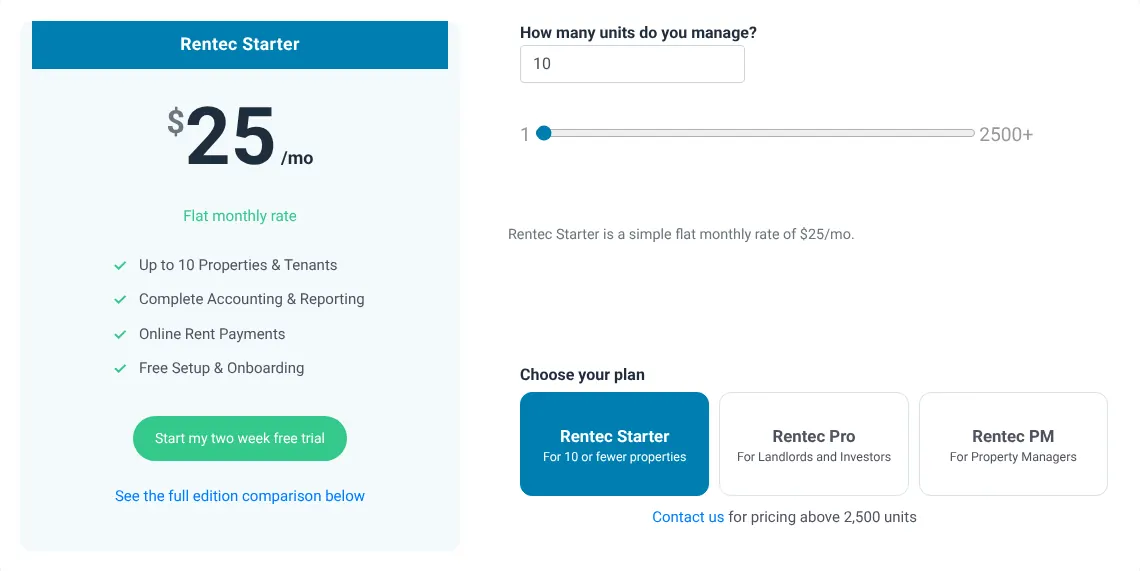
    Rentec Direct publishes the price of each of its three plans. Starter costs a flat $25 a month for up to 10 properties and 10 tenants. It includes three user accounts. Above that, Pro costs $2 a unit and PM $2.50 a unit, each with a $50 monthly minimum. Yearly billing saves 10% on Pro and PM. There is no setup fee and no contract, and the trial lasts two weeks.

    Bank payments from tenants are free on Pro and PM, for one payment per property each month. On Starter, each costs $2. Card fees are charged to the landlord, who may pass them on. Screening packages cost $10 to $18 on Pro and PM. On Starter, they cost $14.95 to $29.45.

    Starter lacks the bank feed, which starts on Pro. The owner portal is on PM only. Lease templates are editable but not state-specific; state forms come through partner sites. Rentec imports spreadsheets for 25 properties or more, after three months paid in advance. Online payments need a business checking account.

    Rentec Direct price calculator set to 10 units: Rentec Starter at a flat monthly rate, with buttons to switch to Rentec Pro and Rentec PM.
    The calculator shows Starter as a flat monthly rate for 10 or fewer properties; the buttons switch to the per-unit plans. Source: rentecdirect.com, captured on 16 Nov 2026.
  6. 6. Buildium

    Buildium fits a landlord with up to 40 units who wants a full suite and accepts paying for each payment, signature and filing.

    Score
    99/100
    Best for
    Landlords who want a known name and a trial first
    From
    $65/mo
    Free plan
    No · 14-day trial

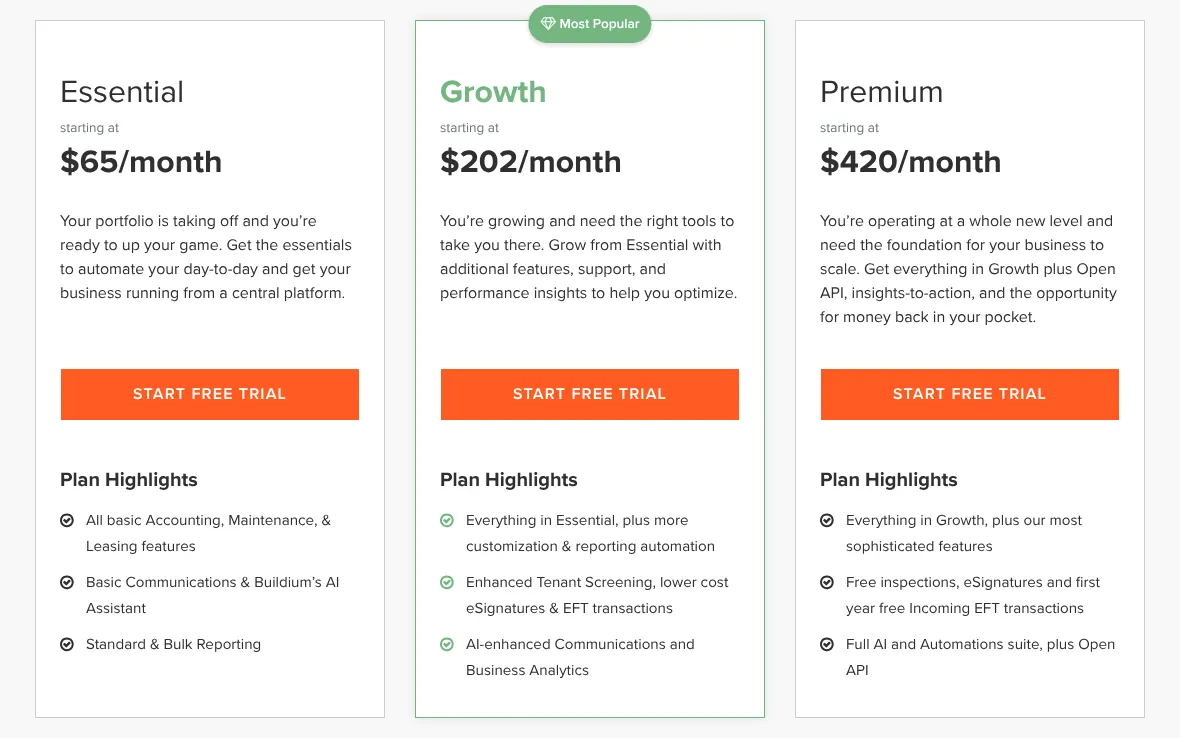
    Buildium, a RealPage company, sells three plans by portfolio size. Essential starts at $65 a month and stops at 40 units. Growth starts at $202 and Premium at $420. Yearly billing saves 10%. The trial lasts 14 days and asks for no card.

    Essential lists vacancies, screens applicants, collects rent and keeps the accounts. Owners get a portal and colleagues get roles on every plan. Several services cost extra. Each incoming bank payment costs the landlord $2.35 on Essential, and opening a bank account for payments costs $99. A business bank account is required. A signed document costs $5 on Essential and $1 on Growth.

    Screening costs $17 when the landlord pays, or $35 when the applicant pays. Filing 1099 tax forms costs $50 a batch plus $4.50 a form. Growth and Premium require a paid onboarding service, whose price is not published. During that service, the Buildium team imports the data.

    Buildium plans: Essential starting at $65/month and Growth at $202/month, Premium beside them, each with a Start free trial button and plan highlights.
    Essential starts at $65/month; Growth, at $202/month, is the plan for a portfolio above 40 units. Source: buildium.com, captured on 16 Nov 2026.
  7. 7. TurboTenant

    TurboTenant fits a landlord who wants to start at $0 and pay a yearly fee only once leases and the books matter.

    Score
    98/100
    Best for
    Starting free, then paying once a year
    From
    $12.42/mo, billed yearly
    Free plan
    Yes · unlimited properties

    TurboTenant starts free, with no time limit and unlimited properties. The free plan lists vacancies on partner sites, takes applications, screens tenants and collects rent. It also tracks repairs and messages. The renter pays about $2 per bank payment and, by default, $55 per screening.

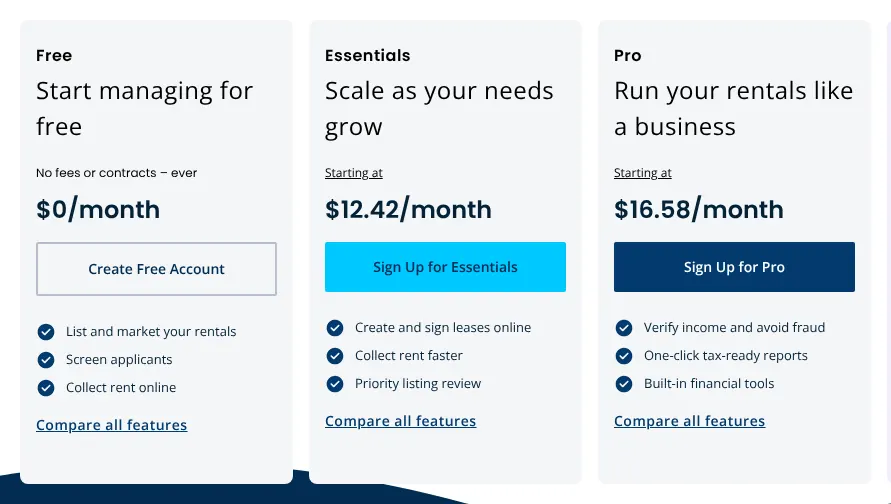
    The paid plans are billed once a year only: there is no monthly option. Essentials costs $149 a year for up to 10 units. The pricing page shows it as $12.42 a month. It adds state-specific leases, e-signatures and card payments. Pro costs $199 a year at that size and adds the accounting. That covers the bank feed, the profit and loss report, the Schedule E report and user roles.

    Schedule E is the US tax form where rental income and costs are declared. TurboTenant has no owner portal, as its help centre says. Properties and tenants are added one by one; only bank transactions can be uploaded from a file.

    TurboTenant plans: Free at $0/month, Essentials starting at $12.42/month and Pro starting at $16.58/month, each with a short list of what it adds.
    The $12.42 and $16.58 monthly figures are yearly prices divided by twelve; TurboTenant has no monthly billing. Source: turbotenant.com, captured on 16 Nov 2026.
  8. 8. RentRedi

    RentRedi fits a landlord whose unit count grows, since 50 units cost the same $29.95 a month as one.

    Score
    98/100
    Best for
    One price for any number of units
    From
    $29.95/mo
    Free plan
    No · 30-day money-back guarantee

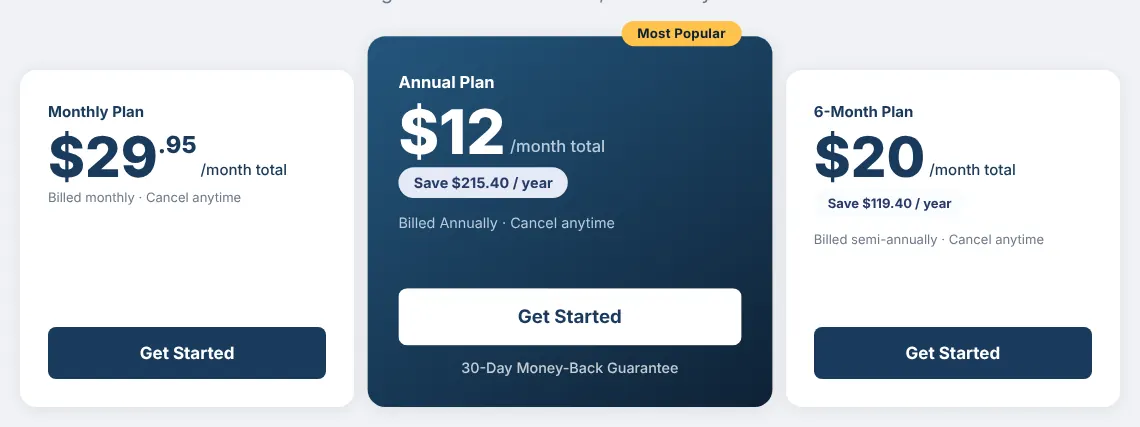
    RentRedi sells one plan with every feature, and the price does not change with the unit count. Monthly billing costs $29.95. Paying for six months brings it to $20 a month, and yearly billing to $12. Properties, tenants and teammates are unlimited. There is no free plan or trial, but a 30-day money-back guarantee applies.

    By default, the tenant pays $1 per bank payment and 3.1% + $0.30 by card; the landlord can cover them. Screening costs the tenant $39.99, or $49.99 with an income check. The accounts link to the bank, report profit and loss by property and produce a Schedule E report. Landlords and tenants each have a phone app.

    Two features stop short. State-specific leases come from an outside website, at $9.99 each. Owners get a view-only login, without statements. Setup can start from an uploaded lease, which the app reads to create the property, unit and tenant.

    RentRedi pricing: the Monthly Plan billed monthly, the Annual Plan billed annually and the 6-Month Plan billed semi-annually, with a 30-day money-back guarantee.
    The three cards are the same plan on three billing terms; the Monthly Plan is the price used on this page. Source: rentredi.com, captured on 16 Nov 2026.
  9. 9. Landlord Studio

    Landlord Studio fits a landlord with a few units who wants rent collection and tax-ready books in one app, starting free.

    Score
    96/100
    Best for
    Small landlords who want rent and the books in one app
    From
    $15/mo
    Free plan
    Yes · Go, up to 3 units

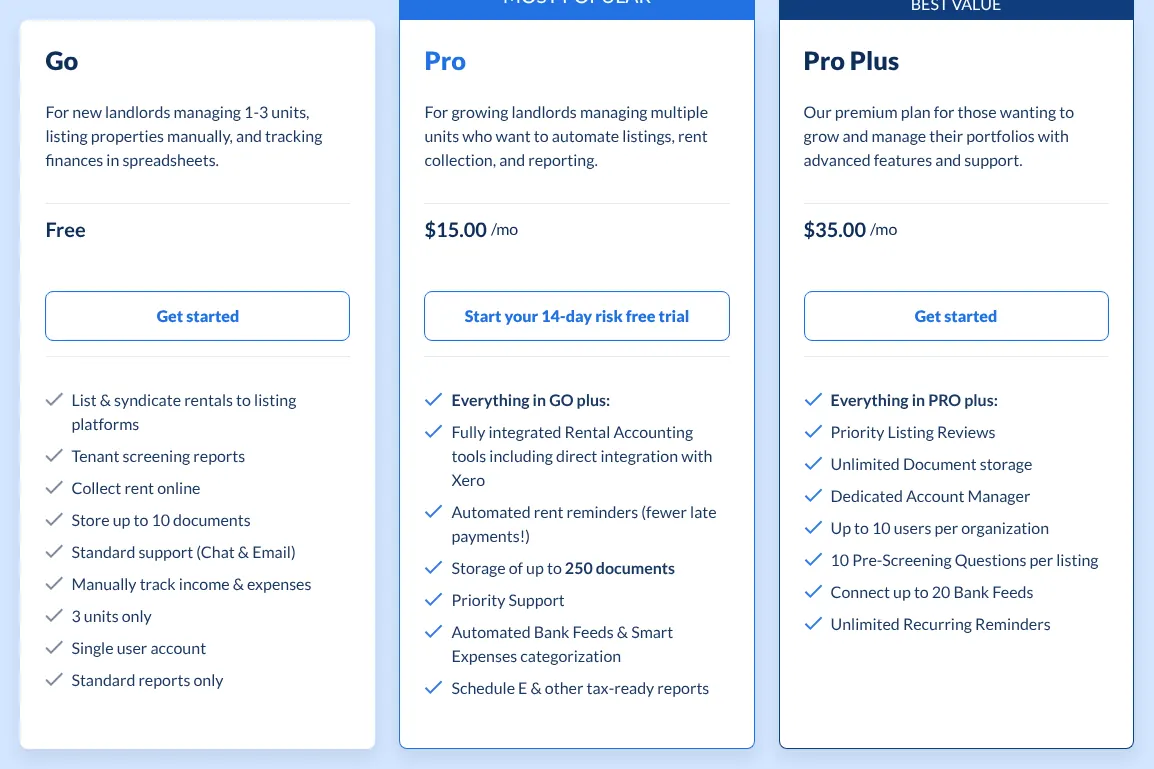
    Landlord Studio is built for independent landlords. Its free plan, Go, covers up to 3 units and a single user. Pro costs $15 a month on monthly billing, or $12 billed yearly, with 3 units included. Each extra unit adds $1.20 a month, so 10 units cost $23.40. Pro offers a 14-day trial without a card, and no refunds.

    Every plan lists vacancies for free on Zillow, Trulia, HotPads and Zumper. Screening is a TransUnion report at $45 on Pro and $55 on Go, paid by the landlord or the applicant. Rent comes in by bank for $2.50 a payment, and the landlord chooses who pays it. Card payments cost the tenant 3.49%. A lease can require renters insurance: the tenant uploads proof or buys a policy from the partner Sure.

    The books depend on the plan. Go tracks income and expenses by hand, while Pro connects up to 5 bank accounts and adds the Schedule E report. Owners serve only to filter reports: there is no owner login. Leases come from one generic US template to download, not a form per state. The spreadsheet import brings in expenses one property at a time, without past income.

    Landlord Studio plans in the monthly view: Go free for 3 units only, Pro at $15.00 per month and Pro Plus at $35.00 per month, with the features each adds.
    Pro shows $15.00 a month in the monthly view, with bank feeds and the Schedule E report in its list. Source: landlordstudio.com, captured on 16 Nov 2026.
  10. 10. Innago

    Innago fits a landlord who wants rent collection and leases at no cost, and keeps the tax books in another tool.

    Score
    95/100
    Best for
    Landlords who want to pay nothing
    From
    Free
    Free plan
    Yes · whole product

    Innago is free for landlords, with no plans, no monthly fee and no contract. It earns its money on tenant payments. By default, a tenant pays $2 per bank payment and 2.99% by card, and the landlord can choose to absorb them. Screening costs the applicant $30, or $35 with an eviction search.

    The free product lists vacancies, signs leases online, collects rent with autopay and adds late fees on its own. Repair requests, messages and renters insurance through a partner are included. Income and expenses are tracked by property, with a profit and loss report and a rent roll. Storage is limited to 5GB under 30 units.

    The books are lighter than on the paid tools. Expenses are typed in by hand in Innago. A bank feed exists only through Ledgre, a separate accounting app with its own subscription. The only tax form is the 1099-K, which reports rent collected online. To start, a landlord can upload a rent roll or leases, and the software reads them to create the account.

    Innago pricing page badges reading No Setup Fee, No Monthly Fee and No Contract.
    The pricing page shows no plans, only three badges: no setup fee, no monthly fee and no contract. Source: innago.com, captured on 16 Nov 2026.

Summary table

The table puts the ten tools side by side. Each price is that of the first paid plan, billed monthly unless the vendor only bills yearly. The last column says who pays a tenant's bank payment by default on that plan.

The 10 landlord tools side by side: score, price of the first paid plan, billing, free plan and the bank payment fee
ToolScoreFirst paid planBilling of that priceFree planBank payment fee by default
01Yardi Breeze100$1/unit/mo, $100 minimumMonthly, yearly agreementNo$0
02TenantCloud100$25/moMonthlyNo · 14-day trialTenant, $1.95
03AppFolio99$1.49/unit/mo, 50-unit minimumNot stated, on a quoteNo · demoNot published
04DoorLoop99$3.00/unit/mo, minimum not publishedMonthlyNo · demoTenant, $1.50
05Rentec Direct99$25/moMonthlyNo · two-week trial$2 on Starter, free on Pro
06Buildium99$65/moMonthlyNo · 14-day trialLandlord, $2.35
07TurboTenant98$149/yrYearly onlyYes · no time limitTenant, about $2
08RentRedi98$29.95/moMonthlyNo · 30-day money-backTenant, $1
09Landlord Studio96$15/moMonthlyYes · Go, up to 3 units$2.50, landlord chooses who pays
10Innago95FreeNo paid planYes · whole productTenant, $2

Prices in USD, read on vendor pages on 16 November 2026, before taxes. Rentec Direct: on Pro and PM, one bank payment per property each month is free, then $0.50 each. Who pays can usually be switched to the landlord.

What property management software costs for your portfolio

For one unit, the ten range from free on Innago to $100 a month on Yardi Breeze. At 50 units the order changes. RentRedi stays at $29.95, because its price ignores the unit count. Landlord Studio rises to $71.40, at $1.20 for each unit above three. Buildium rises to $202, because Essential stops at 40 units. Payment and screening fees are left out.

Monthly price at 1, 10 and 50 units on monthly billing, at the regular price, before payment fees
Tool1 unit10 units50 units
01Yardi Breeze$100 (minimum)$100 (minimum)$100 (minimum)
02TenantCloud$25 (Starter)$25 (Starter)$60 (Pro)
03AppFolio50-unit minimum50-unit minimumFrom $74.50, plus a minimum spend
04DoorLoop$3, before a minimum$30, before a minimum$150, before a minimum
05Rentec Direct$25 (Starter)$25 (Starter)$100 (Pro)
06Buildium$65 (Essential)$65 (Essential)$202 (Growth)
07TurboTenant$149 a year (Essentials)$149 a year (Essentials)$299 a year (Essentials)
08RentRedi$29.95$29.95$29.95
09Landlord Studio$15 (Pro)$23.40 (Pro)$71.40 (Pro)
10Innago$0$0$0

AppFolio: the minimum spend is not published, so any account costs at least the 50-unit price. DoorLoop: a minimum spend and unit count apply and are not published. TurboTenant bills its paid plans yearly only. Landlord Studio: Go is free up to 3 units. Buildium: the price at 10 units comes from the calculator on its pricing page, and Growth needs a paid onboarding whose price is not published.

How we rank

  1. The ten tools are ranked by a category score out of 100. The score measures how many of 22 features expected of landlord software each vendor documents on its own site. It does not measure ease of use, reliability or support.Finding tenants 20% · 3 featuresLeases 8% · 2 featuresCollecting rent 23% · 5 featuresTenants and upkeep 18% · 4 featuresMoney and reports 20% · 5 featuresTeam and growth 13% · 3 features
  2. The 22 features form a grid in six groups: finding tenants, leases, collecting rent, tenants and upkeep, money and reports, team and growth. Five define the category and weigh 3: listings on rental sites, tenant screening, online rent collection, maintenance requests and income and expense tracking. Eight weigh 2, including lease e-signature and automatic late fees. Nine weigh 1, including the owner portal and tax reports. A tool receives 1 for a feature documented as built in, on any plan. It receives 0.5 for a partial feature: a stated limit, a paid extra, or an outside product the vendor points to. A feature that is absent, or that could not be found on the vendor's site, counts 0. The score is the weighted sum divided by the total weight, 40, rounded to the nearest whole number.
  3. At equal scores, the lower price of the first paid plan ranks first. For a price per unit, the price of one unit counts, before any minimum; Free counts as $0. Yardi Breeze ($1 a unit) ranks ahead of TenantCloud ($25) at 100. At 99, the order is AppFolio, DoorLoop, Rentec Direct and Buildium. At 98, TurboTenant ($12.42 a month, billed yearly) ranks ahead of RentRedi ($29.95). Landlord Studio scores 96 alone. At 95, Innago (free) takes the tenth place ahead of Stessa ($15).
  4. Fifteen tools were scored. Stessa (95), Hemlane (93), Avail (81), Baselane (75) and RentPost (75) score below the ten. The help centres of Hemlane, Baselane and RentPost refused the browser used by this site, so features found only there could not count. All prices, limits and features were read on vendor pages on 16 November 2026.
  5. No entry on this page is sponsored. A sponsored entry is marked Sponsored and holds the position paid for; its score stays the computed one.

FAQ

Is there free property management software for landlords?

Yes, three of the ten have a free plan with no time limit. Innago is free in full and earns its money on tenant payment fees. TurboTenant's free plan covers listings, screening and rent collection for unlimited properties. Landlord Studio's Go plan is free for up to 3 units and a single user. Pick the free plan whose missing piece you can live with. Leases need a paid plan on TurboTenant. Go and Innago both track expenses by hand, without a bank feed.

Do tenants pay the online rent fee?

On most of these tools, yes, by default. A tenant pays $1 per bank payment on RentRedi, $1.95 on TenantCloud Starter and $2 on Innago. Card payments cost between 2.95% and 3.5% where the fee is published. Buildium charges the landlord $2.35 per bank payment on Essential. If you absorb the fees, add them to the subscription when you compare prices.

Which tool suits a landlord with one or two units?

A free plan or a flat price suits a small portfolio, since per-unit minimums weigh most there. Innago, TurboTenant and Landlord Studio's Go plan cost nothing to start. TenantCloud and Rentec Direct cost $25 a month. Yardi Breeze still costs its $100 minimum, and AppFolio bills at least 50 units. Start with a free tool and move once you need its missing piece.

Why are Stessa and Hemlane not in the ten?

Stessa scores 95, like Innago, and loses the tenth place on price: its first paid plan, Manage, costs $15 a month, and Innago is free. Its free Essentials plan includes the bank feed. No messaging between landlord and tenant was found on its site. Hemlane scores 93. Its free Starter plan lists vacancies and screens tenants, but no owner portal or landlord phone app was found.

Can I move my data from another tool?

It depends on the tool, and few import everything. TenantCloud imports properties, contacts and leases from a spreadsheet template. DoorLoop's migration team imports properties, units, leases and tenants, but not past payments. Rentec Direct imports spreadsheets for 25 properties or more. Innago reads an uploaded rent roll or leases. TurboTenant only imports bank transactions. Plan to type in the payment history, or keep the old tool's reports.